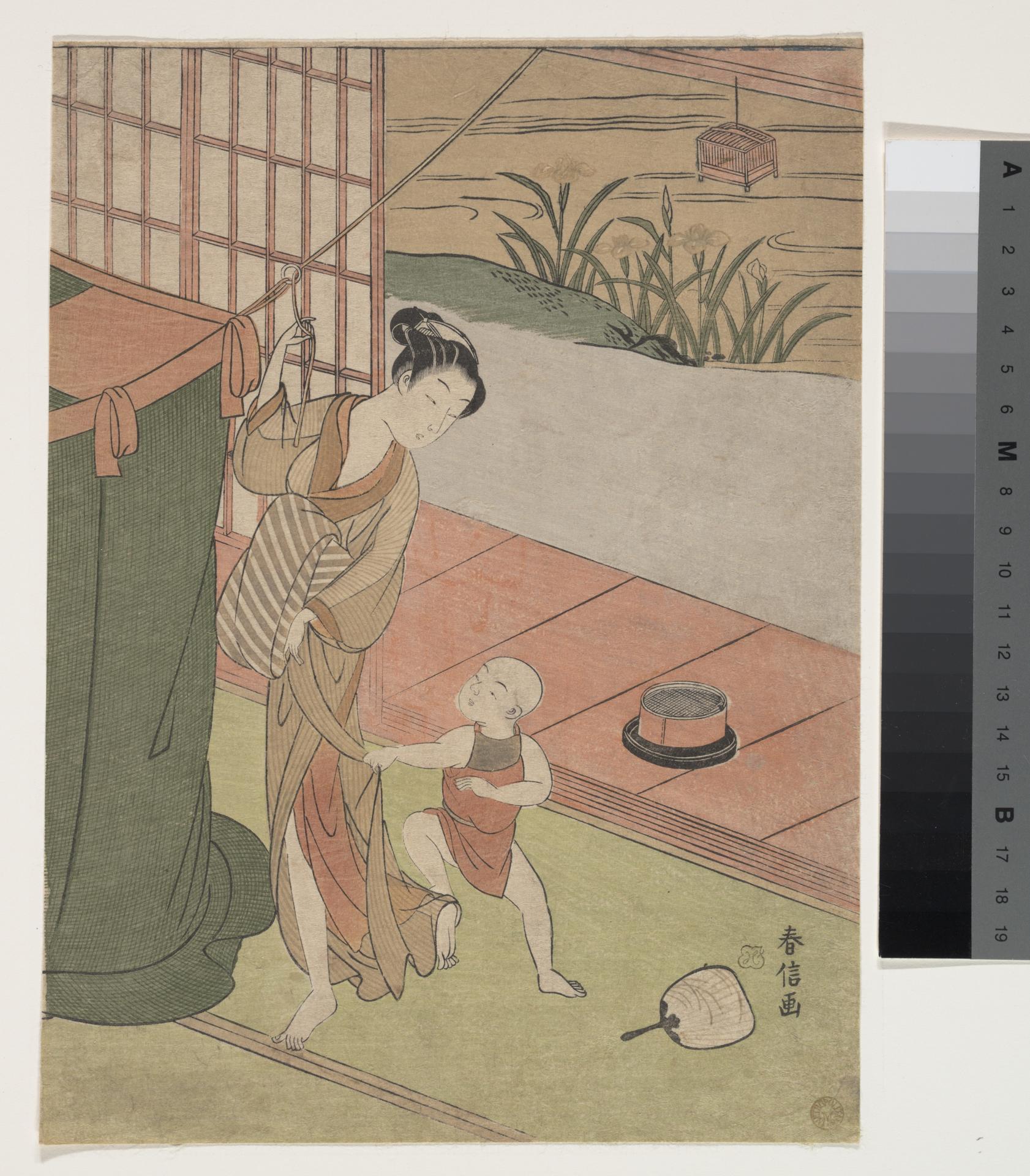
Mother and Son by a Mosquito Net
Original title: Mother and Son by a Mosquito Net
kurzbeschreibung
Suzuki Harunobu made this colour woodblock print, Mother and Son at a Mosquito Net, around 1769. A woman and a child in traditional Japanese dress appear in an interior with tatami mats and a sliding door. The sheet is a medium-sized print (chu-ban) in ink and colour on paper.
Description
Standing on the tatami, the woman holds up a mosquito net while the child kneels on the floor and reaches out for it. A shoji sliding door and plants fill the background. She wears a long-sleeved, striped robe; the child has a plain, single-coloured top and trousers. An object that recalls a parasol or fan lies before the child. Chinese characters at the lower right give what is probably the artist's name or the title.
Context
A leading woodblock artist of the eighteenth century and a pioneer of multicolour printing (nishiki-e), Suzuki Harunobu belongs to the Edo period, an age of cultural flourishing and urban life in Japan. He often took up intimate scenes of daily life, frequently with a touch of elegance and subtlety. Mother-and-child subjects were much loved in Japanese printmaking of the time.
Impact
Calm and harmonious, the layout rests on muted, traditional tones. The gentle interaction between mother and child gives the sheet an intimate, almost poetic atmosphere. Even light without visible shadows underlines the flatness and decorative character of the woodblock print.
Technique
Ink and colour on paper, printed from several woodblocks, produce a process typical of ukiyo-e. The colours were applied with multiple blocks, which allowed fine gradations and great precision. The format is that of a medium-sized print (chu-ban), widely used in the Edo period.
AI-generated description text
Source: Metropolitan Museum of Art · Public Domain (CC0 1.0)