A Girl as a Komuso
Original title: A Girl as a Komuso
kurzbeschreibung
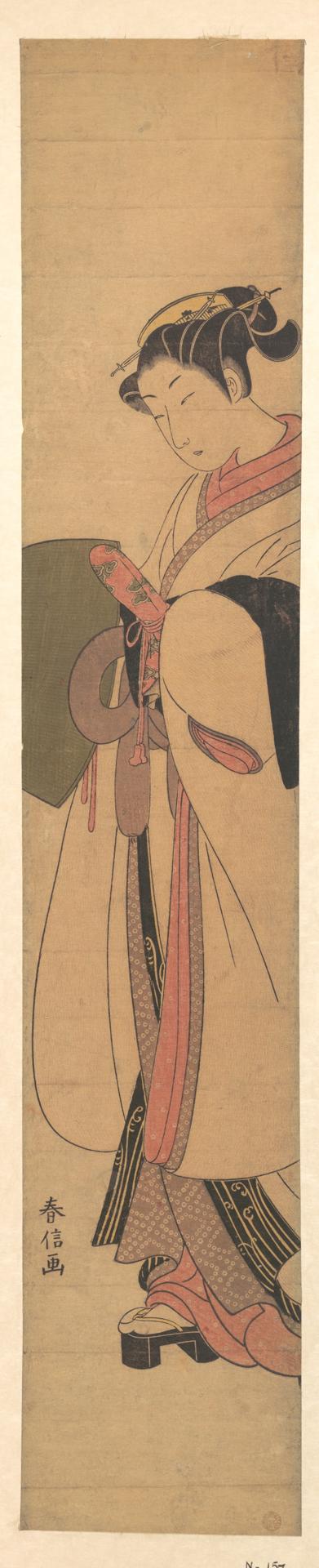
Suzuki Harunobu made this colour woodblock print, 'A Girl as a Komusō', around 1768. The tall, narrow format (64.8 × 12.1 cm) shows a young woman in a sumptuous kimono holding a komusō instrument. The sheet dates from the Edo period and exemplifies Harunobu's portrayal of idealised female beauty.
Description
The woman wears an elaborately patterned kimono in red, white, black and gold. Her hair is intricately braided and adorned with accessories; her gaze is lowered, a faint smile on her lips. In one hand she holds an instrument reminiscent of a komusō. The background remains plain and monochrome, making the figure stand out strongly. On the left two characters appear, probably the artist's or title signature.
Context
Harunobu is regarded as a pioneer of multicolour woodblock printing (nishiki-e) in Japan. This print was made during the Edo period, when the urban bourgeoisie enjoyed a flourishing of printmaking. Komusō were mendicant monks of the Fuke sect who played a bamboo flute; here, however, a woman is shown in that role, which is typical of Harunobu's idealised portrayals of women. The narrow vertical format recalls hashira-e, pillar prints used to decorate the pillars of room dividers.
Impact
The slender silhouette and calm posture of the woman give the image an elegant, graceful presence. The colourful but harmonised patterns of the kimono contrast with the plain background and draw the eye to the face and the instrument. Overall, the sheet conveys a quiet, slightly melancholic mood.
Technique
For this print Harunobu used woodblock printing in ink and colours on paper. In multicolour printing, a separate woodblock is cut for each colour. The delicate lines and precise colouring are characteristic of his technique. The narrow vertical format is typical of hashira-e.
AI-generated description text
Source: Metropolitan Museum of Art · Public Domain (CC0 1.0)