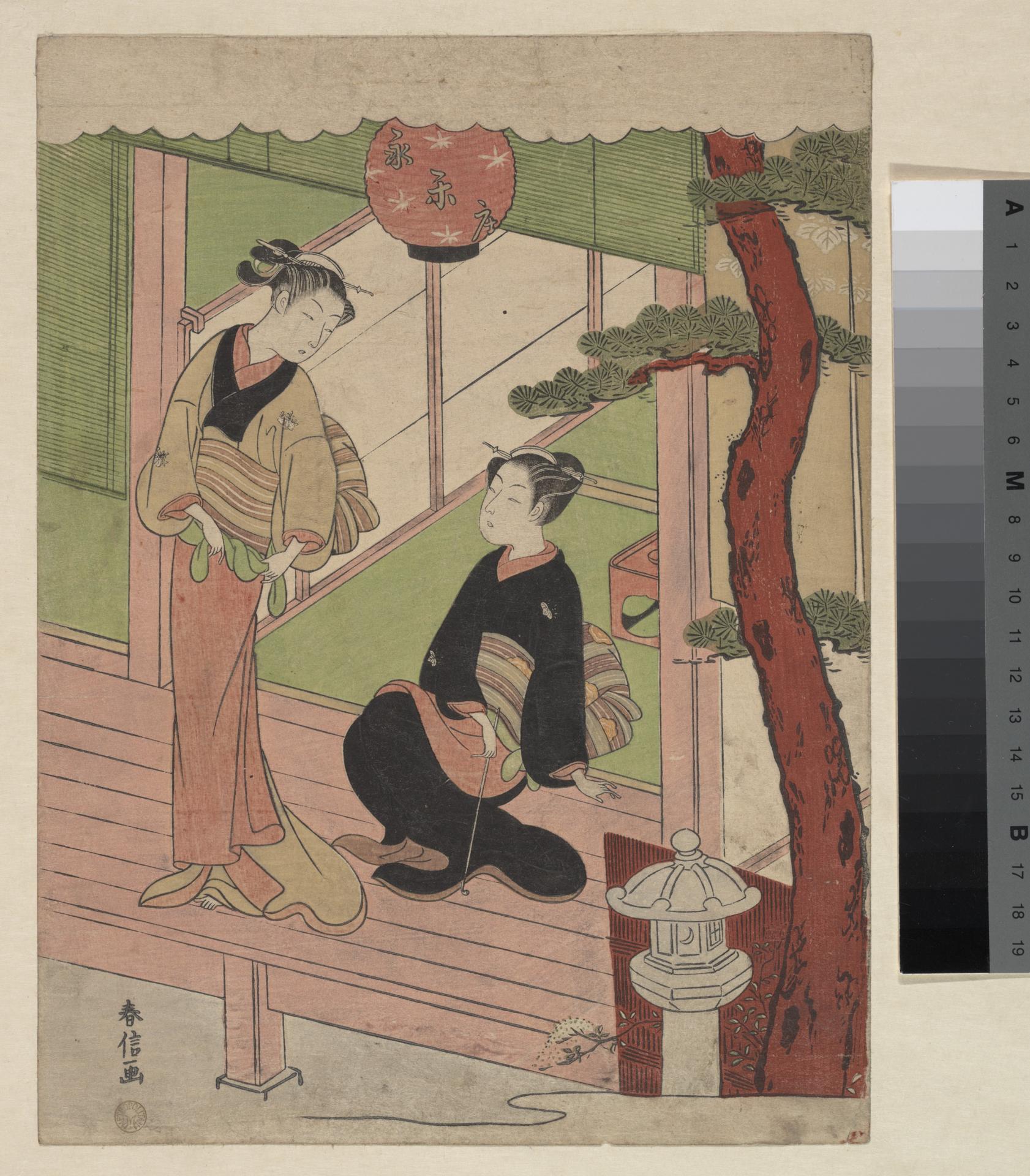
Two Young Women on a Verandah
Original title: Two Young Women on a Verandah
kurzbeschreibung
Suzuki Harunobu made this Japanese woodblock print, "Two Young Women on a Veranda," around 1766–70, working in ink and color on paper. Two women in traditional dress appear on a wooden veranda framed by bamboo and a lantern.
Description
The woman on the left stands and turns toward the one kneeling at the right. Both wear kimonos with different patterns and colors. Wooden beams and a green roof enclose the veranda, with bamboo and a tree visible beyond. A lantern bearing Chinese characters hangs from the ceiling, and a small white lantern stand sits at the right. Earth tones dominate, accented with reds and greens; the layout feels symmetrical, with the figures placed centrally.
Context
Harunobu ranks among the major ukiyo-e artists and is known for his multicolored woodblock prints (nishiki-e). This sheet belongs to the late Edo period, a culturally flourishing phase of Japan. Above all he produced pictures of elegant women (bijinga) that reflect the urban pleasure quarters and the everyday life of townspeople.
Impact
Quiet symmetry and muted earth colors give the sheet balance and harmony. A still elegance emanates from the figures, characteristic of Harunobu's idealized portrayals of women.
Technique
For the woodblock print the design was cut into wooden blocks and printed onto paper with water-based colors. Harunobu is regarded as a pioneer of multicolor printing, which requires several blocks. Crisp lines and finely graduated colors define his technique.
AI-generated description text
Source: Metropolitan Museum of Art · Public Domain (CC0 1.0)