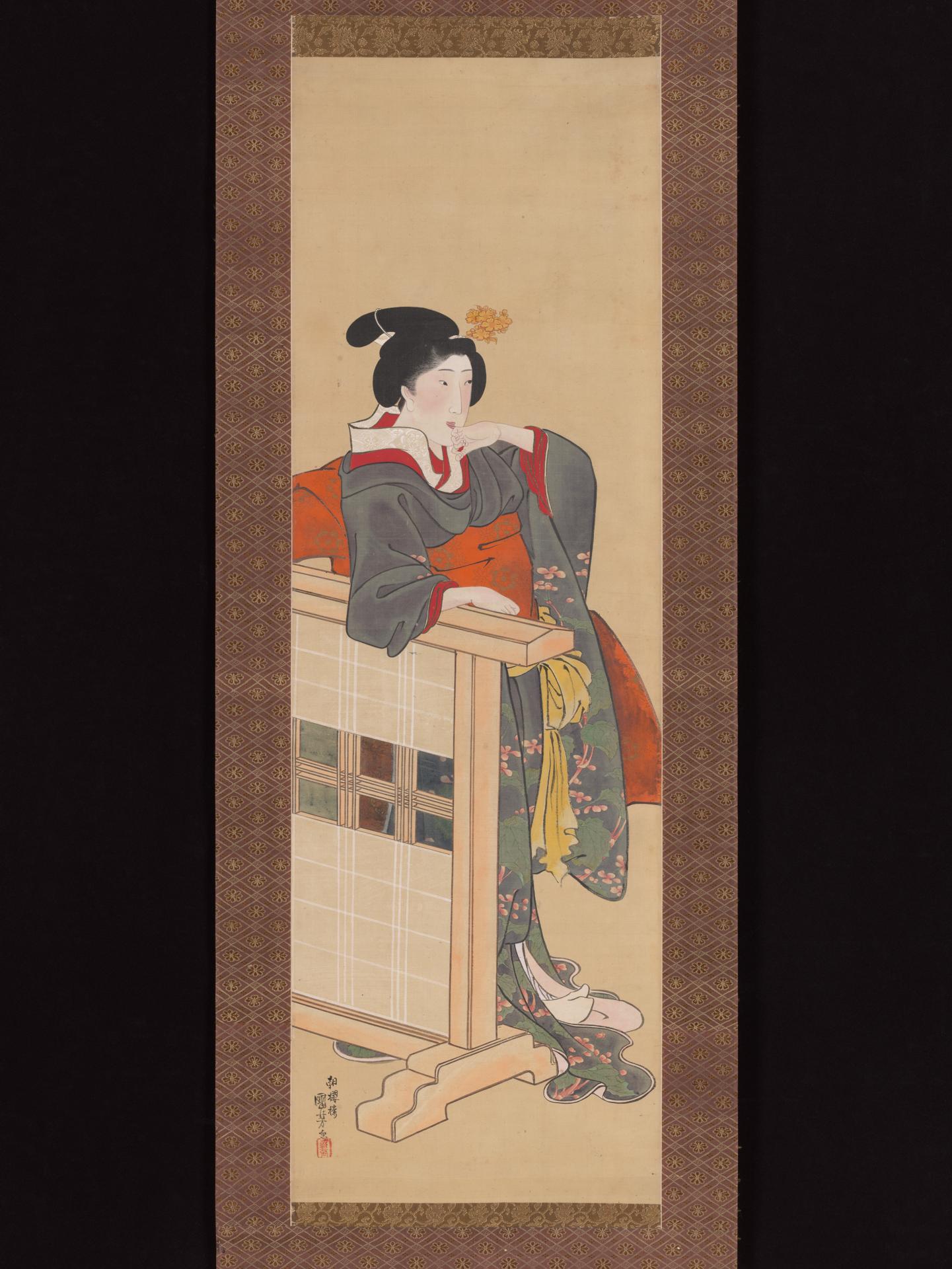
Lady-in-Waiting at Edo Castle
Original title: Lady-in-Waiting at Edo Castle
kurzbeschreibung
Utagawa Kuniyoshi’s hanging scroll “Hofdame im Edo-Schloss” dates from around 1854–60, in the Ansei era. Executed in ink and color on silk, it presents a woman in traditional dress leaning against a wooden table.
Description
At first the eye is drawn to the central female figure, placed before a latticed window. Her colorful robe with floral and leaf patterns, along with her hair ornaments, command attention. In a contemplative pose, one hand resting at her chin, she appears withdrawn. Muted colors and even lighting suggest an interior scene. The layout is vertical and symmetrical.
Context
Kuniyoshi ranks among the outstanding ukiyo-e artists of the Edo period. Created during the politically turbulent Ansei era, the motif of the court lady points to the shogun’s female court at Edo Castle and thus to courtly life.
Impact
The woman’s calm, thoughtful pose and the subdued color range create an intimate, quiet mood. Through the symmetrical arrangement and clear lines, the picture gains a balanced, formal elegance.
Technique
As a hanging scroll (kakemono), the work is executed in ink and color on silk. The painting follows traditional Japanese art with clear contours and emphasizes detailed patterns, such as those visible in the robe.
AI-generated description text
Source: Metropolitan Museum of Art · Public Domain (CC0 1.0)