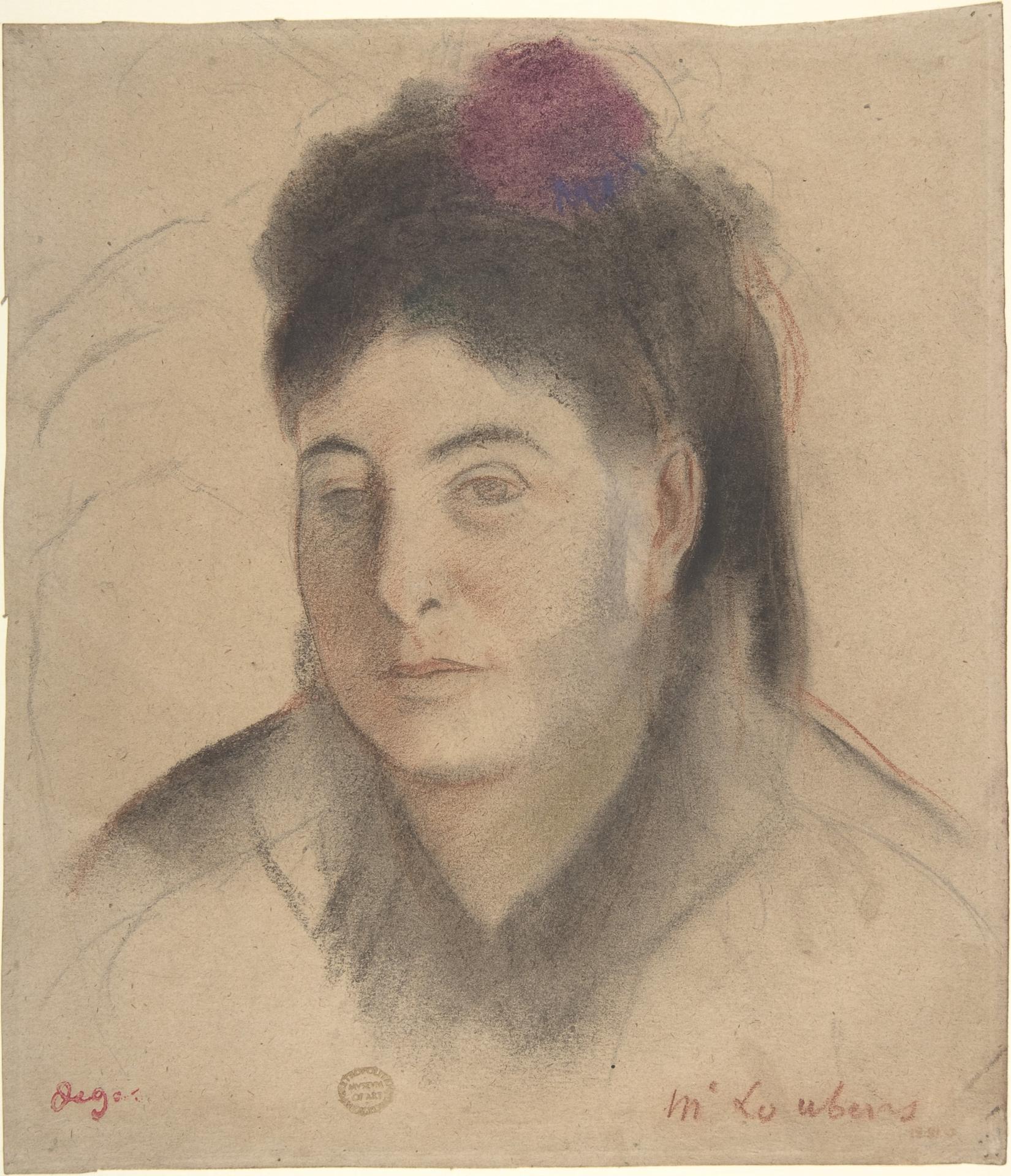
Madame Loubens
Original title: Madame Loubens
kurzbeschreibung
Around 1869, Edgar Degas portrayed a woman named Madame Loubens in a calm, contemplative pose. For this sheet, he combined charcoal and pastel with red, black, and white chalk on beige wove paper.
Description
The sitter's dark hair is pinned back, with a violet flower bud adorning it while loose strands fall over her shoulders. A dark bodice with a high collar encircles her neck. Her gaze is slightly lowered, her expression serious and inward-looking. Grey dominates the palette, punctuated by red and black accents. The arrangement remains simple, focusing on the woman's head and upper body.
Context
Toward the end of the 1860s, Degas devoted himself increasingly to portraiture and experimented with various drawing techniques. Who Madame Loubens was cannot be stated with certainty—possibly an acquaintance or relative of the artist. This sheet dates from a period when Degas was deeply engaged with interiors and figures, often under artificial light.
Impact
The subdued color and lowered gaze create an intimate, almost melancholic atmosphere. Because the drawing is so carefully executed, the facial features and the gentle modeling of forms stand out.
Technique
Charcoal and pastel join red, black, and white chalk, layered over a graphite underdrawing on beige wove paper. This mixed technique allows fine transitions between light and shadow and lends the portrait a soft, painterly quality.
AI-generated description text
Source: Metropolitan Museum of Art · Public Domain (CC0 1.0)