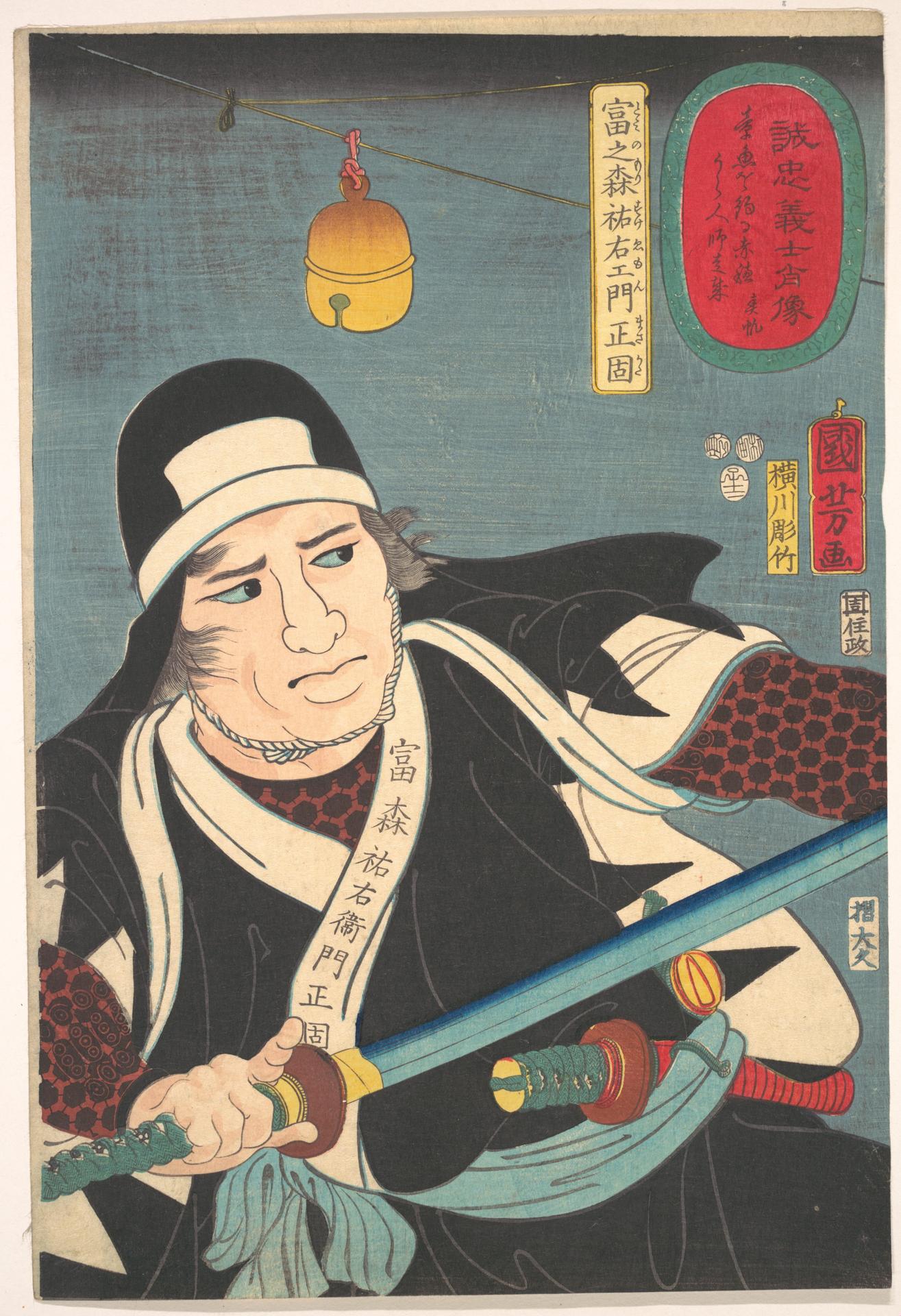
Portrait of Tominomori Sukeyemon Masakata
Original title: Portrait of Tominomori Sukeyemon Masakata
kurzbeschreibung
Utagawa Kuniyoshi's 1852 color woodblock print portrays the samurai Tominomori Sukeyemon Masakata in traditional dress. Unlike many warrior prints from the same series, this sheet offers no combat action but a calm single figure. Ink and color on paper, ukiyo-e.
Description
A black robe patterned in red and white and a white cap identify the sitter. His right hand grips a sword blade. Behind him appears a yellow temple bell. Above his head sits a cartouche with yellow characters on black, and at upper right another with red characters on green. Clean lines and vivid colors shape the design.
Context
Made in 1852, late in the Edo period, the portrait belongs to a phase in which Kuniyoshi produced numerous images of samurai and heroes. It depicts Tominomori Sukeyemon Masakata, a sixteenth-century samurai. Kuniyoshi's dynamic warrior pictures were hugely popular.
Impact
Strong colors and precise lines make the print immediately accessible. The sitter's quiet stance and the meaningful attributes—sword blade and temple bell—join strength with cultural depth. The result is an image of still tension.
Technique
The print was made with ink and color on paper by woodblock. Several passes brought the colors onto the sheet one after another. Crisp contours and flat color are characteristic of the Japanese color woodblock print; the technique allowed the motif to be reproduced.
AI-generated description text
Source: Metropolitan Museum of Art · Public Domain (CC0 1.0)