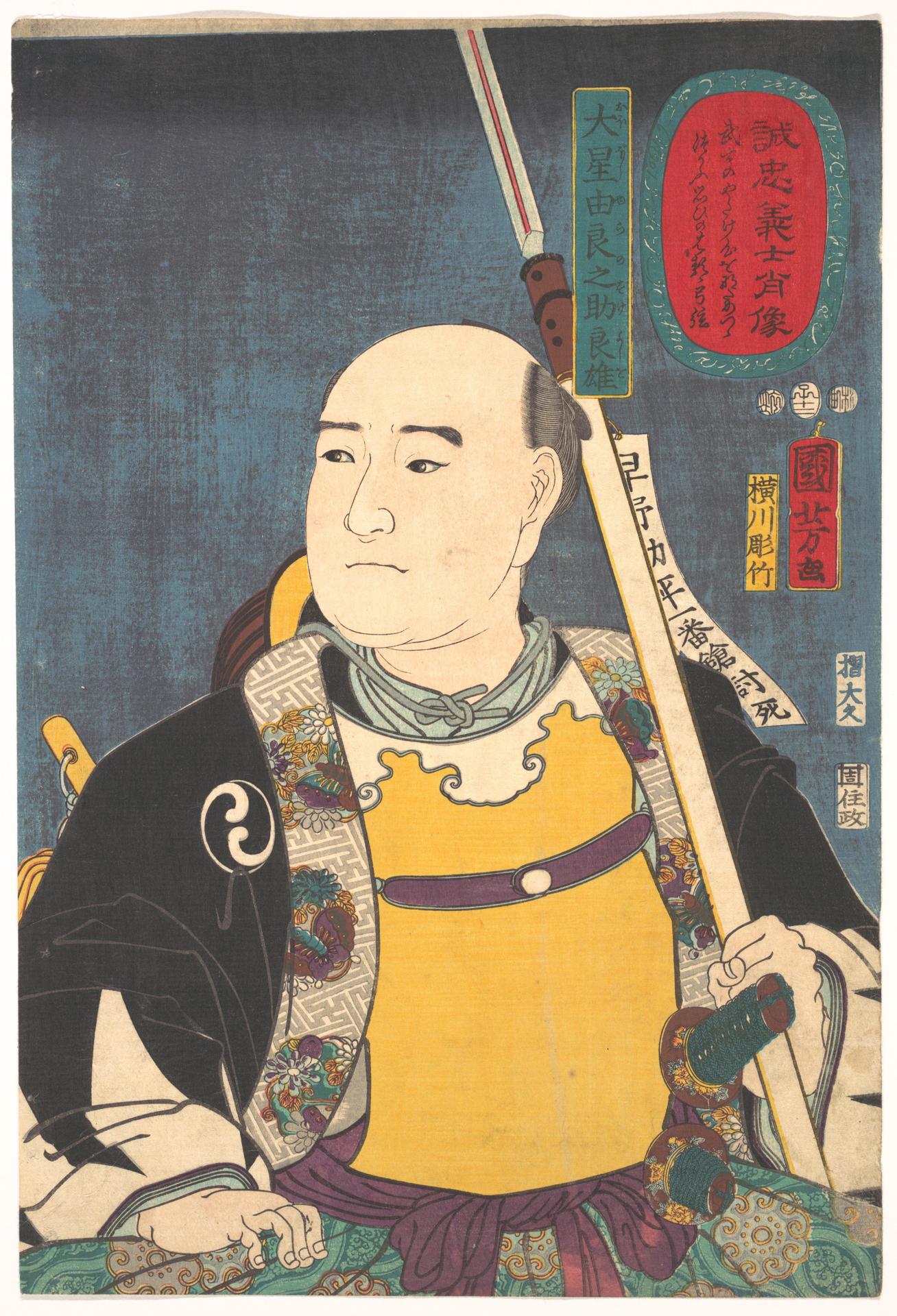
Portrait of Oboshi Yuranosuke Yoshio (The Leader)
Original title: Portrait of Oboshi Yuranosuke Yoshio (The Leader)
kurzbeschreibung
Utagawa Kuniyoshi's 1852 colour woodblock print portrays the samurai Oboshi Yuranosuke Yoshio in traditional attire. Printed on paper with ink and colours, this sheet belongs to the samurai depictions of the Edo period.
Description
Your gaze is drawn immediately to the samurai's upper body, centred in the frame, clad in a yellow kimono with a black-patterned over-robe. A sword rests horizontally on his shoulder. The near-black background, tinged with blue, contrasts sharply with the bright yellows and reds of the clothing. On the right, characters and symbols identify the sitter. His face is evenly lit, contours are crisp, and colour areas are clearly separated.
Context
Created in 1852, late in the Edo period, this portrait appeared when woodblock prints of historical heroes and actors were widely circulated. Oboshi Yuranosuke Yoshio is a historical figure known as the leader of the 47 rōnin, who in 1703 avenged the death of their lord. Kuniyoshi dedicated several series to this legendary samurai, which were extremely popular in 19th-century Japan.
Impact
The dark background and vivid colours give the portrait a dramatic, almost heroic presence. The samurai's direct gaze and upright posture convey determination and dignity—qualities that shape the idealised image of a noble warrior.
Technique
As an ukiyo-e woodblock print, the sheet was printed with ink and colours on paper. This technique allowed for clear lines and flat, bright colours, as seen here in the clothing and background. Measuring about 37.1 × 25.1 cm, the format corresponds to ōban, customary for single portraits.
AI-generated description text
Source: Metropolitan Museum of Art · Public Domain (CC0 1.0)