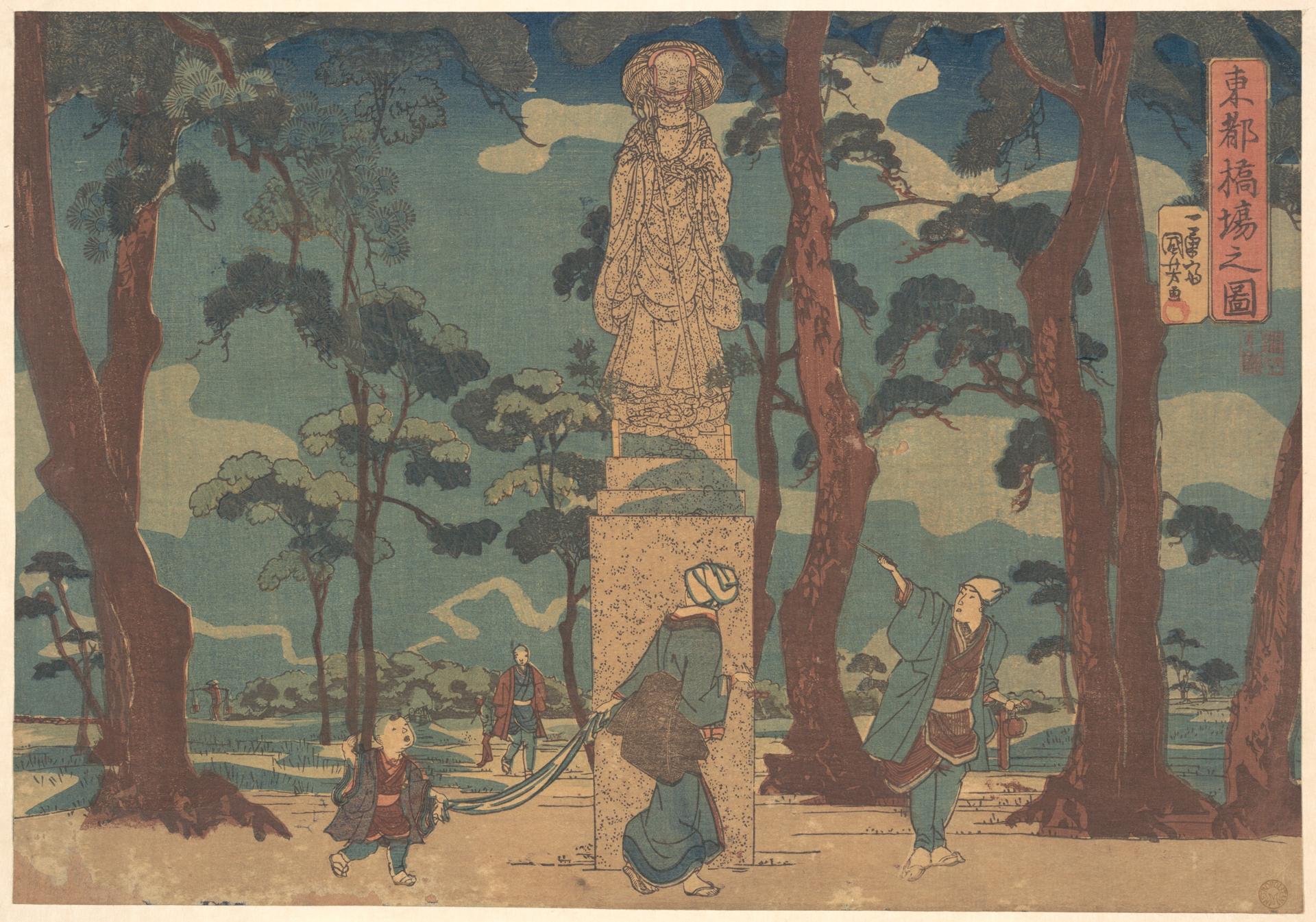
Wayfarers Looking at the Statue of Jizo Bosatsu in a Pine Grove at Hashiba
Original title: Wayfarers Looking at the Statue of Jizo Bosatsu in a Pine Grove at Hashiba
kurzbeschreibung
Where many Edo-period travel prints put landscapes or temple views first, this colour woodblock print by Utagawa Kuniyoshi, made around 1840, joins devotion before a statue with the everyday life of the road. A group of travellers pauses in a pine wood at Hashiba before a Jizo Bosatsu. The sheet is executed in ink and colour on paper.
Description
Jizo Bosatsu stands on a pedestal, surrounded by several pines. Three figures in traditional dress come forward in the foreground: a woman holding a chain, a child running after her, and a man leading the chain. Further figures and trees echo in the rear of the image. Blues and browns dominate the palette, which looks strong thanks to the woodblock process. Light falling from above picks out the outlines of the people and the statue.
Context
Utagawa Kuniyoshi was one of the leading ukiyo-e artists of the nineteenth century, known for hero tales, landscapes and religious subjects. In the late Edo period, travel and pilgrimage held great importance in Japan. The appearance here of Jizo Bosatsu, regarded as a protector of travellers and children, points to the popular piety of those years. The sheet belongs to a series of views of famous places and was probably intended for a wide audience.
Impact
Calm and contemplation set the mood of the print, helped by earthy colours and clear lines. The way the figures turn toward the statue feels unforced and gives the image a narrative pull that invites lingering and looking closer.
Technique
The design was printed from woodblocks with colour on paper. Ink and dyes allowed fine contours as well as larger areas of flat colour. Because the ukiyo-e process could be repeated in large editions, such images could reach a wide public.
AI-generated description text
Source: Metropolitan Museum of Art · Public Domain (CC0 1.0)