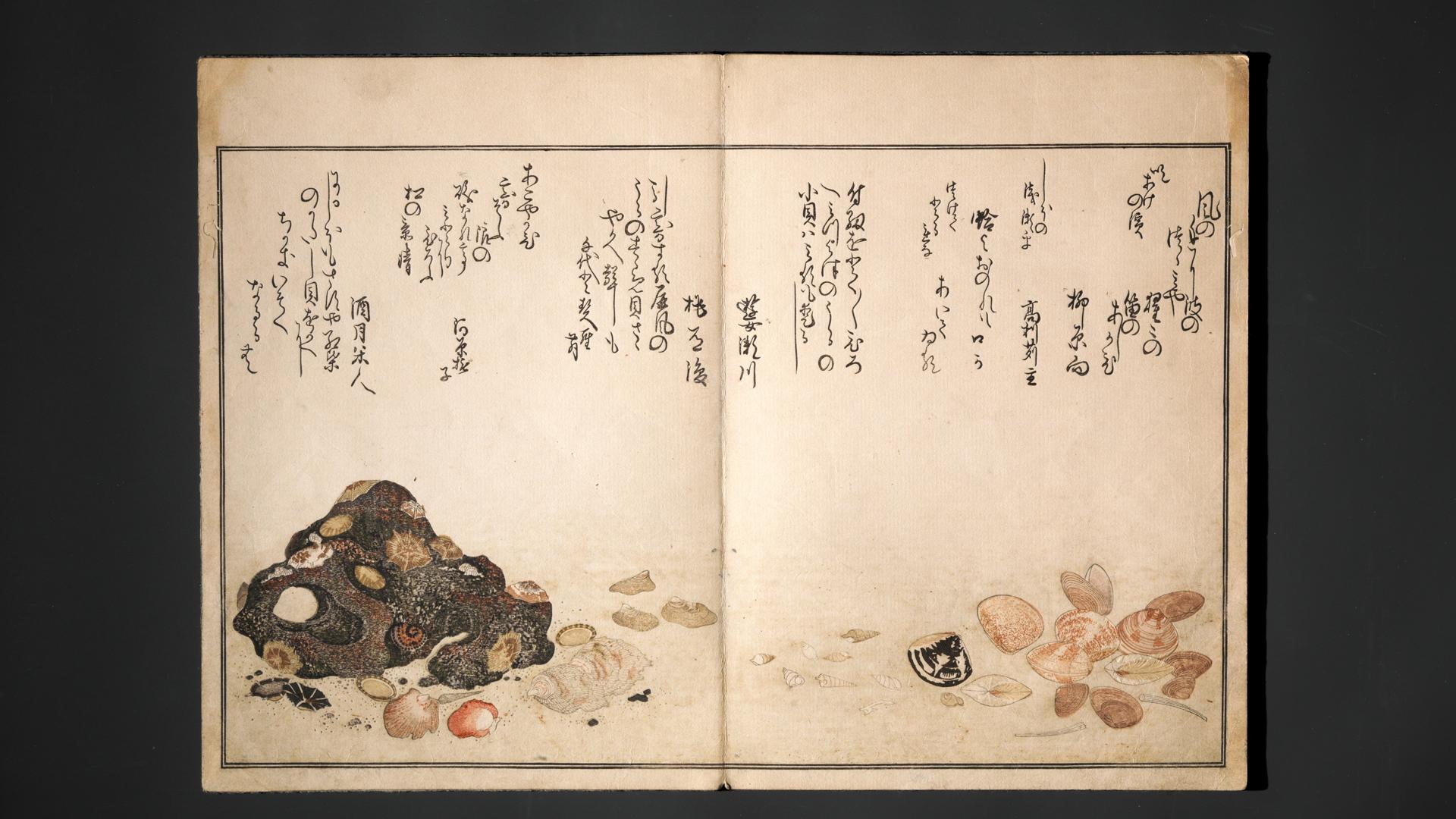
Gifts of the Ebb Tide (The Shell Book) (Shiohi no tsuto)
Original title: Gifts of the Ebb Tide (The Shell Book) (Shiohi no tsuto) 潮干のつと(都登)
kurzbeschreibung
Kitagawa Utamaro is best known for his portraits of women, yet around 1789 he also produced "Gifts of the Ebb Tide (The Shell Book)," a study of marine life that belongs among his investigations of the natural world. It takes the form of a woodblock-printed book in the orihon, or accordion-fold, style, in which pictures of shells and sea motifs alternate with Japanese characters.
Description
Opened, the book divides into two halves. On the left a rocky outcrop is pierced by several caves and openings, with smaller stones and shells scattered singly around it. On the right, shells and leaves in varied shapes and tones spread across the page. Both sides carry Japanese characters that serve as commentary on the images. Earth tones dominate — browns, grays, and whites — with golden accents added to the shells; a restrained border sets the illustrations apart from the surrounding paper.
Context
Utamaro was one of the defining ukiyo-e artists of the Edo period. He became famous for his portrayals of women, but he gave just as much attention to nature. Around 1789, botanical and zoological illustration was gaining popularity in Japan, and the shell book takes its place within a group of natural-history publications in which close observation and artistic interpretation are held in balance.
Impact
The precisely worked motifs give off a quiet, contemplative mood. Delicate lines meet muted colors, lending the shells and rock forms an almost scientific elegance.
Technique
The book was printed as a woodblock in ink, color, mica, and gold leaf on paper. The multicolor printing method (nishiki-e) allows for soft color transitions and the finest details, while the accordion-fold format (orihon) gathers the illustrations into a compact space.
AI-generated description text
Source: Metropolitan Museum of Art · Public Domain (CC0 1.0)