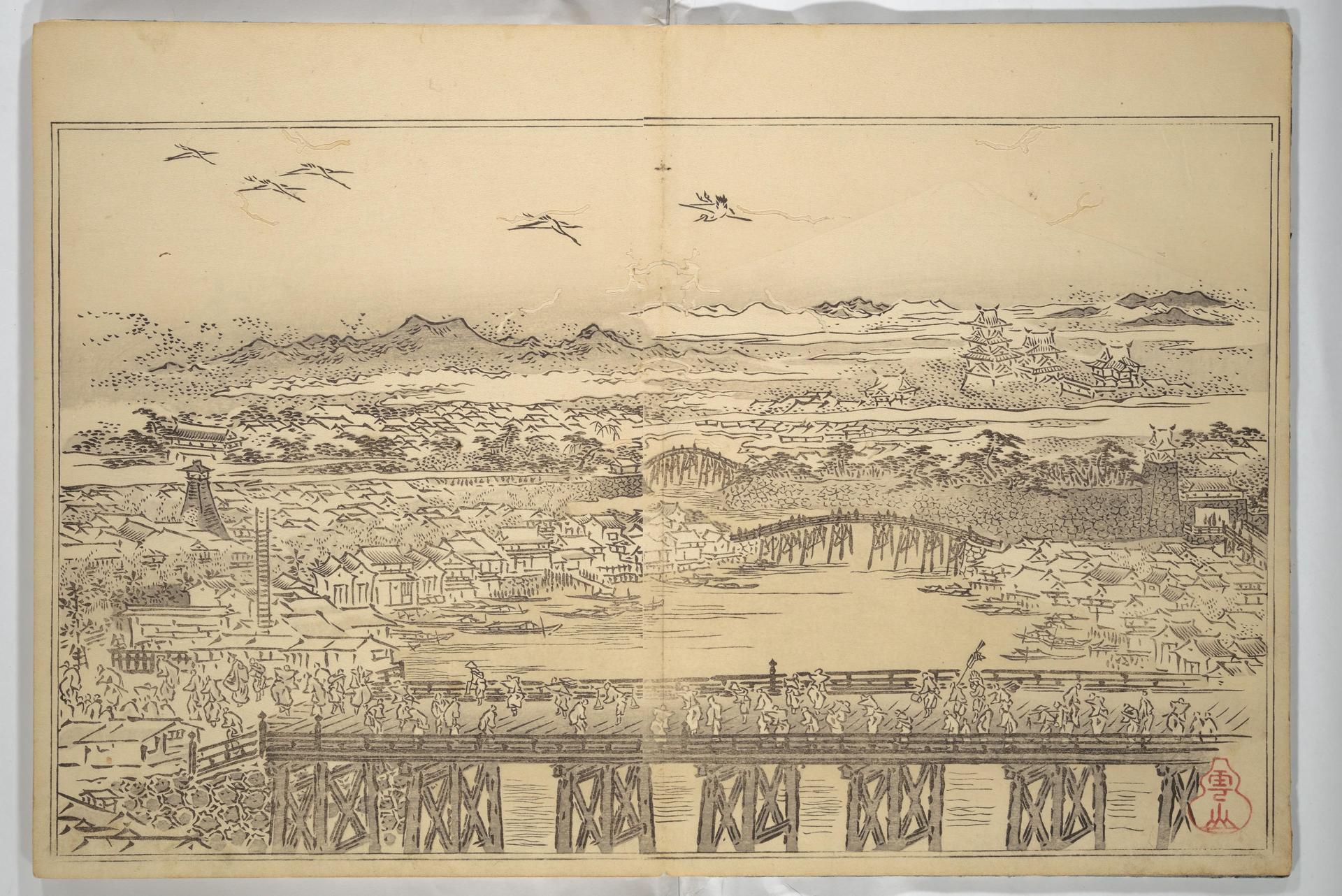
The Colors of Spring (Haru no iro)
Original title: The Colors of Spring (Haru no iro) 春の色
kurzbeschreibung
Kitagawa Utamaro's 'The Colors of Spring (Haru no iro)' is a woodblock-printed book whose preface is dated 1794. It contains views of a broad landscape with a river, bridges, and a city in the distance. The work belongs to the ukiyo-e print tradition and was printed with ink, color, and metallic pigments on paper.
Description
Your eye is first drawn across a river in the foreground, spanned by several bridges. On these bridges, small, finely detailed figures move in various directions. Behind them rise mountains and a city with numerous buildings and towers. The palette is mostly restricted to grays and browns; visible color embellishments or metallic pigments are absent. The horizontal perspective extends from the city to the mountains, and the lighting appears even, without shadows.
Context
The book, with its preface of 1794, was made during the Edo period, a heyday of Japanese woodblock printing, and was part of a series devoted to the seasons. Utamaro was known for his depictions of women and landscapes that reflected the urban culture of Edo. Metallic pigments were part of the repertoire of high-quality prints of the time, even if they are not visible in this analysis of the image.
Impact
The calm, expansive landscape radiates serenity and order. Clear structures and precise lines give the sheet an almost graphic quality that invites close looking. Your gaze can wander freely over river, bridges, and city without being directed by shadows or strong colors.
Technique
To print the image, the design was cut into woodblocks and transferred to paper with ink, color, and metallic pigments. This process allowed for fine lines and an even distribution of color, as is characteristic of ukiyo-e prints of the eighteenth century.
AI-generated description text
Source: Metropolitan Museum of Art · Public Domain (CC0 1.0)