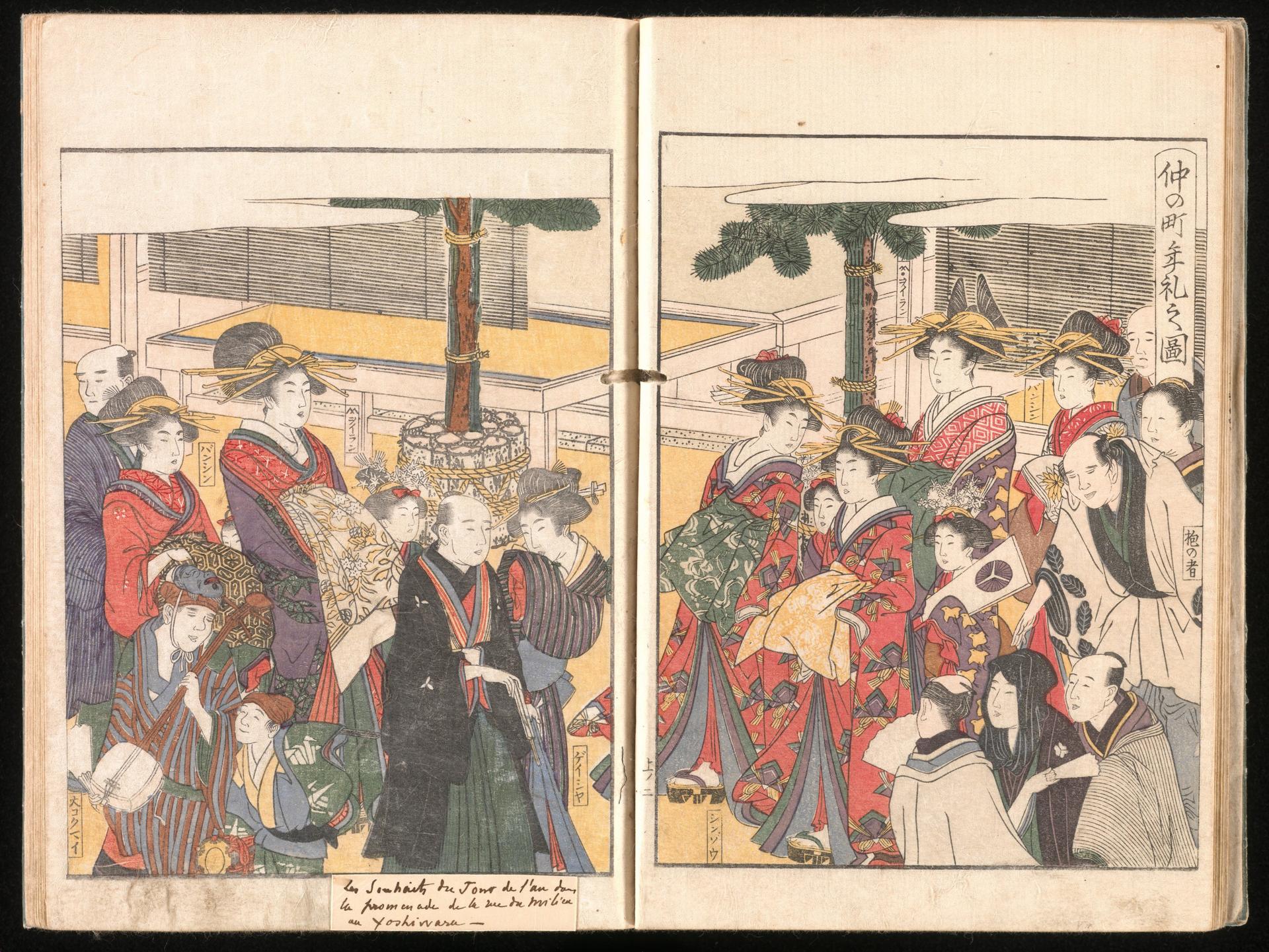
Yoshiwara Picture Book of New Year’s Festivities (Seirō ehon nenjū gyōji) (1804, Met-Objekt 4617)
Original title: Yoshiwara Picture Book of New Year’s Festivities (Seirō ehon nenjū gyōji) 青楼繪本年中行事
kurzbeschreibung
In 1804 Kitagawa Utamaro released the Yoshiwara Picture Book of New Year Festivities (Seirō ehon nenjū gyōji), a set of two woodblock-printed books in ink on paper. It presents a festive procession of people in traditional Japanese dress, set within a ceremonial environment of buildings and trees.
Description
Figures in sumptuous robes and headgear crowd together in a tight space, forming a procession. Several carry umbrellas and various accessories suited to the occasion. Participants look and move in different directions, bringing restlessness and motion to the image. Behind the crowd stand traditional buildings and trees that make the setting recognizable. Red, green, blue, and white stand out strongly, and the light falls evenly across the entire surface.
Context
When the book appeared in Japan in 1804, woodblock-printed books were a common medium. Utamaro was among the well-known ukiyo-e artists and gained fame with pictures of women and scenes from the Yoshiwara pleasure quarter. New Year festivities were important social events in the Edo period and often found their way into art and literature. The work was published as a two-volume series.
Impact
The dense multitude of figures and the strong colors give the image a festive, animated mood that draws the viewer's gaze into the action. Costumes and accessories are rendered with great care, hinting at something of the splendor and cultural richness of the Edo period. Even light and clear contours produce an overall impression that is calm yet lively.
Technique
The work was made in the Japanese color woodblock print technique, in which several woodblocks successively apply the individual color layers to the paper. Strong lines and closed areas of color define the result. Inscriptions and texts within the image follow traditional Japanese forms and testify to careful craftsmanship.
AI-generated description text
Source: Metropolitan Museum of Art · Public Domain (CC0 1.0)