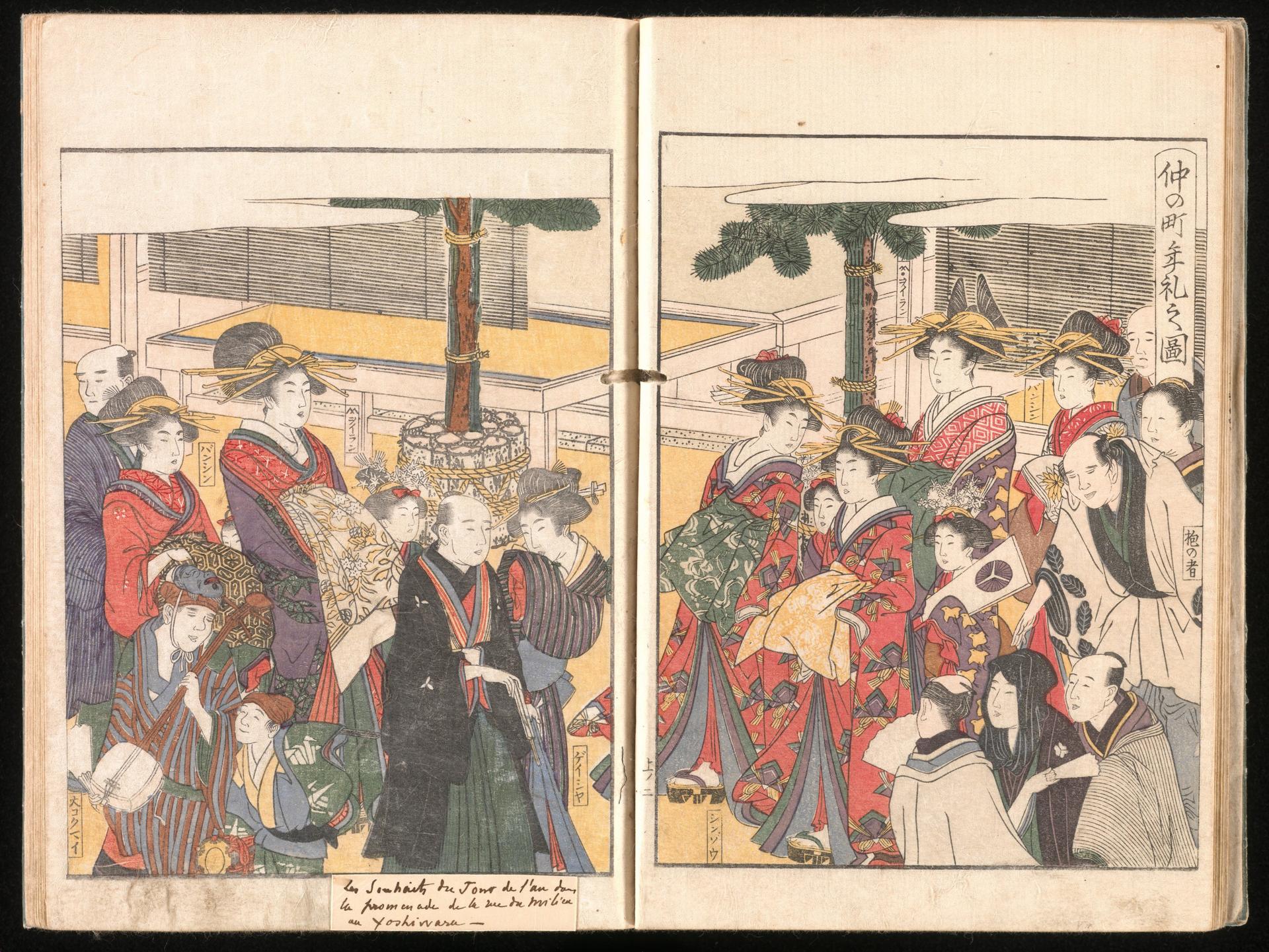
Yoshiwara Picture Book of New Year’s Festivities (Seirō ehon nenjū gyōji) (1804, Met-Objekt 4616)
Original title: Yoshiwara Picture Book of New Year’s Festivities (Seirō ehon nenjū gyōji) 青楼繪本年中行事
kurzbeschreibung
Kitagawa Utamaro's "Picture Book of Yoshiwara New Year Festivities" (Seirō ehon nenjū gyōji), made in 1804, comes in two woodblock-printed volumes in ink and color on paper. Its pages bring the bustle of the Yoshiwara pleasure quarter to life during the New Year celebrations and belong to the ukiyo-e tradition.
Description
Two book pages spread out, filled with figures in traditional Japanese dress forming a procession or formal gathering. Their robes glow in red, blue, green and gold, and some wear headdresses trimmed with ribbons and flowers. Behind them stand traditional buildings with wooden siding and shingled roofs. A tall wreath-like structure dominates the view, while the figures line up in a row and look toward the viewer. Japanese characters on the pages give the title and the artist's name.
Context
When Utamaro made this work in 1804, the Yoshiwara district of Edo, today's Tokyo, was thriving as a center of entertainment culture. New Year festivities counted as a major social event and were often taken up in ukiyo-e art. The book belongs to Utamaro's late output; that same year he fell foul of the authorities and died shortly afterward.
Impact
Vivid color and closely observed costumes create a festive, almost theatrical mood. The symmetrical arrangement of the figures and the dominant wreath structure lend the image something calm and ceremonial, drawing the viewer into the world of the historical Yoshiwara.
Technique
Several woodblocks were used for printing, one for each color, to achieve the strong tones. The ukiyo-e process allowed fine lines and precise patterns in the clothing; the colors were applied as watercolors on paper. The even lighting reflects this printing method.
AI-generated description text
Source: Metropolitan Museum of Art · Public Domain (CC0 1.0)