Picture Book on Flowers of the Four Seasons (Ehon shiki no hana)
Original title: Picture Book on Flowers of the Four Seasons (Ehon shiki no hana) 絵本四季花
kurzbeschreibung
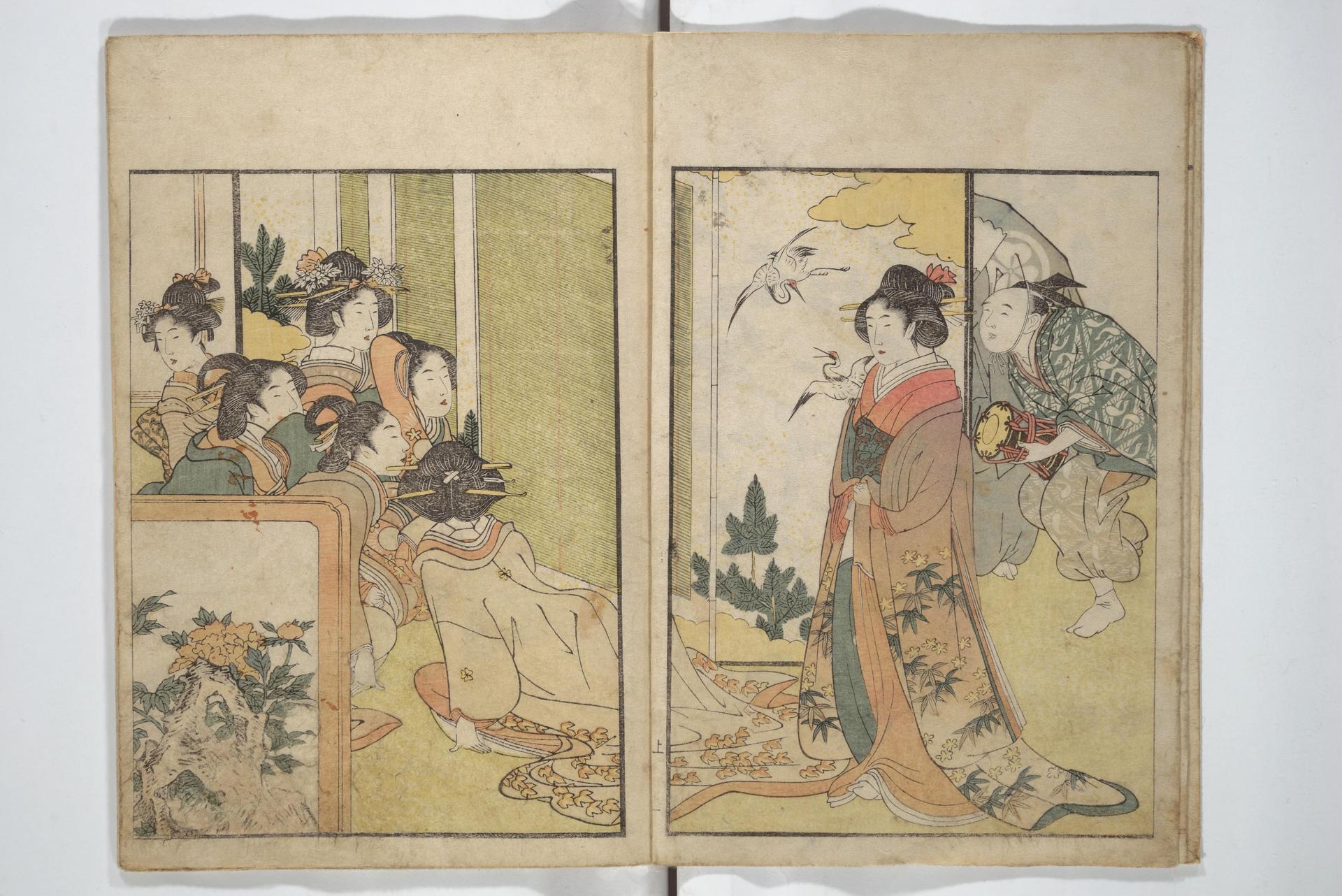
Two woodblock-printed books from 1801 by Kitagawa Utamaro, printed in ink and colour on paper, make up this set. Women and a single man appear in traditional Japanese dress, surrounded by flowers, plants and birds that follow the turning of the four seasons. Both volumes belong among the characteristic products of Edo-period printmaking.
Description
On the left-hand page several women in traditional robes have gathered in a room hung with green curtains; they sit or stand and talk among themselves. The right-hand page is given over to a woman in a red kimono patterned with flowers, holding a feather in her hand, while a man with an instrument stands beside her. Plants and a bird fill the background, and a bunch of flowers lies in the lower left corner. Earth tones dominate the palette, set off by red and blue; even light brings out the details.
Context
When Utamaro brought out the book in 1801, woodblock-printed books (ehon) were widespread in Japan and often showed flowers, birds and beautiful women (bijin-ga). The artist was above all famous for his portrayals of women, especially those of the Yoshiwara pleasure quarter. The work reflects the cultural flowering of the Edo period, when nature motifs and elegant figures were prized in equal measure.
Impact
The layout meets the viewer calmly and harmoniously, with the figures set within everyday scenes. Clear lines and a restrained, finely graded palette create an aesthetic tension that draws the eye into the world of Edo-period visual language.
Technique
The book was printed by woodblock, a process that lays ink and colour onto paper. This method allows precise contours and finely nuanced tones of the kind characteristic of Japanese printmaking of the period.
AI-generated description text
Source: Metropolitan Museum of Art · Public Domain (CC0 1.0)