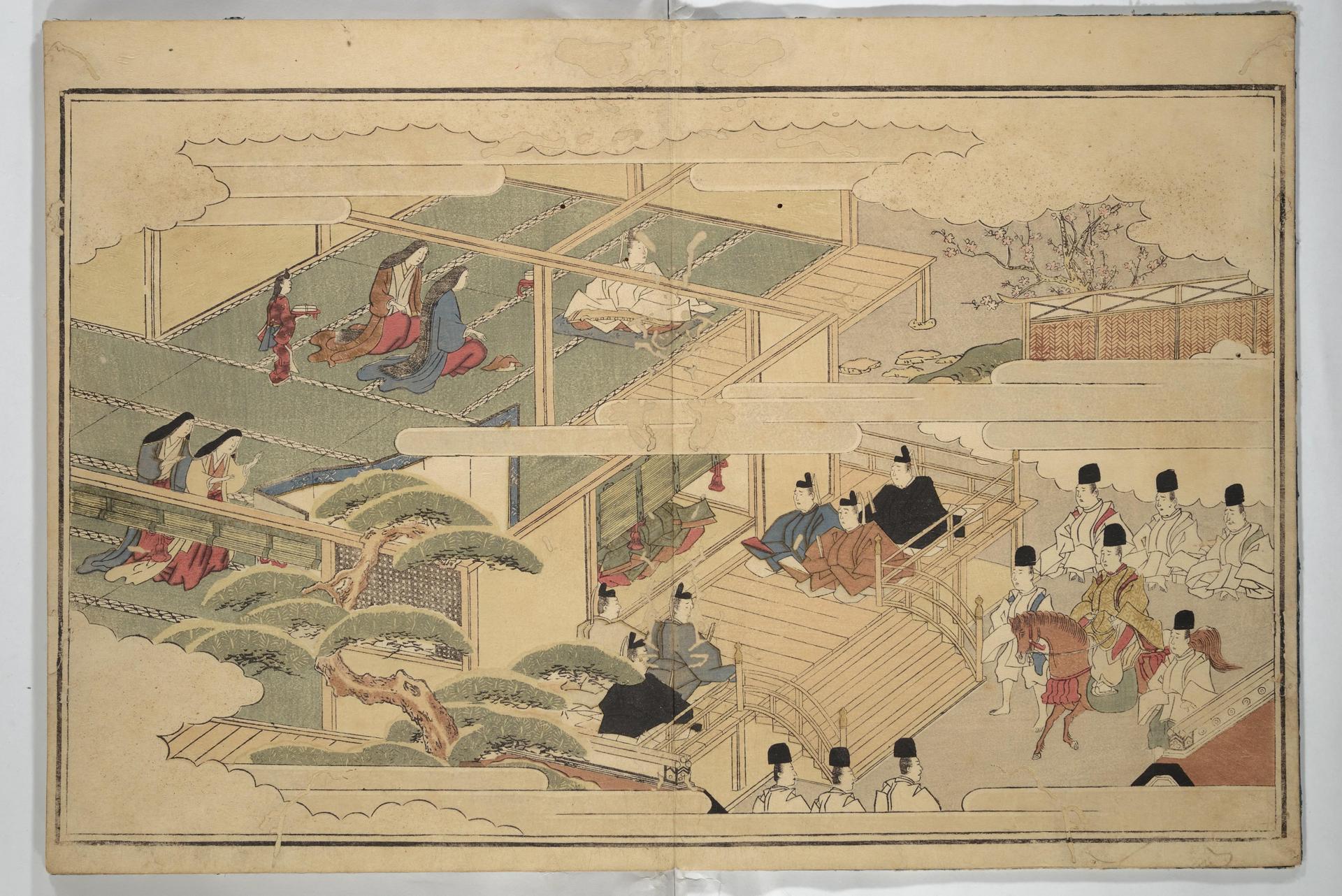
The Young God Ebisu (Waka ebisu)
Original title: The Young God Ebisu (Waka ebisu) 和歌夷
kurzbeschreibung
This 1789 colour woodblock print by Kitagawa Utamaro presents the young fortune god Ebisu within a tranquil landscape. The sheet belongs to an illustrated book and was printed with ink, colour and brass dust on paper.
Description
Several figures in traditional Japanese dress have gathered on a platform or balcony, with red, blue, brown and green setting the tone. Some sit together in conversation while others stand or move about. Trees and clouds fill the background and add to the calm, idyllic mood.
Context
The print dates from the late Edo period, an era of lively cultural flowering in Japan. It formed part of an illustrated book likely aimed at a prosperous urban readership. The figure of the fortune god Ebisu reflects how much city dwellers of the time valued deities of good fortune in daily life.
Impact
The layout conveys quiet and balance, and the harmonised colours reinforce the peaceful atmosphere. The figures feel lively and at ease, giving the viewer an intimate glimpse of an idealised scene.
Technique
Printed as a woodblock from a book, the sheet combines ink, colour and brass dust on paper. The brass dust lends a restrained shimmer to certain passages. Multi-colour printing allowed for subtle gradations and detailed execution.
AI-generated description text
Source: Metropolitan Museum of Art · Public Domain (CC0 1.0)