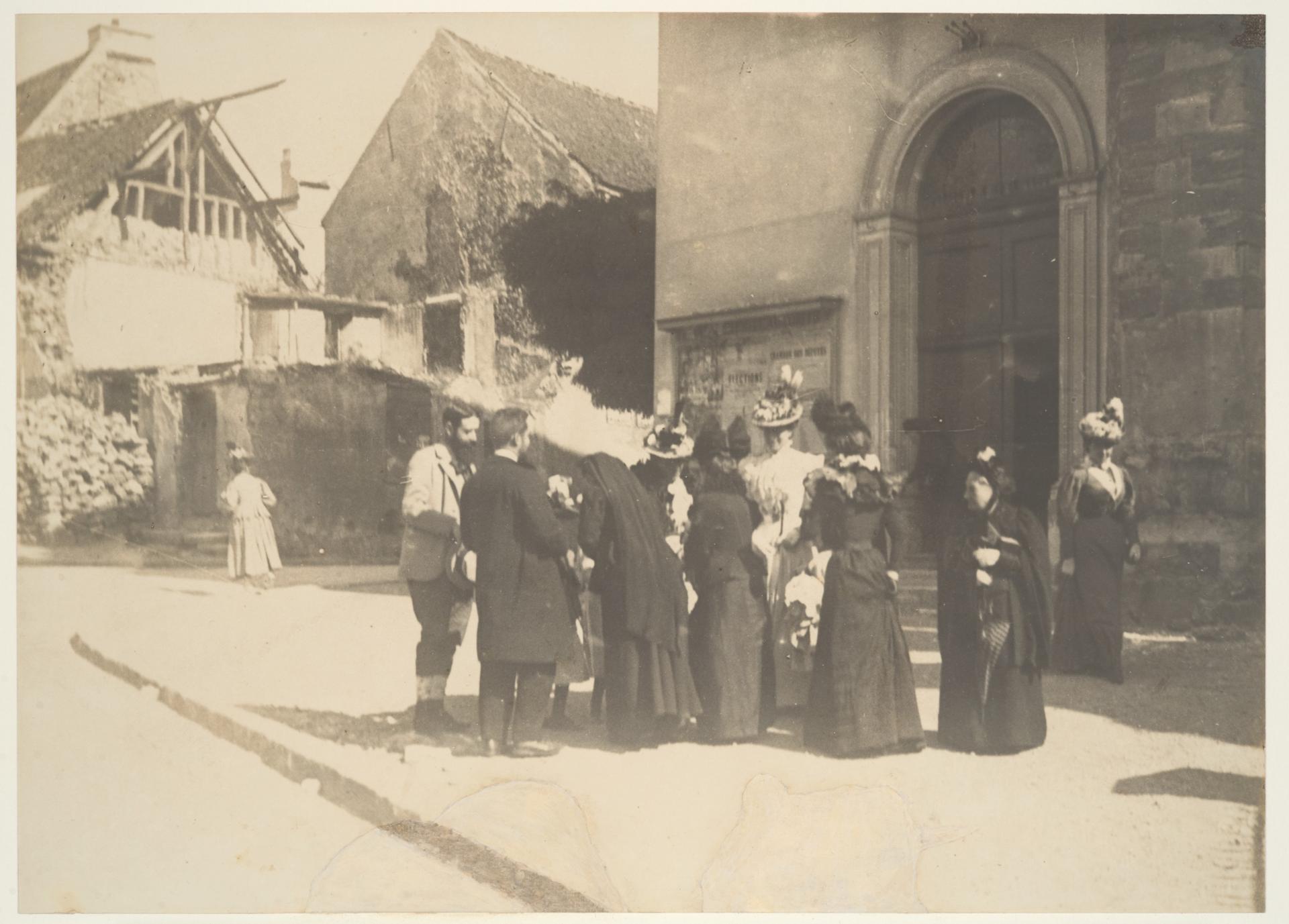
Street Scene, La-Queue-en-Brie (Val-de-Marne)
Original title: Street Scene, La-Queue-en-Brie (Val-de-Marne)
kurzbeschreibung
Edgar Degas, celebrated for his paintings and sculptures, also took up photography around 1896. This gelatin silver print, Straßenszene, La Queue-en-Brie (Val-de-Marne), measures 28.5 x 39.5 cm. It captures a group of women in the dress of the day standing before a building with a rounded entrance. The image preserves an everyday moment in a small French town at the end of the 19th century.
Description
Several women in period dresses and hats cluster in the foreground, facing a house with a large, rounded doorway. Behind it, more buildings appear, including a half-timbered house and one with a steep roof. The layout feels symmetrical: the group up front, architecture behind. Black and white, with signs of age that point to the print's long history. The light is even, without harsh shadows, suggesting it was taken in daylight.
Context
Edgar Degas, a painter and sculptor of Impressionism, turned to photography in his later years. This shot was made around 1896 in La Queue-en-Brie, a commune in the Val-de-Marne department east of Paris. Degas was experimenting with the still relatively new medium, using it for studies of movement and everyday scenes. The subject of a street scene with passersby fits his interest in unobserved moments of modern life.
Impact
The calm, symmetrical arrangement and even daylight give the picture a matter-of-fact, documentary feel. The women in historical dress and the old buildings create a timeless, almost intimate mood. Visible weathering underscores its character as a historical record.
Technique
This is a gelatin silver print, a process already established by 1896 that allowed fine gradations of gray. The shot was likely made with a plate camera; the even light points to exposure in daylight. The signs of aging are typical for prints of this age and are part of the work's material history.
AI-generated description text
Source: Metropolitan Museum of Art · Public Domain (CC0 1.0)