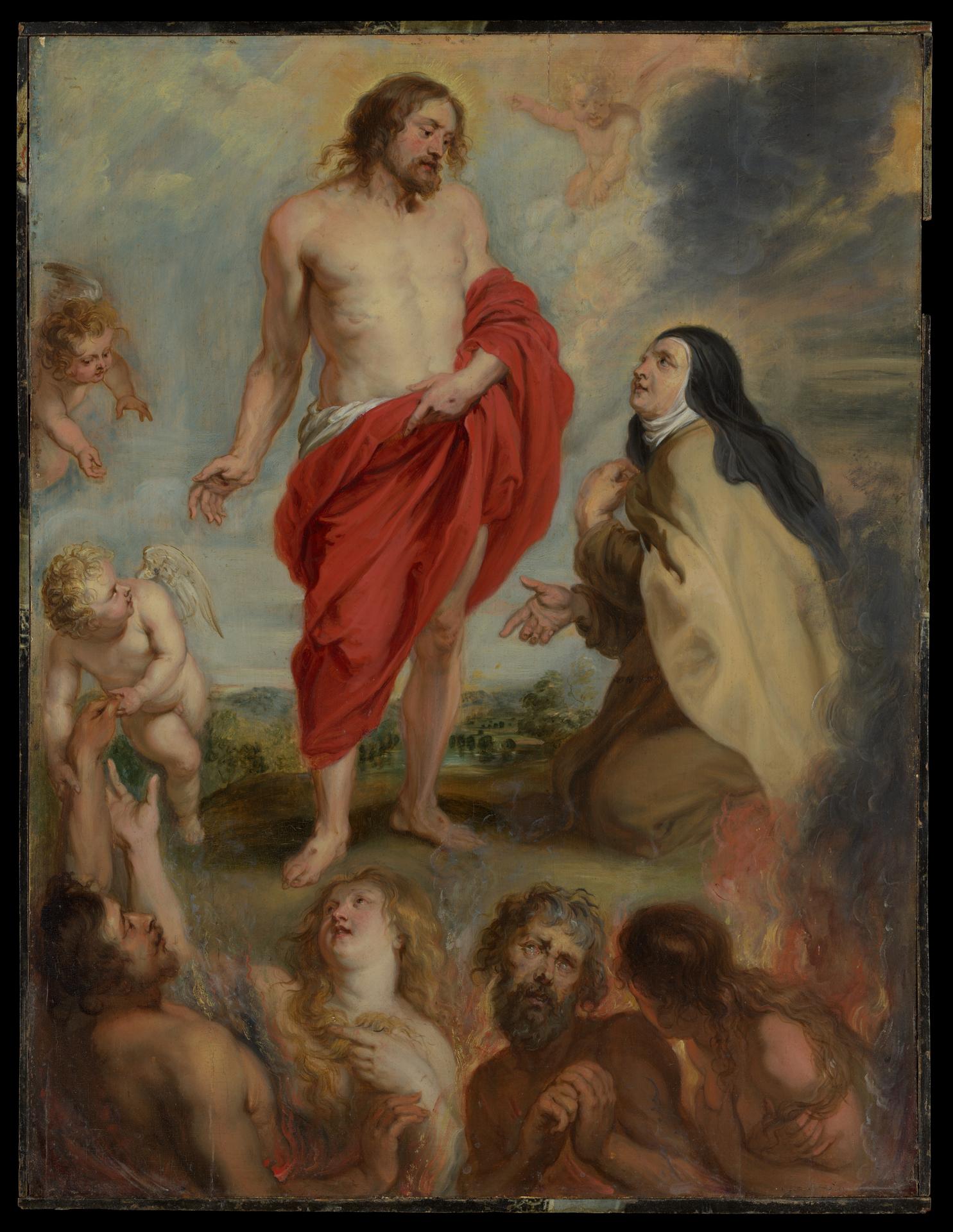
Saint Teresa of Avila Interceding for Souls in Purgatory
Original title: Saint Teresa of Avila Interceding for Souls in Purgatory
kurzbeschreibung
Peter Paul Rubens painted Saint Teresa of Ávila pleading with Christ for the redemption of souls in purgatory. Executed in oil on wood and likely dating from the 1630s, the image bridges the realm of suffering souls with the heavenly world of angels and Christ.
Description
Jesus Christ stands at the center, barefoot and in a red robe, his gaze directed downward, one hand extended. Facing him, Teresa of Ávila kneels in a brown habit, dark-haired, her eyes also lowered. Below, naked souls writhe in flames, their faces marked by despair and terror. Angels ascend toward heaven, one with a lance, another playing a flute; the sky appears in blues and cloud tones. The picture's structure is dynamic, with clear planes that draw focus to Jesus and Teresa, while the warm colors of the souls contrast with the cool blue of the sky.
Context
Created during the Counter-Reformation, when the Catholic Church emphasized purgatory and the intercession of saints. Rubens, a Flemish Baroque painter, produced numerous religious works for churches and private patrons. Teresa of Ávila, a Spanish Carmelite and mystic, was canonized in 1622, which encouraged her depiction in art. The exact date of creation is unknown, but stylistically the painting can be placed in Rubens's late period.
Impact
An intense emotional tension arises between heavenly grace and earthly suffering. The contrast of warm and cool tones, along with the dynamic arrangement, gives the image a dramatic yet hopeful radiance. Soft light from above emphasizes the divine presence and directs the viewer's gaze to Teresa's central plea.
Technique
Oil paint on a wooden panel allows for fine details and soft color transitions. The painting method shows typical Baroque features such as lively brushwork and a rich palette. The precise rendering of figures and nuanced lighting demonstrate the artist's technical mastery.
AI-generated description text
Source: Metropolitan Museum of Art · Public Domain (CC0 1.0)