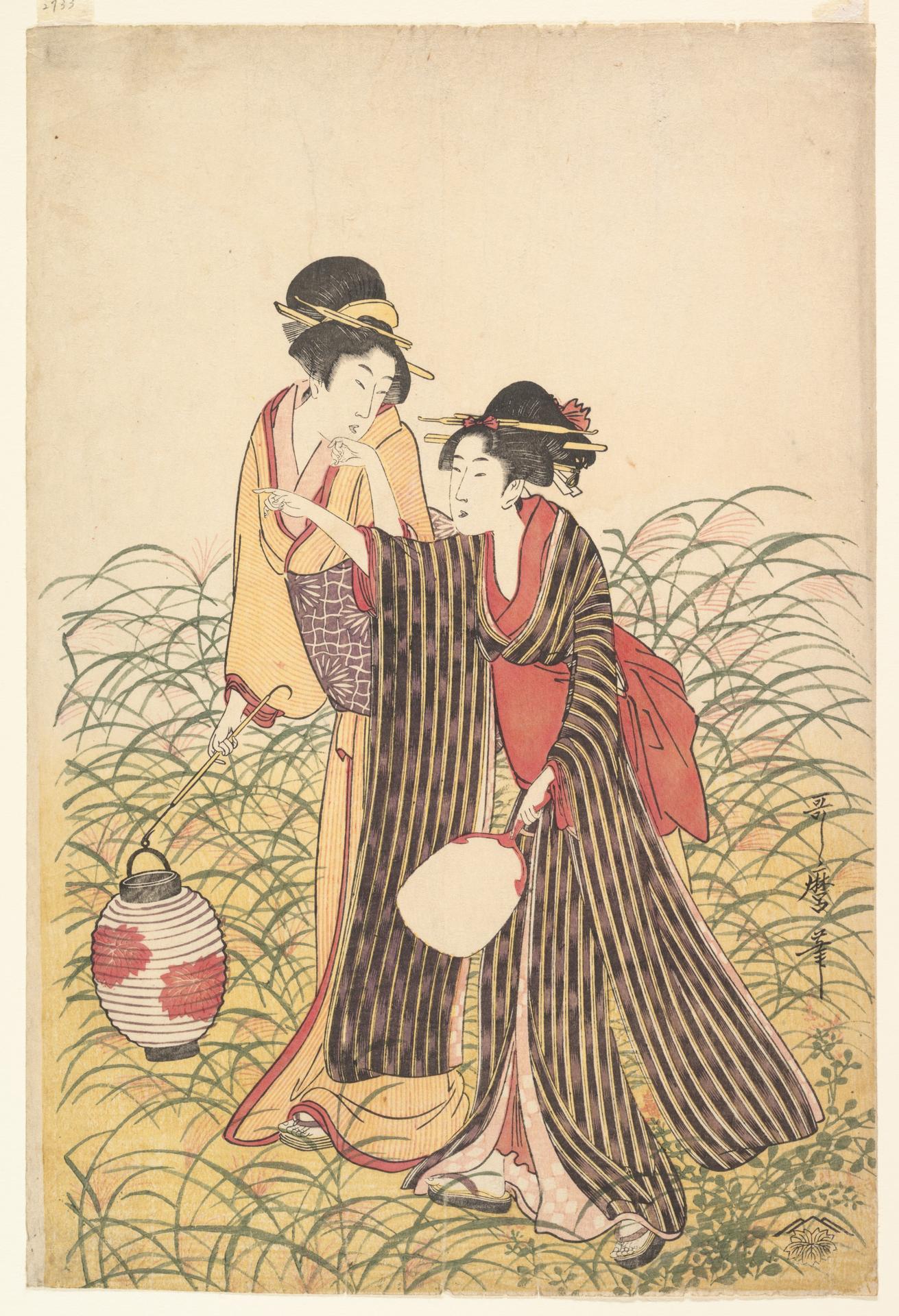
Elopers in Musashino
Original title: Elopers in Musashino
kurzbeschreibung
Kitagawa Utamaro (c. 1753–1806) made this right-hand sheet of a triptych, in which two women in traditional dress walk a path through tall, rank grass. It dates from the early nineteenth century and is a woodblock print in ink and colour on paper.
Description
On the left stands a woman in a yellow garment with a black pattern; a yellow stripe trims her black head covering, and she carries a lantern painted with red blossoms. Beside her walks a companion in a brown-and-white striped robe and red top, her head crowned with a red, flower-decorated covering, a white bag at her side. Both look straight ahead, apparently absorbed in talk. Dense grass in varied greens frames the two figures, with flowers blooming here and there among the blades.
Context
Utamaro was one of the defining masters of ukiyo-e in Japan around 1800, and he devoted himself above all to portraying women. Running away, or slipping off, recurs as a theme in the Japanese art of those years. This sheet belongs to a series of triptychs conceived from the outset as multi-part prints.
Impact
Clean colours and sharp contours give the picture its odd blend of liveliness and quiet. Because the two women are on the move, the view gains narrative tension and draws the viewer into what is happening.
Technique
Utamaro's workshop printed this sheet in colour with ink on paper by the woodblock method. The carefully executed fabric patterns and precise lines testify to the high print quality for which the studio was known.
AI-generated description text
Source: Metropolitan Museum of Art · Public Domain (CC0 1.0)