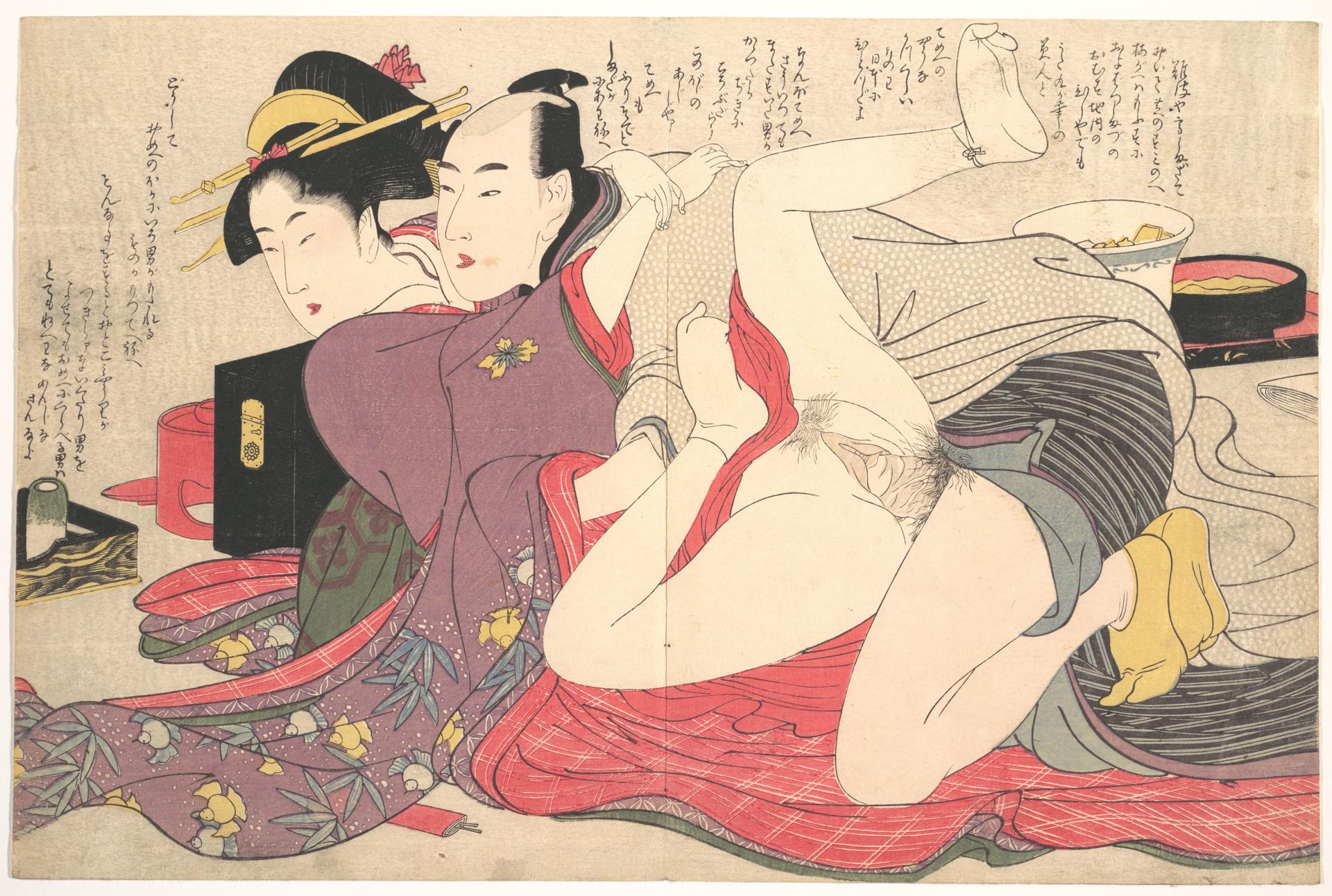
Erotic Print (Woodblock print; ink and color on paper, Met-Objekt 4592)
Original title: Erotic Print
kurzbeschreibung
A couple in traditional Japanese dress appears in this color woodblock print by Kitagawa Utamaro. The exact date of the sheet is not recorded; it probably belongs to the second half of the eighteenth century. That places it among the shunga prints, a genre widely circulated during the Edo period.
Description
Two figures meet in an intimate pose: a woman lies on her back while a man sits above her, holding her from behind. Both wear kimonos patterned with flowers, the woman with a red obi and the man with a purple one. The action unfolds on a tatami floor scattered with cups and bowls. Red, purple and grey meet yellows and greens, and the contrasts come out strongly. The layout feels symmetrical, the figures hold the center, and accompanying characters comment on what takes place.
Context
Utamaro (1753–1806) ranks among the leading masters of ukiyo-e and became known above all for his portrayals of women. Shunga sheets of this kind were common throughout Edo-period Japan and were traded quite openly despite official censorship. The period of origin falls in a phase when woodblock prints were produced in large editions and often aimed at a bourgeois public.
Impact
Strong colors and the symmetrical arrangement pull the eye quickly to the intimate encounter, creating an immediate, almost voyeuristic closeness. The explicit scenes are set against ornamental fabric patterns, and from this arises a simultaneous sense of decoration and provocation.
Technique
The sheet was executed as a color woodblock print with ink and colors on paper. The process used several woodblocks, one for each color, which had to be aligned precisely with one another. The exact lines and flat areas of color reveal the high craft quality of the printmaking of the time.
AI-generated description text
Source: Metropolitan Museum of Art · Public Domain (CC0 1.0)