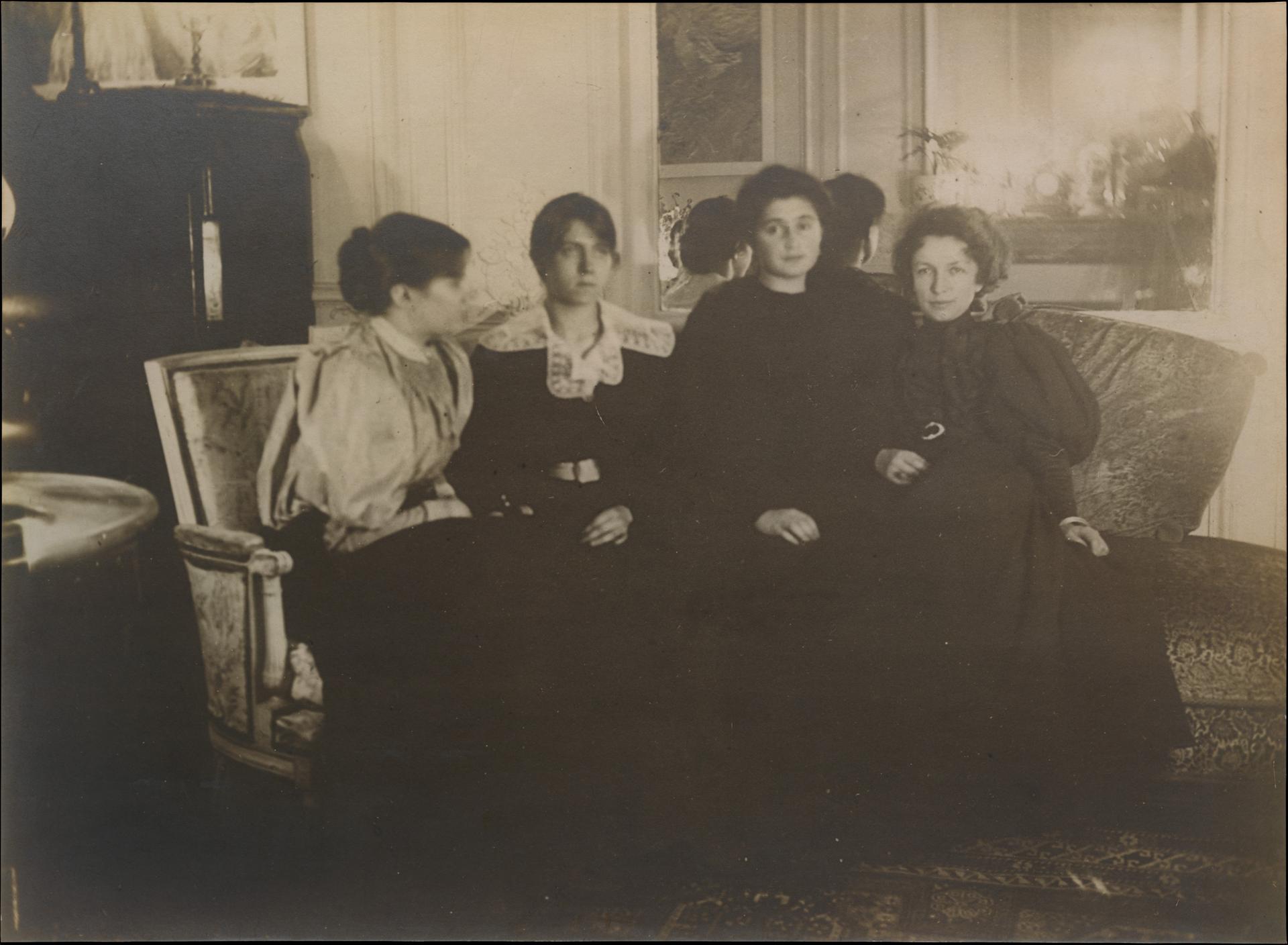
Paule Gobillard, Jeannie Gobillard, Julie Manet, and Geneviève Mallarmé
Original title: Paule Gobillard, Jeannie Gobillard, Julie Manet, and Geneviève Mallarmé
kurzbeschreibung
Four young women sit in a living room, exchanging glances—captured in a black-and-white photograph by Edgar Degas from 1895. They are Paule Gobillard, Jeannie Gobillard, Julie Manet, and Geneviève Mallarmé. The image is a gelatin silver print.
Description
A couch, a chair, and a tea table form the setting where the four women have taken their places. Their clothing reflects the fashion around 1895; their postures seem relaxed, as if they are deep in conversation. The furnishings suggest a wealthy household. Soft light falls from the side, emphasizing shadows and contours of the figures. As is typical for a black-and-white photograph, the image is monochrome.
Context
Edgar Degas was known as a painter and sculptor of Impressionism, but in the 1890s he also experimented with photography. This group portrait from 1895 was made in his private circle; he maintained close ties to the Manet and Mallarmé families. The four sitters belonged to the intellectual and artistic milieu around Degas. The photograph is one of the examples of the then still young amateur photography in artistic circles.
Impact
The photograph feels relaxed and almost intimate, with a calm layout. The side lighting and monochrome rendering give it a timeless, quiet elegance. It captures a private moment and demonstrates Degas's interest in showing people in their everyday surroundings.
Technique
This work is a gelatin silver print, a photographic process common around 1895. A gelatin layer with silver halides is coated on paper, exposed, and developed. At 28.4 x 38.9 cm, it is a medium-format print, typical for its time.
AI-generated description text
Source: Metropolitan Museum of Art · Public Domain (CC0 1.0)