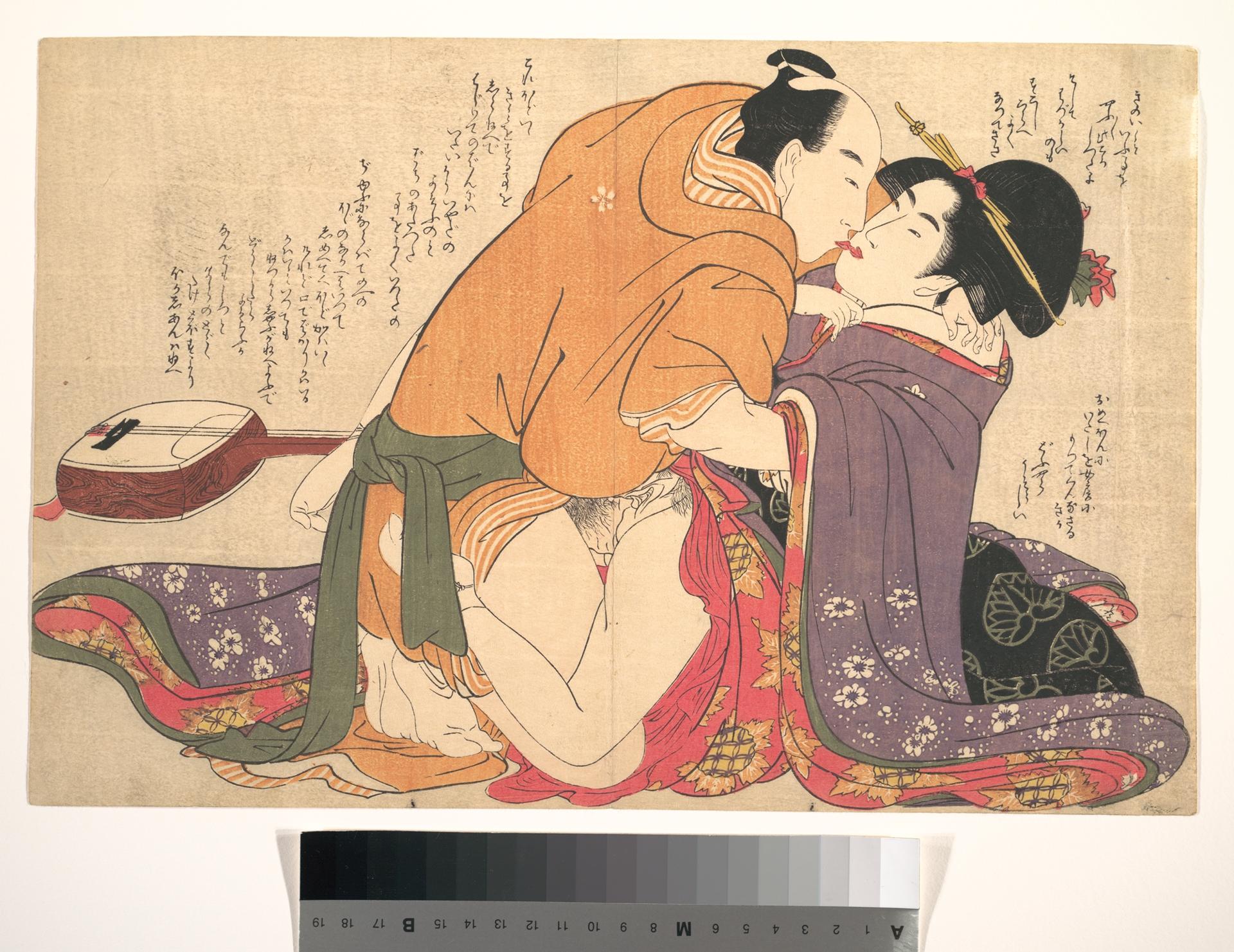
A couple making love beside a shamisen, a leaf from Unravelling the Threads of Desire (Negai no ito-guchi)
Original title: A couple making love beside a shamisen, a leaf from Unravelling the Threads of Desire (Negai no ito-guchi)
kurzbeschreibung
Kitagawa Utamaro's 1799 colour woodblock print shows a lovers' embrace beside a shamisen. The sheet comes from the illustrated erotic book 'Negai no ito-guchi' and was produced using the nishiki-e technique of multicoloured woodblock printing.
Description
The woman wears a purple kimono patterned with flowers, and red blossoms adorn her black hair. Behind her kneels a man in a brown kimono with an orange obi, his hand touching her neck gently. A shamisen, the traditional Japanese stringed instrument, lies to one side of the pair. The layout feels symmetrical and centred, with strong contrasts between the garments and the instrument and lively colours throughout.
Context
Utamaro made this sheet for a shunpon, an erotic book common in late eighteenth-century Edo. Such works belonged to ukiyo-e culture and addressed a broad urban audience. Intimate scenes with everyday objects like the shamisen were characteristic of Utamaro's art; he was known for his sensitive portrayals of women.
Impact
The tender touch and calm arrangement make the scene feel intimate rather than explicit. Bright colours and clear lines give the print an aesthetic elegance that extends beyond its erotic content.
Technique
As a nishiki-e, a multicoloured woodblock print, the work was printed with ink and colour on paper. This process allowed fine colour gradations and details, as seen in the kimono patterns. The sheet is in the horizontal ōban format, common for book illustrations of the period.
AI-generated description text
Source: Metropolitan Museum of Art · Public Domain (CC0 1.0)