Erotic Print (Woodblock print; ink and color on paper, Met-Objekt 4585)
Original title: Erotic Print
kurzbeschreibung
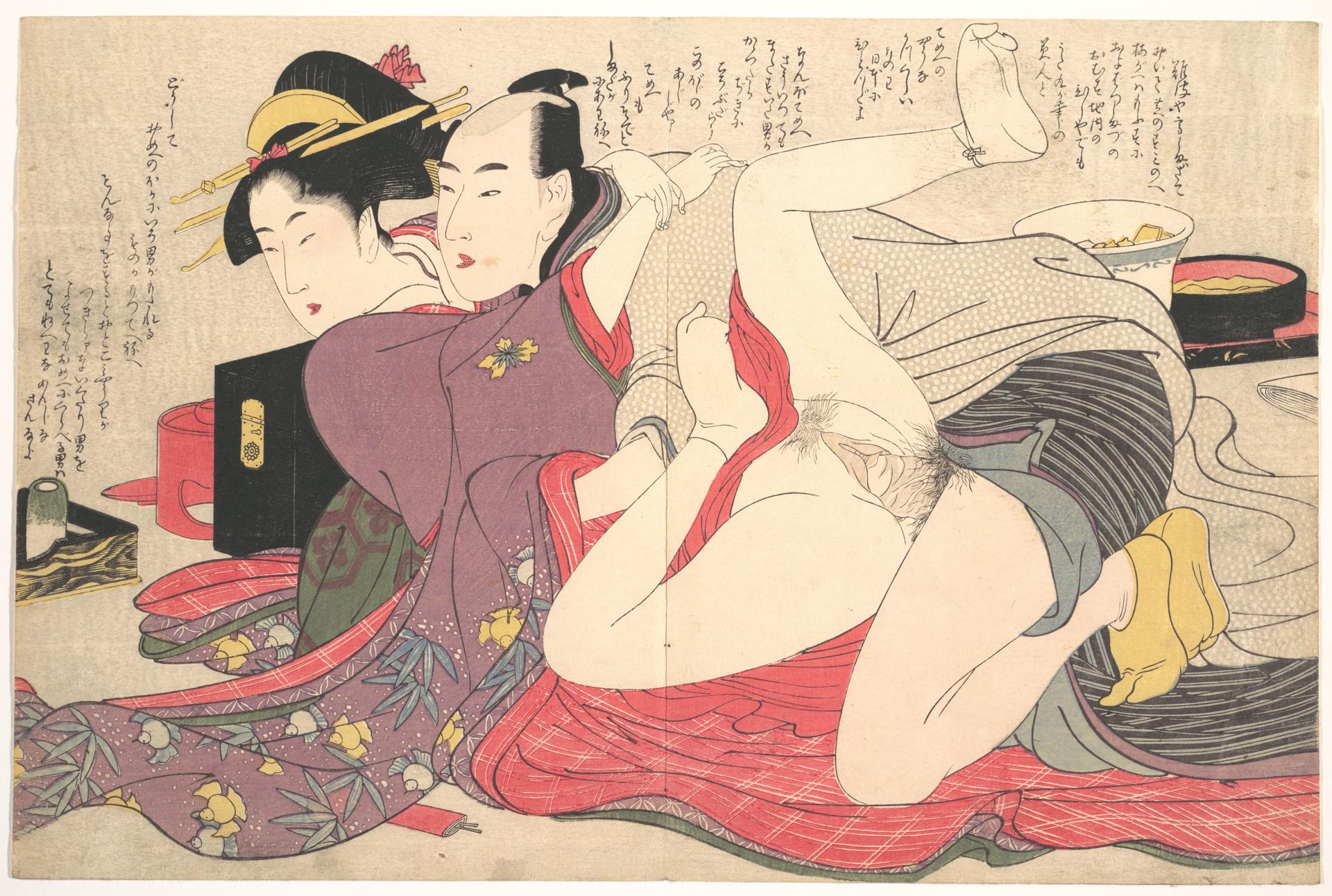
This late eighteenth-century woodblock print by Kitagawa Utamaro presents a lovers' scene in a domestic setting. Executed in ink and colour on paper, it belongs to the genre of erotic prints. Two figures in traditional Japanese dress appear in an intimate, familiar situation.
Description
At the left a woman sits in a floral kimono, her hair pinned up with ribbons, and looks thoughtfully across at the man. He lies on his back, one hand at his hip, the other slightly raised, wearing an obi and trousers. Both rest on a bed with a red cloth patterned with leaves and flowers. Cups, bowls and other utensils point to the household setting. Red, blue and grey dominate the palette, with gold and white as accents.
Context
Utamaro ranks among the outstanding masters of Japanese ukiyo-e and became best known for his images of women. Shunga, the erotic prints, were widespread in the Edo period and valued across many levels of society. No precise date for this sheet exists; it is placed in Utamaro's working phase of the late eighteenth century. Such prints were often produced as series that circulated first in Japan and later in the West.
Impact
The even balance of the two figures and the muted colouring give the sheet a calm, intimate mood. The domestic surroundings and traditional clothing lift the erotic subject into the aesthetic without becoming insistent. Clear lines and flat areas of colour produce graphic sharpness and draw the eye into the scene.
Technique
The sheet was made as a woodblock print in ink and colour on paper, as was usual for Japanese ukiyo-e. Sharp contours and flat applications of colour define this process, with separate woodblocks used for each colour. The finest details, such as the pattern of the kimono, attest to the great care taken in printing.
AI-generated description text
Source: Metropolitan Museum of Art · Public Domain (CC0 1.0)