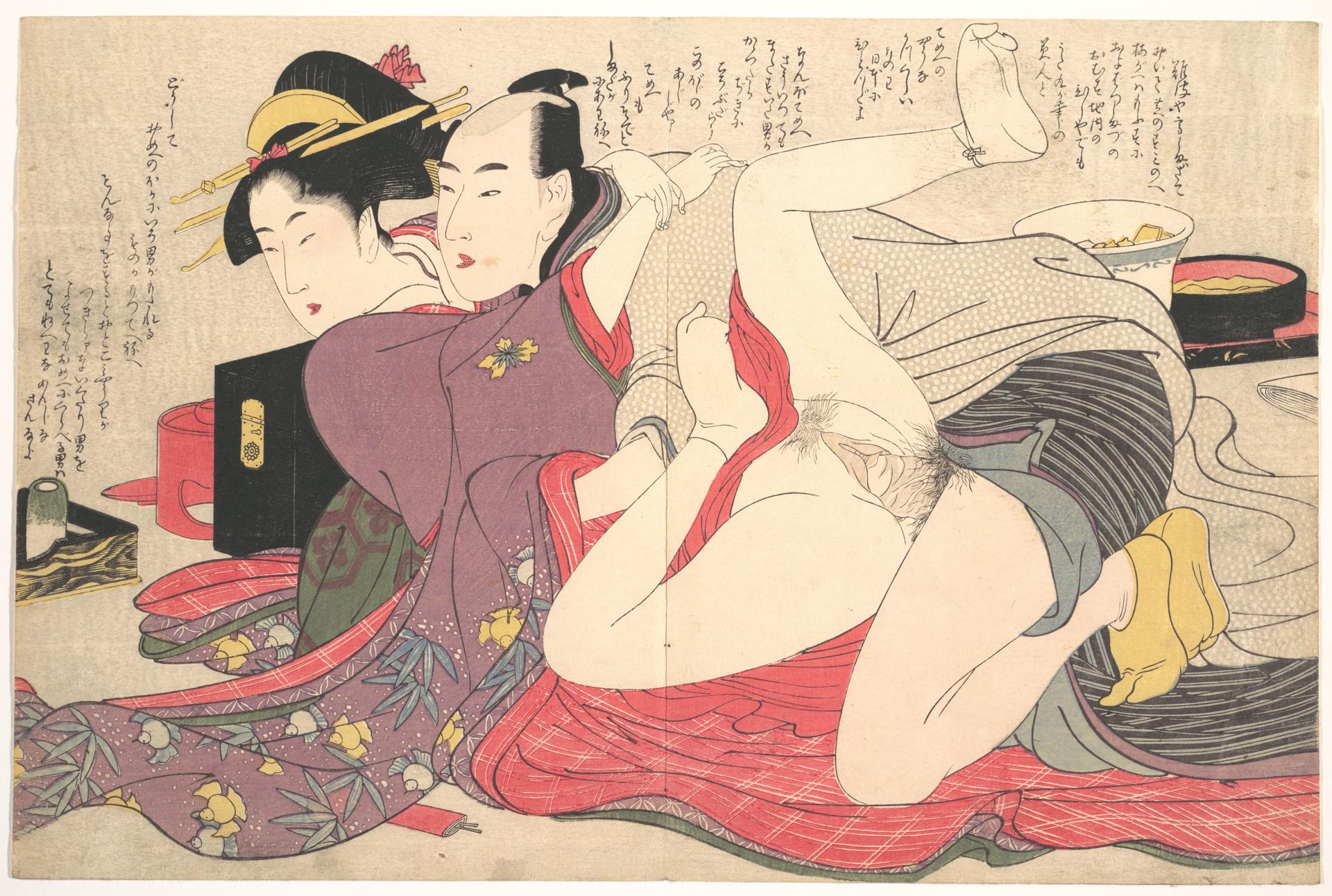
Erotic Print (Woodblock print; ink and color on paper, Met-Objekt 4583)
Original title: Erotic Print
kurzbeschreibung
Unlike many shunga prints that isolate the couple, this sheet by Kitagawa Utamaro (c. 1753–1806) places an intimate encounter between two figures in traditional Japanese dress within a domestic interior. Executed in ink and colour on paper, it dates from the Edo period.
Description
Two people appear in an intimate pose: one lies on her back with legs open, the other kneels over her with arms wrapped around her. Both wear kimono with floral patterns and elaborate hairstyles; the front figure has a red sash. Cups, bowls and other utensils furnish the background. Red, blue and grey dominate the palette, accented with gold and white; the light falls evenly.
Context
Utamaro ranks among the outstanding masters of ukiyo-e and is known for his portrayals of women and intimate scenes. Erotic prints such as this (shunga) were regarded in the Edo period (1603–1868) as works of art and at the same time as educational material. A precise date is lacking, but it is thought to have been made in the 1790s, when Utamaro was in his most productive phase. The Chinese characters in the image probably serve a narrative function, as is usual in shunga.
Impact
The close arrangement of the figures and the warm colours give the sheet an immediate, intimate appeal. The carefully worked kimono and hairstyles lend the scene an aesthetic elegance that goes beyond the erotic content.
Technique
The sheet was produced as a woodblock print in ink and colour on paper. For this technique, common in ukiyo-e, a separate woodblock had to be cut for each colour and the paper then printed precisely, allowing a detailed reproduction.
AI-generated description text
Source: Metropolitan Museum of Art · Public Domain (CC0 1.0)