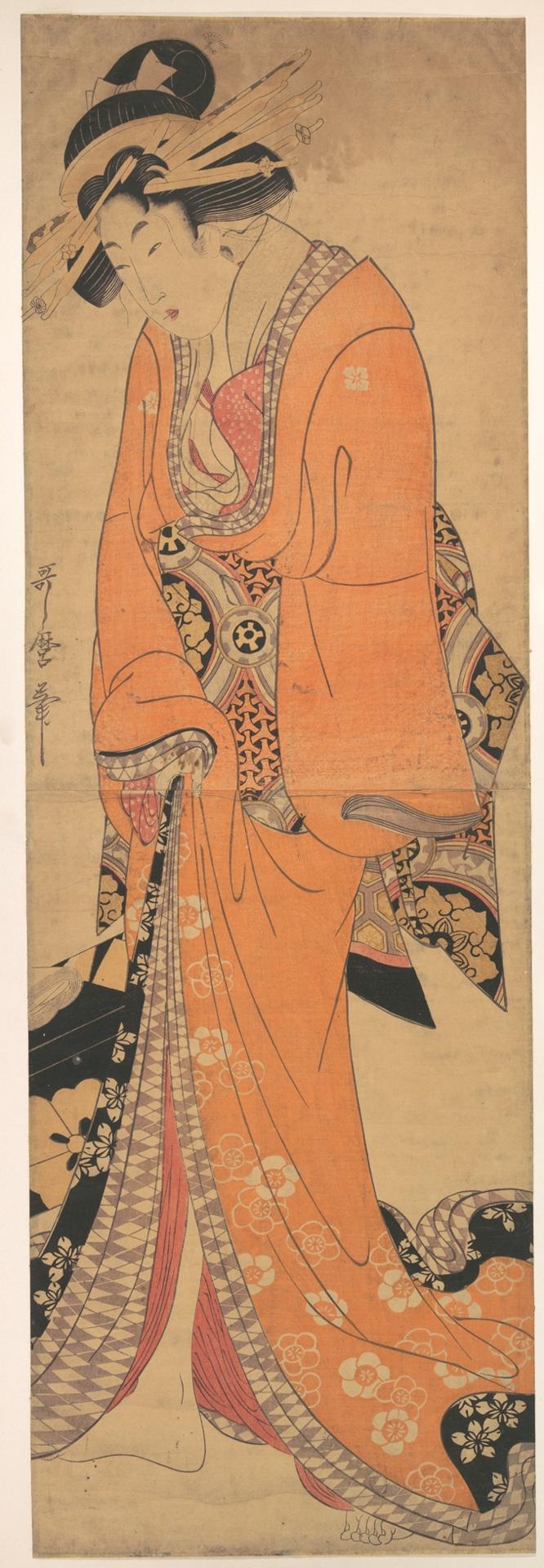
Geisha, probably a Singing Girl
Original title: Geisha, probably a Singing Girl
kurzbeschreibung
Kitagawa Utamaro's print 'Geisha, Probably a Singer' portrays a woman in traditional Japanese attire who may be a geisha or a singer. It is a woodblock print in ink and color on paper, made around 1800. The sitter wears an orange kimono with elaborate patterns, and her hair is intricately styled.
Description
The figure stands centrally, wrapped in a striking orange kimono adorned with floral and geometric motifs. Her hair is piled high and decorated with feathers and flowers. Her gaze drops to the left, creating a pensive mood. The colors are vivid and contrasting; the orange of the kimono stands out sharply against the background. The light appears even, with no visible shadows, as is typical of ukiyo-e.
Context
Kitagawa Utamaro is counted among the major ukiyo-e artists of late eighteenth-century Japan and is known for his depictions of women. This print was made during the Edo period, an era of economic and cultural flourishing. Geishas and singers were popular subjects in woodblock art because they embodied the beauty and elegance of the urban pleasure districts. Utamaro produced numerous portraits of women, often called bijin-ga (pictures of beautiful women).
Impact
A quiet, intimate atmosphere emanates from the image, reinforced by the lowered gaze and the delicate coloring. Clean lines and lively colors exert an aesthetic appeal and transport the viewer into the world of eighteenth-century Japanese culture.
Technique
The woodblock print with ink and color on paper was widespread during the Edo period and allowed multiple impressions to be made. Colors were applied in several printing passes, with each color requiring its own woodblock. Precise linework and vivid coloring are characteristic of the ukiyo-e prints of this time.
AI-generated description text
Source: Metropolitan Museum of Art · Public Domain (CC0 1.0)