Yamauba Tying Kintarō’s Topknot
Original title: Yamauba Tying Kintarō’s Topknot
kurzbeschreibung
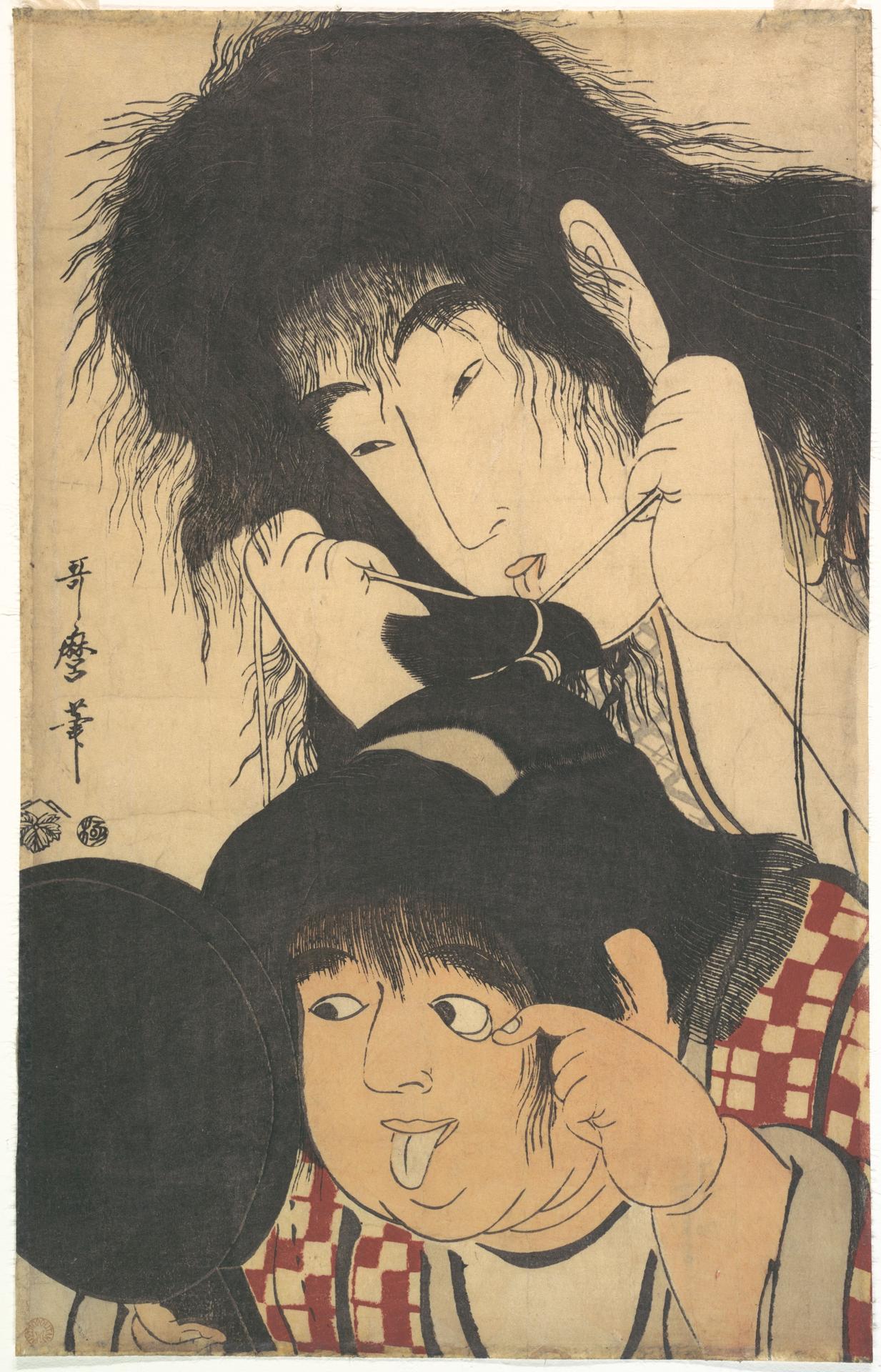
Kitagawa Utamaro captures the mountain nymph Yamauba tying a topknot in her son Kintarō's hair in this colour woodblock print (nishiki-e) from around 1795. Ink and colour on paper, created during the heyday of Japanese colour woodblock printing.
Description
Two figures fill almost the entire surface: above, Yamauba with dark, curly hair and traditional robes, her eyes wide open, her expression poised between worry and surprise. Below, Kintarō, also dark-haired, wears a robe with a red-and-white check pattern, his gaze equally startled. Black, white and red dominate the palette, with a touch of brown; the light falls evenly, without harsh shadows. Sharp contours and clear areas of colour define the style typical of Japanese woodblock prints of this period.
Context
This print was made in the 1790s, when Utamaro was known above all for his portrayals of women and mothers. The motif of Yamauba and Kintarō comes from Japanese mythology and was hugely popular in the Edo period. The print belongs to a series exploring the mother-child relationship. Utamaro worked for the publisher Tsutaya Jūzaburō, who stood for high-quality woodblock prints.
Impact
The frontal orientation and intense faces bring the figures very close to the viewer. Restrained colours and clear contours give the print a calm yet striking presence. The startled glances lend the scene a touch of humour and emphasise the intimate everyday situation.
Technique
This colour woodblock print (nishiki-e) used several woodblocks, one for each colour. First the black contours were printed from a sumi ink block, then the colour areas in red, brown and other tones followed. The handmade paper was printed with an even technique that allows clear colour transitions.
AI-generated description text
Source: Metropolitan Museum of Art · Public Domain (CC0 1.0)