Yamauba Playing with Kintarō
Original title: Yamauba Playing with Kintarō
kurzbeschreibung
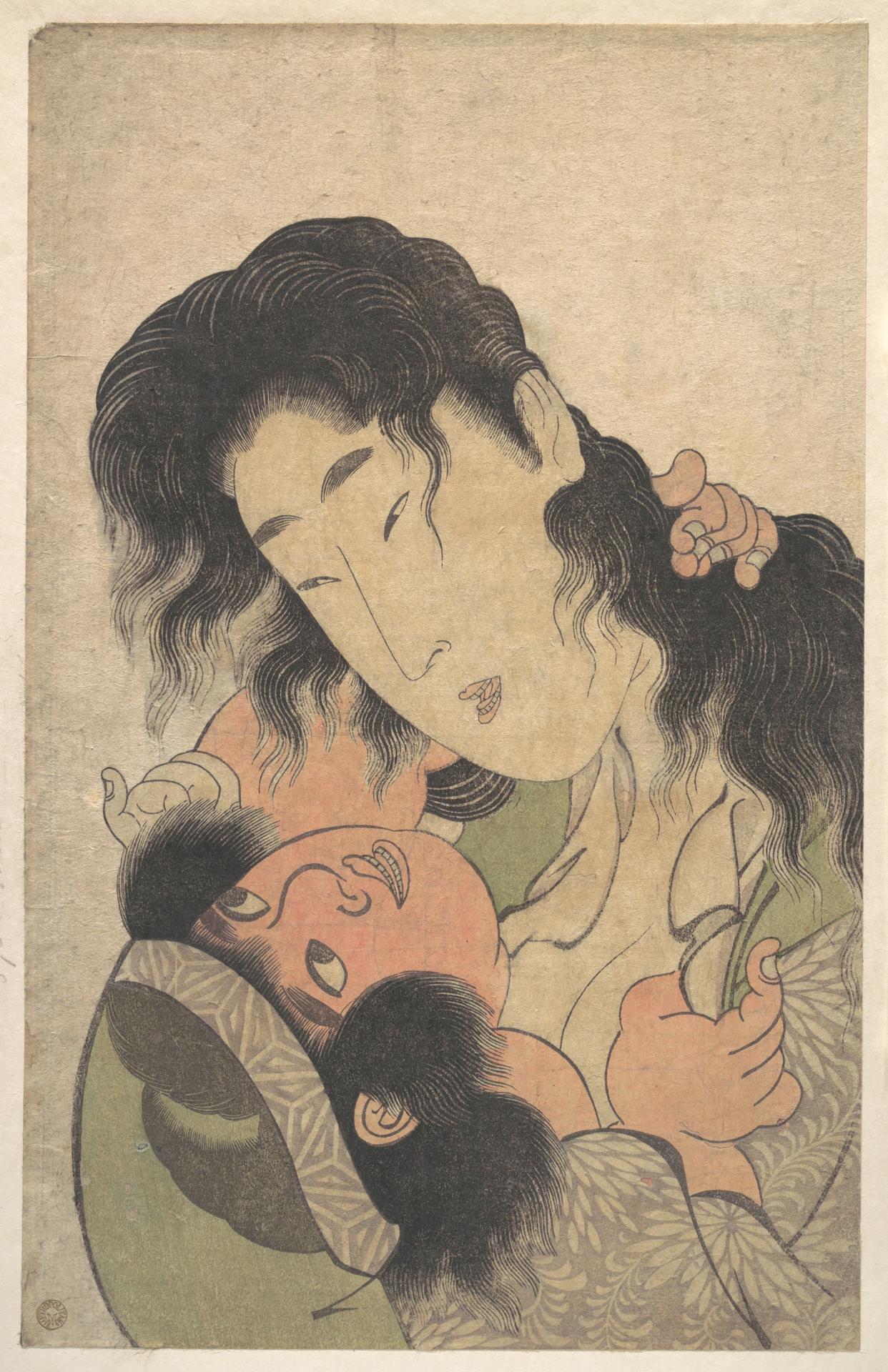
Kitagawa Utamaro made this colour woodblock print around 1795. It shows the mountain witch Yamauba and the legendary boy Kintarō, whom she holds in her arms. The sheet is an ōban nishiki-e, printed with ink and colour on paper.
Description
A woman with long, wavy hair and traditional robes wraps a young man in her embrace. Her smile turns slightly upward, while the boy lies beneath her, also smiling. His fabric bears a pattern reminiscent of leaves or flowers. Earthy tones dominate the palette, with accents of green and beige; the light falls evenly and without harsh shadows.
Context
The print dates from the late Edo period, when nishiki-e became widely available in Edo. Utamaro thus takes up the legend of Yamauba and Kintarō, rooted in Japanese mythology. The artist was known for his portrayals of women; here he combines that motif with a mythical subject. The sheet belongs to a phase when Utamaro was at the height of his career.
Impact
The embrace and the smiling faces evoke a familiar yet playful mood in the viewer. Calm colours and clear lines create a harmonious, almost idyllic impression. The mythical figures feel close and at the same time distant because of their historical clothing.
Technique
As a nishiki-e, a multicoloured woodblock print, the sheet was printed with ink and colour on paper. The technique required several woodblocks, one for each colour, which had to be precisely aligned. Clear contours and flat areas of colour are typical of eighteenth-century Japanese colour woodblock printing.
AI-generated description text
Source: Metropolitan Museum of Art · Public Domain (CC0 1.0)