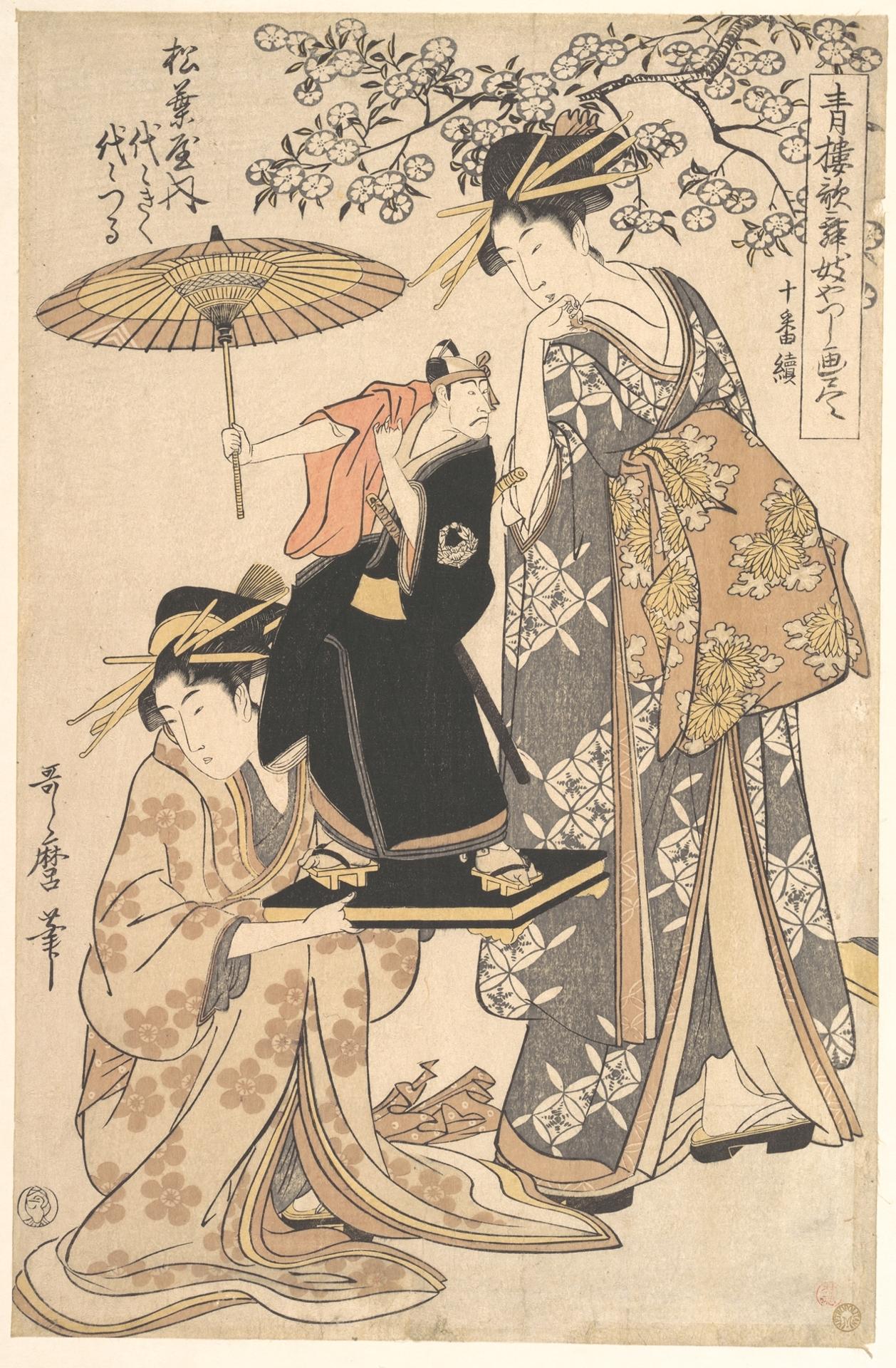
The Oiran Yoyogiku of Matsubaya Standing under a Cherry Tree
Original title: The Oiran Yoyogiku of Matsubaya Standing under a Cherry Tree
kurzbeschreibung
Unlike many contemporary bijin-ga, this print by Kitagawa Utamaro does not present the oiran Yoyogiku of the Matsubaya house in an isolated pose but places her within a flowering cherry-tree landscape. Executed in ink and colour on paper in the late eighteenth century, the print conveys the courtesan's dignified bearing in traditional dress.
Description
Yoyogiku stands in the foreground, slightly sunk at the knees, wearing an elaborately patterned kimono. In her hands she holds a wooden board on which a smaller figure wearing a helmet has taken its place. Behind her appears another person with a parasol, likewise in traditional clothing. A cherry tree arches over the scene, its blossoms clearly visible. Earth tones dominate the palette, broken by accents of blue and gold; the contours are sharp and precise.
Context
Utamaro ranked among the leading masters of ukiyo-e in eighteenth-century Japan and became famous for his pictures of beautiful women (bijin-ga). The oiran Yoyogiku was a well-known courtesan of the Matsubaya house in the Yoshiwara pleasure district of Edo. The woodblock print was made in an era when courtesan portraits served at once as advertising and as an art form. In Japanese culture the cherry blossom is a symbol of transience and beauty.
Impact
The calm, almost symmetrical arrangement gives the sheet a noble presence. Earthy tones and golden accents create a stately, nearly ceremonial mood. The cherry blossoms underscore the delicate beauty of the scene and invite the viewer to linger.
Technique
This print was made as a woodblock print, with ink and colour on paper. The drawing is cut into wooden blocks, inked and then pressed onto paper. Crisp contours and fine shading attest to the high craftsmanship that distinguishes Utamaro's prints.
AI-generated description text
Source: Metropolitan Museum of Art · Public Domain (CC0 1.0)