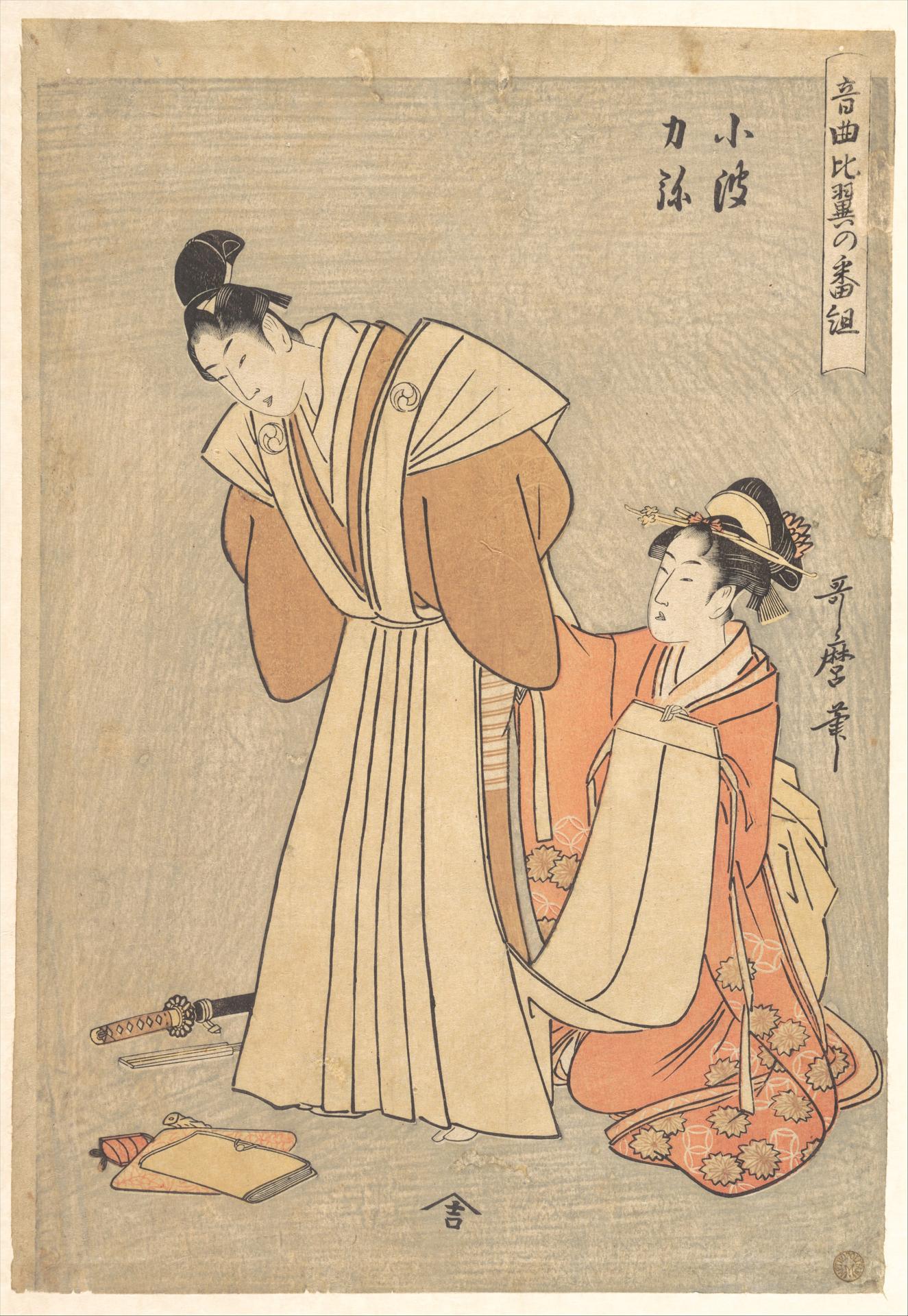
Rikiya and Konami, from the series A Program with Music about Loving Couples (Ongyoku hiyoku no bangumi)
Original title: Rikiya and Konami, from the series A Program with Music about Loving Couples (Ongyoku hiyoku no bangumi)
kurzbeschreibung
Kitagawa Utamaro created Rikiya and Konami from the series 'A Program with Music about Loving Couples' (Ongyoku hiyoku no bangumi) in 1798 as a woodblock print in ink and color on paper. Two figures in traditional attire meet in a familiar encounter.
Description
Two people in Japanese clothing fill the sheet. The figure on the left leans slightly forward to look at something on the ground; they wear a beige-brown kimono with a striking waist pattern, along with an elaborate hairstyle and hair ornaments. On the right, a person kneels in an orange kimono with a floral pattern, also with a traditional hairstyle and hair ornaments, and turns their gaze toward the other figure. A book and a sword lie on the floor. The background remains plain and textured; Chinese characters appear in the upper right. Warm tones from beige to orange to brown dominate the color scheme, with white and gray providing accents.
Context
Utamaro was among the leading artists of ukiyo-e and was known for his depictions of women and theater scenes. The series 'Ongyoku hiyoku no bangumi' was created in 1798, when he was long established and appreciated for his elegant figure pictures. At that time, woodblock prints were widespread in Japan and served both artistic and commercial purposes. Rikiya and Konami are characters from Kabuki theater, which demonstrates the close connection between ukiyo-e and the theater culture of the Edo period.
Impact
The encounter feels quiet and intimate; the figures are absorbed in a silent interaction that radiates closeness and familiarity. Warm colors and clear contours give the print a harmonious aura and draw the viewer into the world of traditional Japan.
Technique
Ink and color on paper were used for the color woodblock print. This technique, also known as nishiki-e, enabled multicolored images through multiple woodblocks. Clear lines and the distinct separation of contours and color areas characterize the woodblock art of the Edo period.
AI-generated description text
Source: Metropolitan Museum of Art · Public Domain (CC0 1.0)