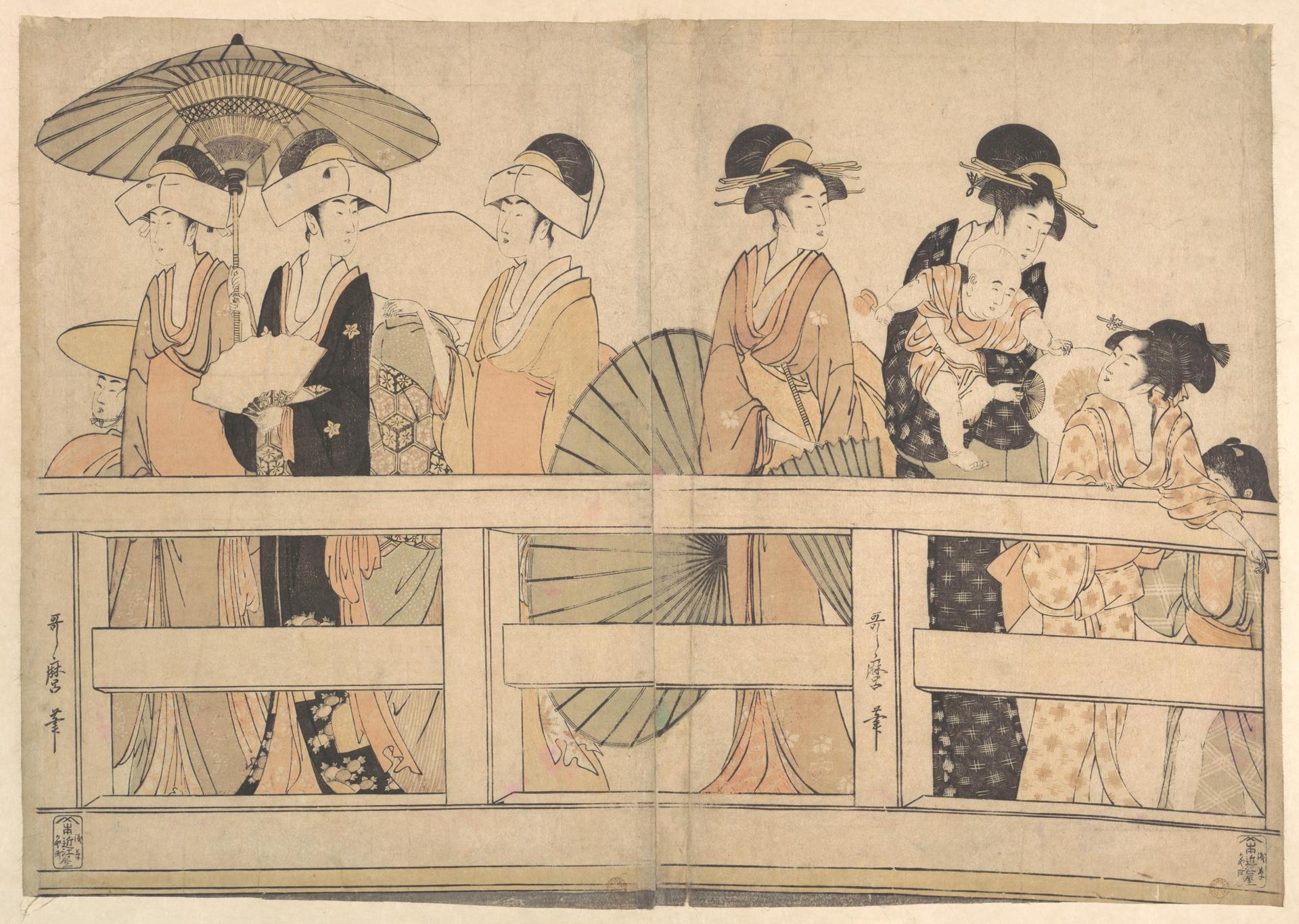
Enjoying the Cool Evening Breeze on and under the Bridge (ca. 1800, Met-Objekt 4540)
Original title: Enjoying the Cool Evening Breeze on and under the Bridge
kurzbeschreibung
Kitagawa Utamaro made this colour woodblock print, "Enjoying the Cool Evening Breeze On and Beneath the Bridge," around 1800, using ink and colour on paper. A group of women in traditional dress has gathered on a wooden bridge and fallen into conversation.
Description
Several women stand together on a plain wooden structure, chatting among themselves. Their kimonos and obi are clearly visible; some hold fans, one carries a parasol, and another holds a child. The figures are spaced loosely along the bridge, a few leaning slightly forward to hear and speak more easily. Browns, beiges and blues set the restrained tonal key. Light falls evenly, without shadows, suggesting an hour free of harsh sun.
Context
Utamaro was active around 1800, during the Edo period, when Japanese ukiyo-e printmaking was at its height. He became famous above all for his images of women, including courtesans and beauties of the pleasure quarters. Scenes of cooling evening air by rivers and bridges were a favourite subject in Japanese art, reflecting the everyday pleasures of city life.
Impact
A quiet, idyllic mood emanates from the print and draws the viewer's gaze into the gathering. The muted colours and even light produce a calm, almost meditative atmosphere, characteristic of Utamaro's images of women.
Technique
Three sheets survive from a six-part woodblock print (a hexaptych), printed in ink and colour on paper. Clean lines and flatly applied colour define the process, in which separate blocks were used for each colour.
AI-generated description text
Source: Metropolitan Museum of Art · Public Domain (CC0 1.0)