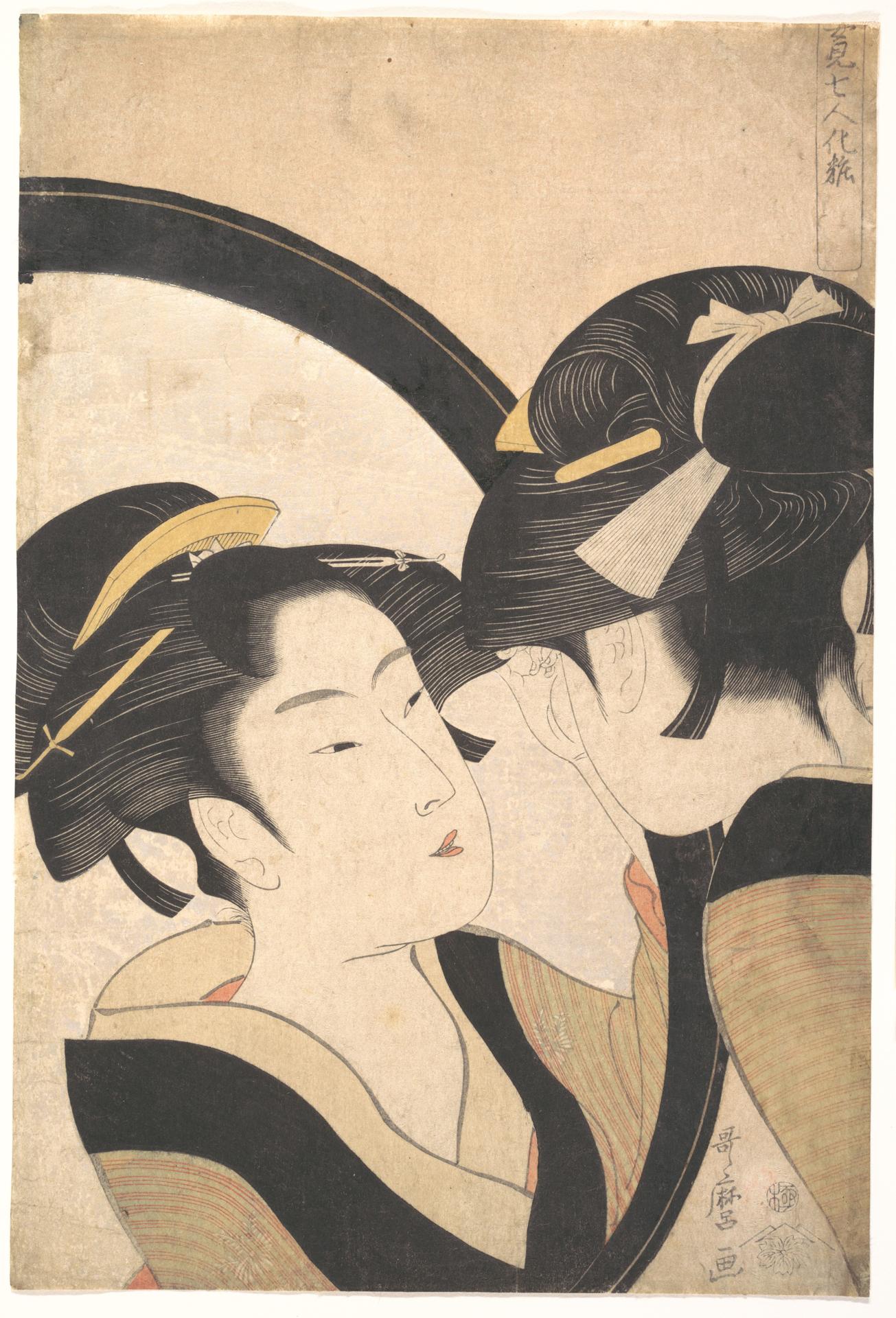
Naniwa Okita Admiring Herself in a Mirror
Original title: Naniwa Okita Admiring Herself in a Mirror
kurzbeschreibung
Kitagawa Utamaro made this print around 1790–95, and it belongs to the Edo period as well as to his long-running engagement with the beauty print. Two women are shown checking their appearance in a mirror. The sheet is a colour woodblock print on paper with a mica ground, a familiar example of bijin-ga, the genre in which good looks themselves become the subject.
Description
Up front stands a woman with an elaborate upswept hairstyle and hair ornaments, her upper garment bright with colour. She directs a pensive gaze into the mirror, and the second woman behind her looks into it as well. Both wear patterned robes with touches of colour. The setting stays sparse and never competes with the figures. Black and white carry the palette, joined by pale tones that bring clothing and hairstyles forward.
Context
Utamaro worked on this sheet in the late Edo period, when portraits of beautiful women sold strongly in Japan. It takes its place in a series presenting courtesans and celebrated beauties of the Yoshiwara pleasure quarter. The mica ground counted as an expensive technique and was often used for high-quality portraits. Women at a mirror were a widespread motif for addressing self-regard and the cult of beauty.
Impact
The arrangement feels quiet and close, the women absorbed in themselves. Through the mica ground a noble, shimmering surface settles over the print and underlines the elegance of the figures. Clear contours and the restrained colour range produce a graphically coherent aesthetic.
Technique
Utamaro used multicolour printing (nishiki-e) with ink and colour on paper, supplemented by a mica ground. This allowed finely graded tones and details in the garments. The mica was applied as a powder to create a shimmer that throws light back.
AI-generated description text
Source: Metropolitan Museum of Art · Public Domain (CC0 1.0)