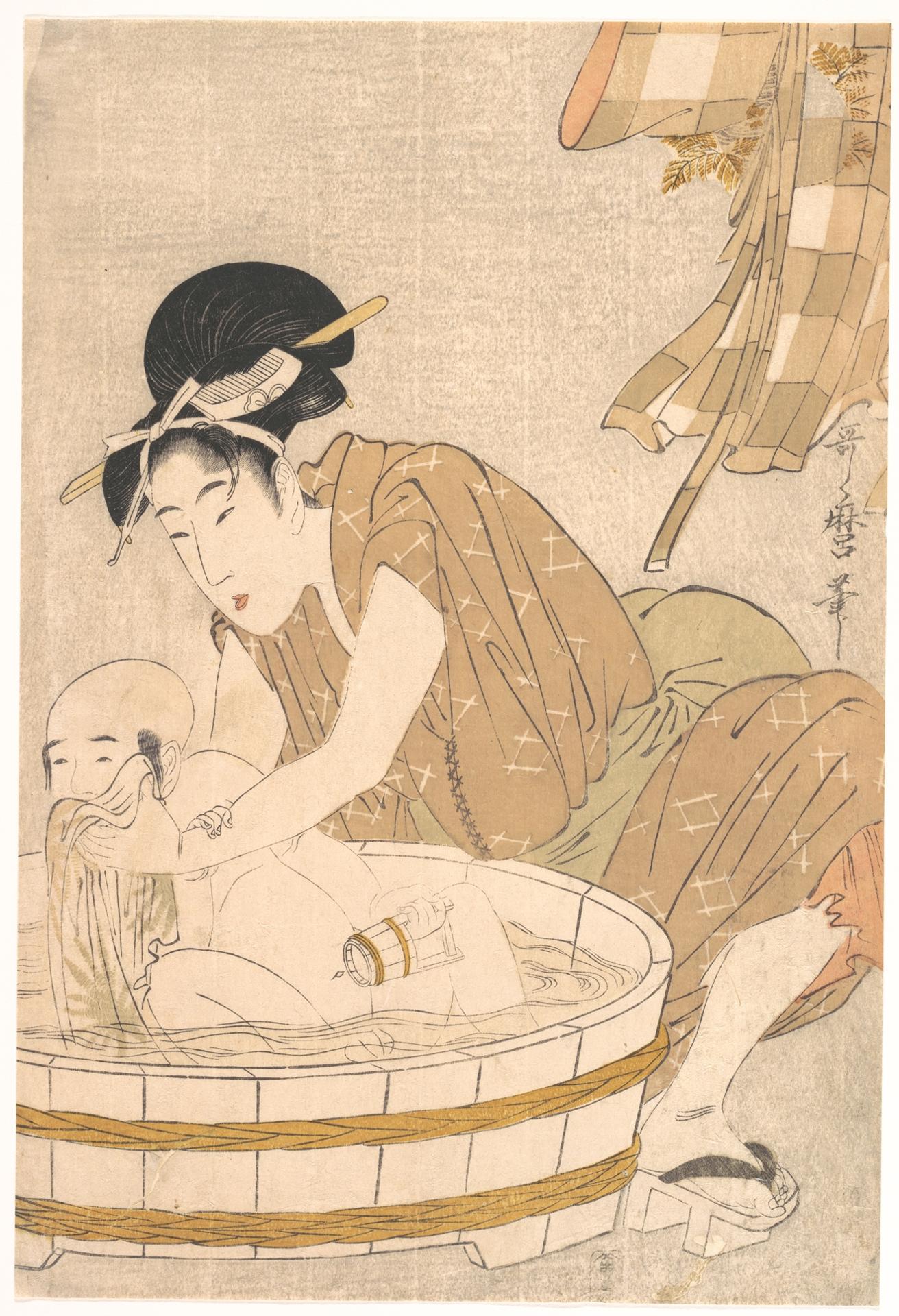
Bathtime (Gyōzui)
Original title: Bathtime (Gyōzui)
kurzbeschreibung
Kitagawa Utamaro made this colour woodblock print around 1801. It shows a woman bathing a child in a wooden tub. The sheet is executed in ink and colour on paper.
Description
Where many bathing scenes of the period push the action forward, Utamaro keeps to a quiet domestic moment: a woman sits on a low seat with a barefoot child on her lap. The child wears a simple garment; the woman holds a small washing brush and cleans the child. Parts of a curtain and a piece of furniture are suggested behind them. The palette stays mostly muted, in browns, whites and greys. Even light runs across the view and gives it a still mood.
Context
The print dates from the late Edo period, when woodblocks of everyday life and pictures of beautiful women (bijinga) were widely popular. Utamaro was part of that development. This sheet belongs to a series devoted to intimate household subjects, a genre that was gaining importance at the time. The mother-and-child interaction reflects the era's regard for family care.
Impact
The calm bearing of the figures and the soft colouring create an intimate, unhurried atmosphere. Crisp contours and the restrained palette give the image a timeless elegance. The viewer is drawn into the quiet business of the bath.
Technique
The colour woodblock (ukiyo-e) combines ink and colour on paper. The process allowed fine lines and multi-coloured areas to be reproduced precisely. Emphasis on contours and shading is typical of Japanese woodblock art of this era.
AI-generated description text
Source: Metropolitan Museum of Art · Public Domain (CC0 1.0)