Washing Day
Original title: Washing Day
kurzbeschreibung
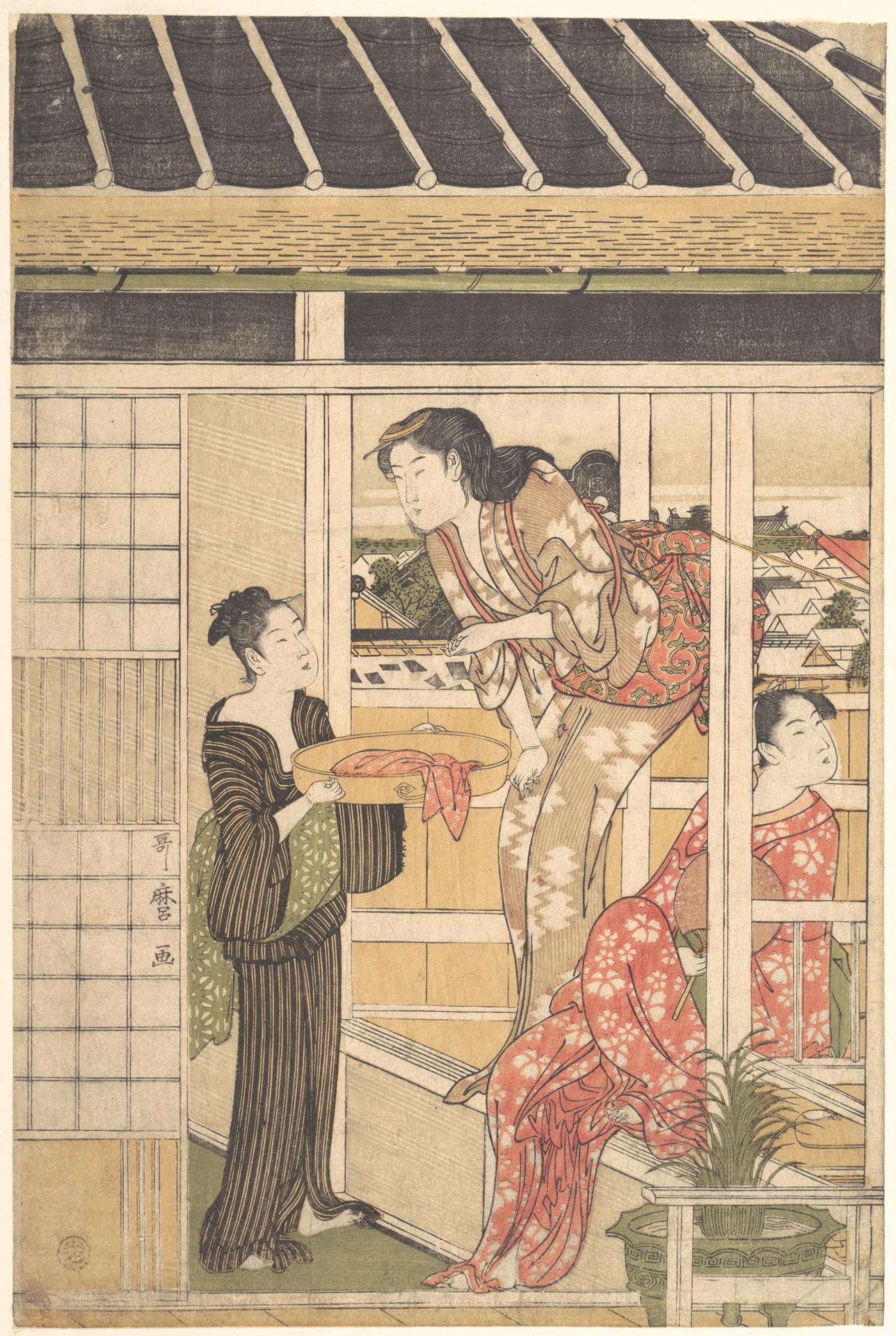
Kitagawa Utamaro turns to a domestic subject in Waschtag, a print from around 1788. Three women dressed in traditional Japanese robes are busy washing clothes indoors. Issued as a woodblock print in ink and colour on paper, the sheet belongs to the familiar themes of ukiyo-e.
Description
A room with a wooden floor and a door standing open to the outside frames three figures. At the middle a woman handles a basin full of laundry, while the woman on the left also carries a vessel and turns her gaze inward. On the right another woman sits on a bench and looks upward. Through the doorway the eye travels to houses and trees. Earth tones dominate the palette, loosened by touches of red and blue; light entering from outside picks out the figures.
Context
The print was made in the late Edo period, when ukiyo-e sheets found a wide audience among city dwellers. Utamaro was known for his portrayals of women, courtesans among them as well as scenes of everyday life. With Waschtag he gave his public a glimpse of a private moment of household life, a subject that was widespread in eighteenth-century Japan.
Impact
Calm and intimacy emanate from the sheet and invite the viewer to share in the women's daily routine. The balanced layout with its clear lines creates an orderly, harmonious mood characteristic of Utamaro's work. Colour and incoming light give the image a warm, natural presence at the same time.
Technique
For this sheet the design was cut into a woodblock and then pulled onto paper in ink and colour. This method allowed several impressions to be made, which helped such images circulate. Crisp contours and flatly applied colours are in keeping with eighteenth-century Japanese colour woodblock printing.
AI-generated description text
Source: Metropolitan Museum of Art · Public Domain (CC0 1.0)