Horse at Trough
Original title: Horse at Trough
kurzbeschreibung
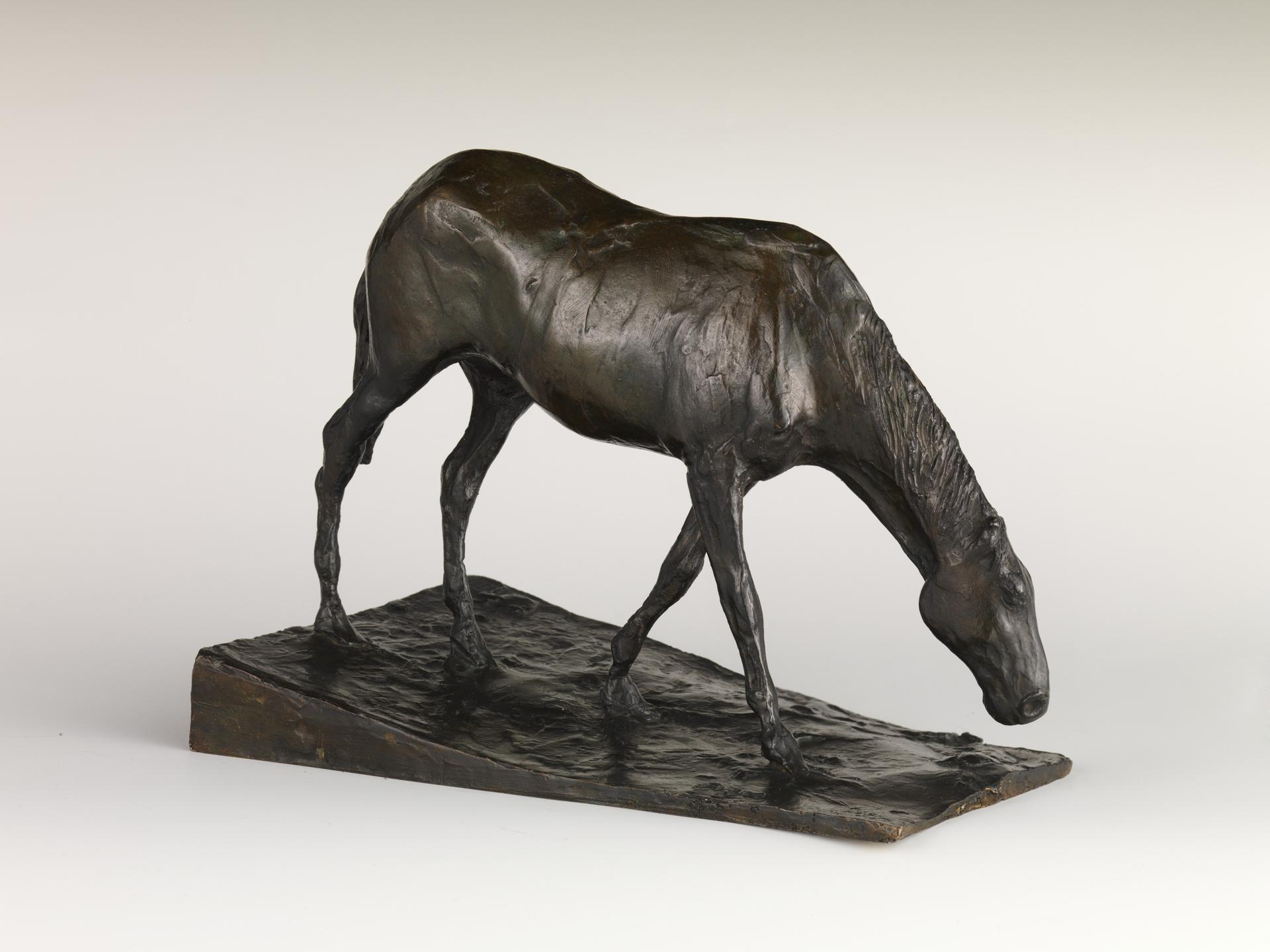
Edgar Degas made the bronze statuette 'Horse at the Manger' probably between 1860 and 1868; it was cast in 1920. It depicts a horse feeding with realistic precision at a manger that is not shown. Measuring 16.5 x 22.5 x 13.5 cm, the work belongs to Degas's early explorations of the horse motif.
Description
The horse assumes a lively pose: its head is lowered, the front legs slightly bent, the hind legs straight, and the flanks appear drawn in. Muscles and folds of skin stand out clearly, indicating a detailed execution. Standing on a flat base, the statuette gains stability and spatial depth. Light falling from the side accentuates contours and surfaces, while shadows further emphasize the forms.
Context
In the 1860s Degas devoted himself intensively to the horse motif; photographs of horses and visits to the racetrack shaped this work. The bronze cast was made only in 1920, after the artist's death, which is typical of many of his wax models that were transferred to bronze posthumously. The statuette is part of a series of small sculptures with which Degas pursued his interest in the anatomy and movement of horses.
Impact
The dynamic pose and the precise rendering of anatomy give the statuette an immediate liveliness. Dark brown patina and rough surface create an earthy, natural aura that draws the viewer into the scene.
Technique
Cast in bronze, the surface shows a rough, structured texture suggesting the lost-wax method. The modeling carefully reproduces musculature and coat, which is especially evident through the lighting when viewed.
AI-generated description text
Source: Metropolitan Museum of Art · Public Domain (CC0 1.0)