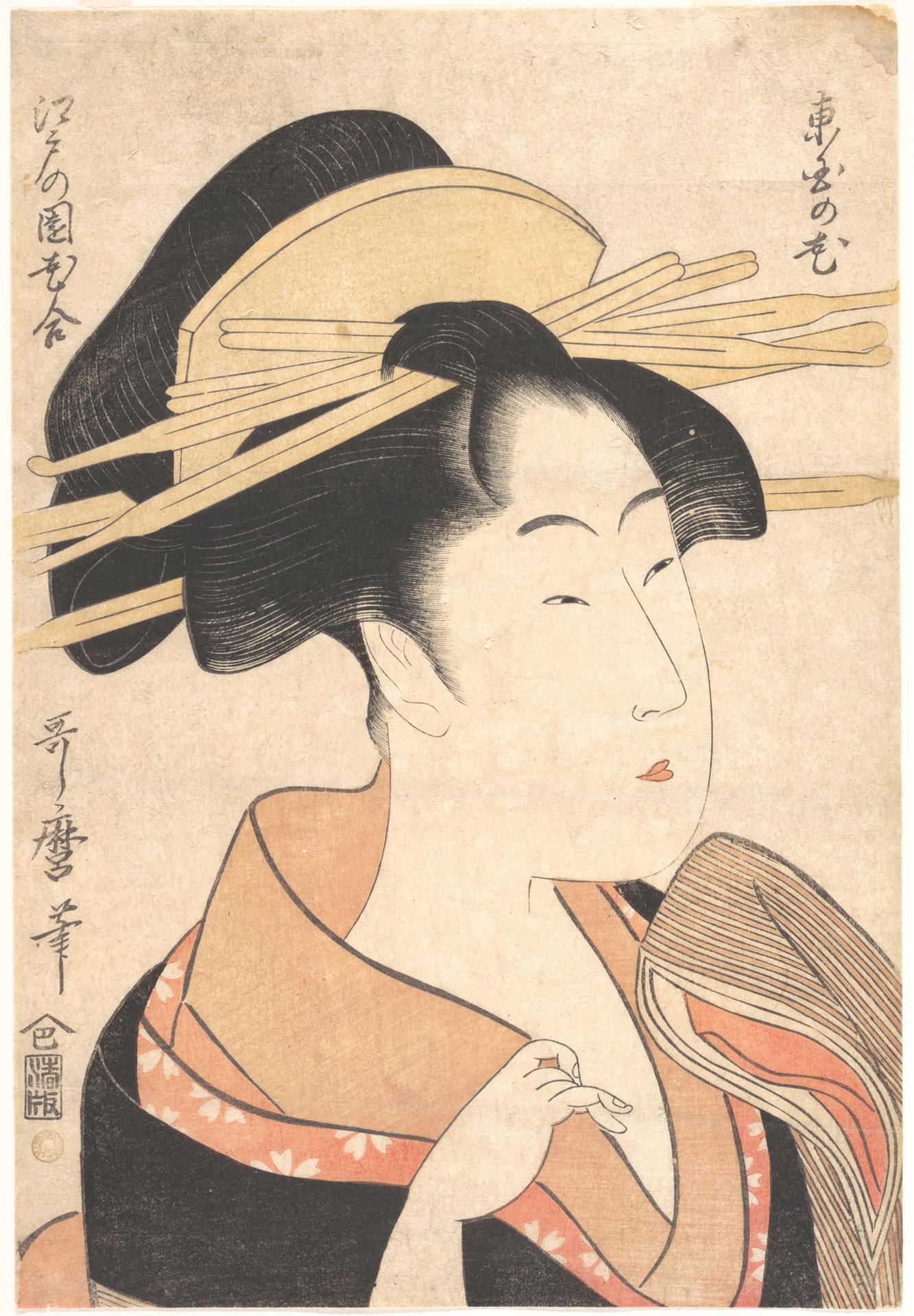
Azumaya no Hana
Original title: Azumaya no Hana
kurzbeschreibung
Kitagawa Utamaro's colour woodblock print "Azumaya no Hana" (Flowers of the Azumaya) dates from around 1790. It presents a woman in traditional Japanese dress against a largely bare pictorial space. The sheet is an ōban print of roughly 33.2 × 22.5 cm, printed in ink and colour on paper.
Description
A single female figure in a patterned kimono carries the image. Her hair is piled up and pinned with bamboo sticks. Large areas of the sheet are left empty, so the eye settles entirely on the figure. Black, white and red govern the palette; fine lines run through hair and garment alike. Characters in the upper section give the title or the artist's name.
Context
The print belongs to the late Edo period, when ukiyo-e was at its height. By subject it counts as bijin-ga, the genre of beautiful women. The Azumaya was a well-known teahouse in the Yoshiwara pleasure district, and the series most likely presents courtesans or teahouse girls. Prints of this kind were prized as collectibles among the urban bourgeoisie.
Impact
Calm and elegance emanate from the sheet, carried by the sparing colour and the clear arrangement. The eye is led by the decorative clothing and the delicate linework, then lingers on the figure's grace. Because the ground stays empty, the atmosphere feels intimate and self-contained.
Technique
The sheet was produced in the ukiyo-e woodblock method, which employed several colour blocks. Ink and colours reached the paper by way of these blocks, with black, red and white predominating. Cleanly cut lines and areas demanded great artisanal precision from the printing blocks.
AI-generated description text
Source: Metropolitan Museum of Art · Public Domain (CC0 1.0)