Woman after a Bath
Original title: Woman after a Bath
kurzbeschreibung
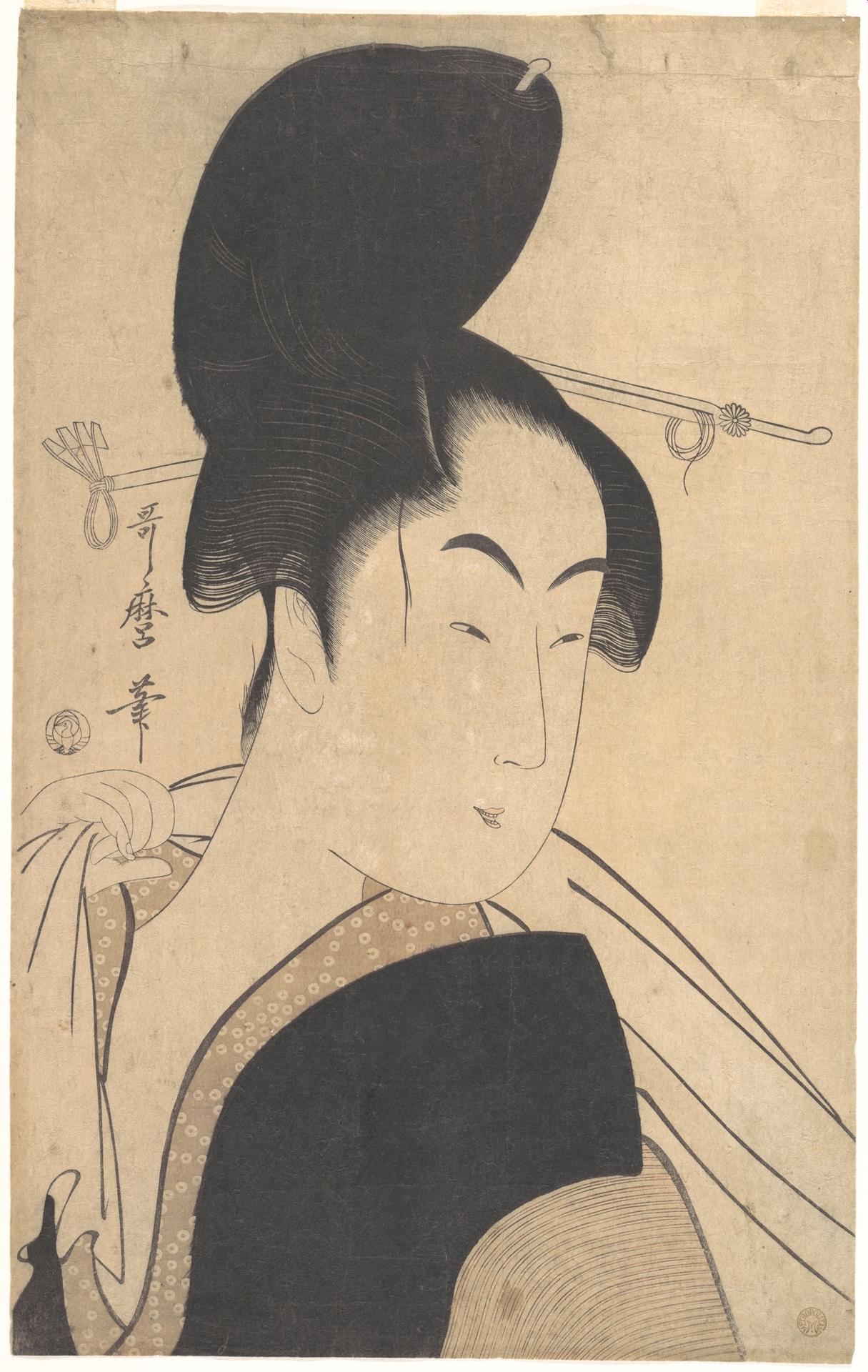
A woman stands just after her bath. Her hair is pinned up and adorned with flowers, and she wears traditional Japanese dress. Kitagawa Utamaro made this color woodblock print around 1795.
Description
An obi and obi-eri mark her attire as that of someone of higher social standing. Black, beige and grey set the tone, with a few delicate accents in the hair and on the obi. Evenly distributed light draws out the contours and surface textures of the print. Precise lines and clearly defined areas of shadow place the style firmly within Edo-period woodblock printing.
Context
Kitagawa Utamaro ranks among the outstanding ukiyo-e artists of eighteenth-century Japan. His career fell in the Edo period, when woodblock prints circulated widely in urban centers such as Edo, present-day Tokyo. He became known above all for his portrayals of women, often from the pleasure quarters, and for his nuanced linework and restrained coloring.
Impact
The print gives off a quiet, familiar mood, capturing a private moment after the bath. Muted colors and clear lines produce an air at once elegant and natural, drawing the viewer straight into the moment.
Technique
Ink and color were applied to paper for this print. The process requires a separate woodblock carved for each color area, printed one after another. Sharp lines and distinct shadows are characteristic of Edo-period woodblock technique.
AI-generated description text
Source: Metropolitan Museum of Art · Public Domain (CC0 1.0)