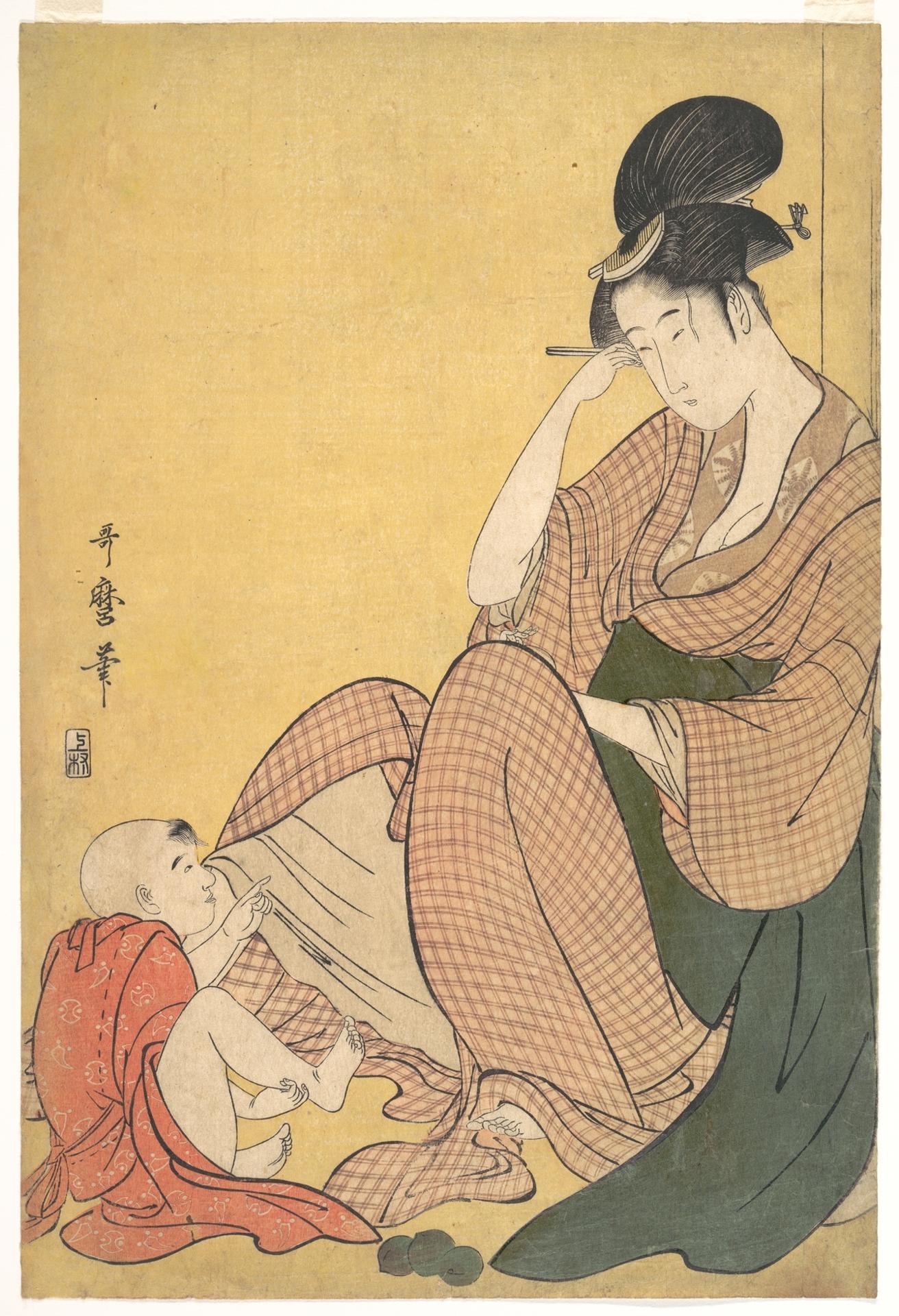
Woman and Child (ca. 1794–95)
Original title: Woman and Child
kurzbeschreibung
Kitagawa Utamaro’s colour woodblock print "Frau und Kind" (around 1794–95) sets itself apart from many mother-and-child pictures of the period by giving the woman an active role: she sits on the floor in traditional dress, brush in hand, writing, while a child in red kneels before her. Executed in ink and colour on paper, the sheet measures 37.8 × 25.4 cm.
Description
Instead of a static portrait, the print presents a woman in a striped robe of brown and green, her upswept hair adorned with ornaments. She holds the brush as if in the middle of writing or drawing. A child dressed in red kneels in front of her, looks up, and points a finger at something. The traditional woodblock style, with muted colours and clear, precise lines, defines the image. A plain background draws attention to the figures; in the upper left, characters appear that may be read as a signature or the artist’s name.
Context
Utamaro ranks among the outstanding artists of Japanese woodblock printing in the Edo period and is known for his portrayals of women. This motif dates from the 1790s, when colour woodblock printing in Japan flourished. The ukiyo-e genre was devoted to scenes of everyday life, especially in the pleasure quarters. Mother and child recur as a subject in Utamaro’s work.
Impact
A calm, intimate mood emanates from this sheet; the interaction between woman and child feels close and tender. The subdued palette and clear lines create a harmonious, almost silent atmosphere. The viewer is drawn into a private scene that comes alive through the precise observation of the figures.
Technique
The work was produced as a woodblock print, printed with ink and colour on paper. In this process, the motif is transferred to woodblocks, which are then inked in different colours one after another and printed onto the paper. Precise contours and flat areas of colour are characteristic of Japanese colour woodblock printing of the late eighteenth century.
AI-generated description text
Source: Metropolitan Museum of Art · Public Domain (CC0 1.0)