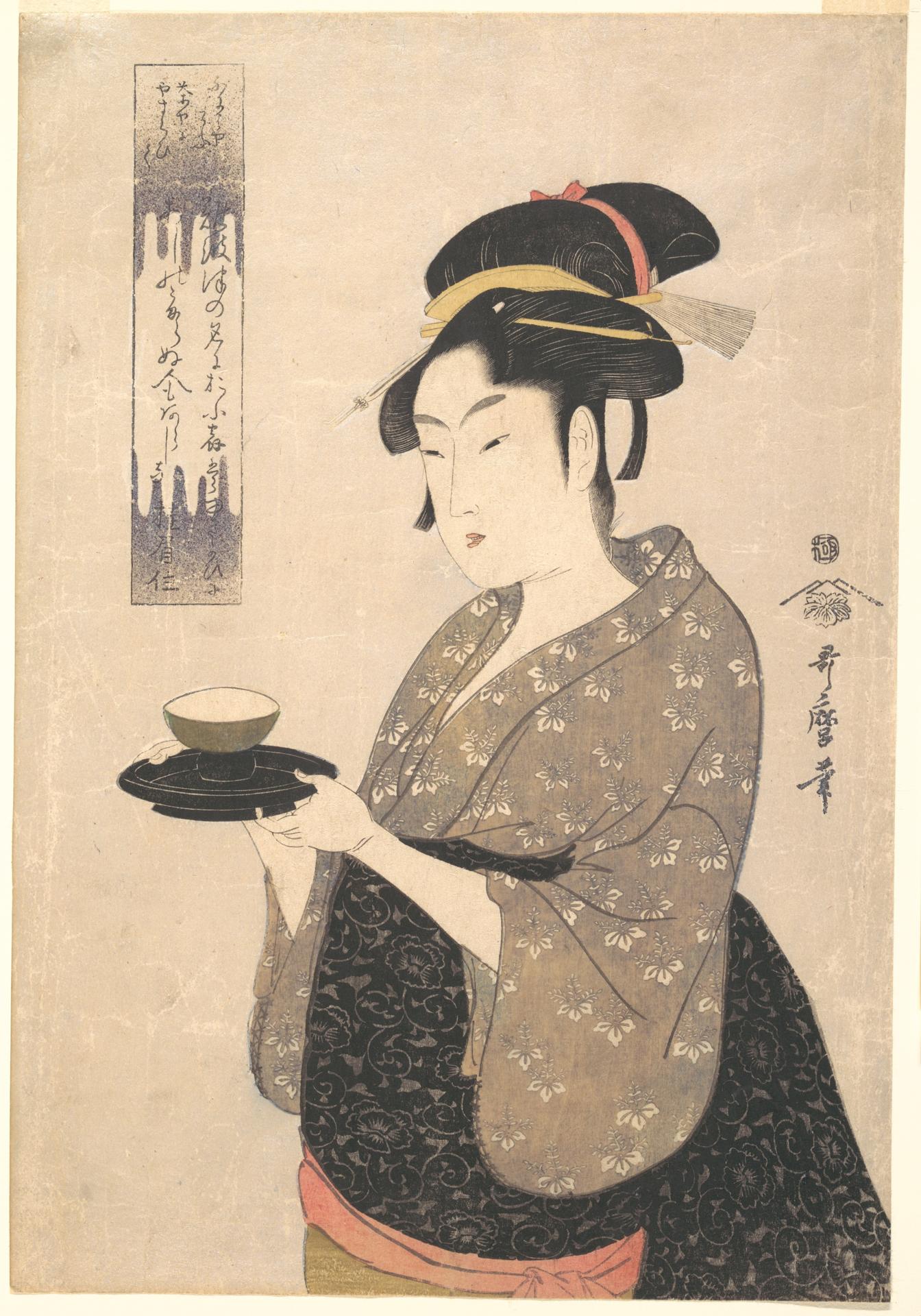
Okita of the Naniwaya Teahouse
Original title: Okita of the Naniwaya Teahouse
kurzbeschreibung
Around 1793 Kitagawa Utamaro portrayed Okita, a young waitress from a teahouse, dressed in traditional clothing and holding a tea bowl on a tray. This colour woodblock print on paper catches her in a quiet moment, far from the bustle of the shop at work.
Description
Layers of hair and ribbons are pinned into an elaborate style. Over a dark underskirt lies a pale outer robe patterned with flowers. Okita looks to the left, her posture calm and turned inward. A vertical cartouche of Chinese characters runs along the edge of the sheet. Muted tones govern the view, while light brings out the face and the details of the fabric.
Context
Utamaro made this print in the Edo period, when woodblock printing had become a mass medium. Bijin-ga, portraits of beautiful women, was one of the leading genres of those years. Okita was a well-known waitress at an Edo teahouse and appears in many ukiyo-e prints. The subject belongs to a series presenting famous beauties of the day, taking up their standing in urban culture.
Impact
A quiet elegance radiates from the sheet, a composure that draws the viewer close to the atmosphere of the teahouse. Clean lines and restrained colour combine into a harmonious, almost meditative whole, characteristic of Utamaro's work.
Technique
The sheet was printed as a nishiki-e, a multicolour woodblock print in ink and colours on paper. Several blocks were used for the different tones, one for each colour. The precise drawing of the lines and the soft colour transitions attest to the great care of this craft.
AI-generated description text
Source: Metropolitan Museum of Art · Public Domain (CC0 1.0)