Woman and Child (ca. 1795)
Original title: Woman and Child
kurzbeschreibung
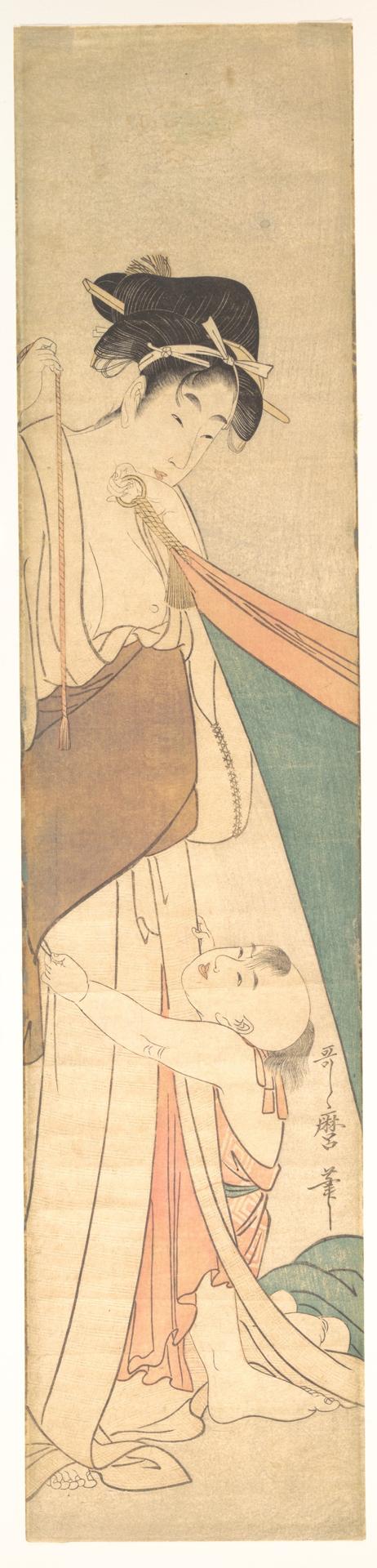
Kitagawa Utamaro made this color woodblock print around 1795, titled "Frau und Kind" (Woman and Child). It shows a woman in traditional Japanese dress bending toward a child lying on the ground. The mother-child motif is characteristic of Utamaro's scenes of everyday life.
Description
An elaborate, large headdress and a long, colorful robe define the woman's appearance. Her gaze is directed downward as she touches the child, who lies on its back wrapped in a long garment. Beige, pink, and blue dominate the mostly pastel palette. Even light spreads across the surface without strong shadows. Japanese characters appear at the lower right, likely the artist's signature.
Context
The print dates from the Edo period, an era of cultural flourishing and lively urban life in Japan. Utamaro was known for his pictures of women, including courtesans and mothers with children. Woodblock prints like this were produced in series and remained affordable for a broad public. The mother-and-child motif was widely popular and reflected ideals of care and family life.
Impact
The scene feels quiet and intimate; the attentiveness between woman and child gives the image emotional depth. The pastel palette and clear lines create a harmonious yet elegant mood. The viewer becomes a silent observer of a private moment.
Technique
Woodblock print with ink and color on paper. In this process, the design is cut into woodblocks, which are then inked and printed onto paper. Clear contours and flat areas of color are characteristic of late eighteenth-century Japanese color woodblock printing.
AI-generated description text
Source: Metropolitan Museum of Art · Public Domain (CC0 1.0)