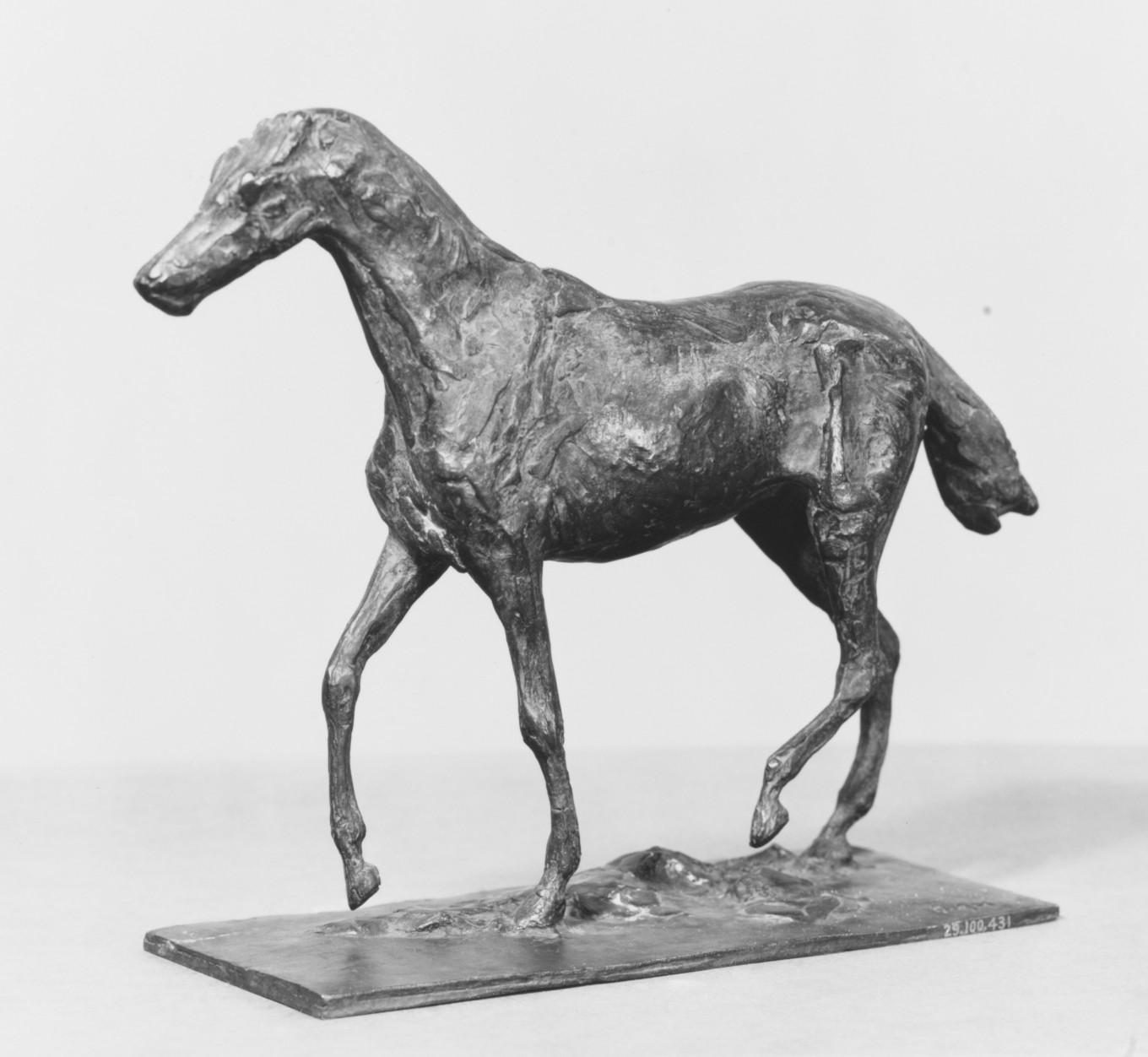
Horse Walking (modeled probably before 1881, cast 1920)
Original title: Horse Walking
kurzbeschreibung
Edgar Degas's bronze statuette 'Gehendes Pferd' (Horse Walking) was likely modeled before 1881 and cast in bronze in 1920. It depicts a horse in mid-stride on a flat base. The work belongs to Degas's series of equestrian sculptures.
Description
A horse in dynamic gait, its musculature clearly defined. The bronze has a silvery tone, and light falls evenly, creating almost no shadow. The layout is spare: just the horse on a flat base, with no other elements.
Context
During this period Degas devoted himself intensively to depictions of horses, inspired by visits to the racetrack and photographs of equine movement. The model was probably made before 1881; the cast was produced posthumously in 1920 as part of the serial production of Degas's wax sculptures in bronze. This work belongs to a group of horse sculptures that demonstrate his interest in anatomical accuracy and motion.
Impact
From the first glance, the horse's lively posture captivates, reinforced by the muscular modeling. The calm, even surface and reduced arrangement direct attention to the animal's form and movement. The result is a concentrated, quiet effect.
Technique
Cast in bronze, the material preserves the finest details of the modeling. The cast followed a wax model that Degas originally made. The surface shows an even patina and renders the anatomical structure precisely.
AI-generated description text
Source: Metropolitan Museum of Art · Public Domain (CC0 1.0)