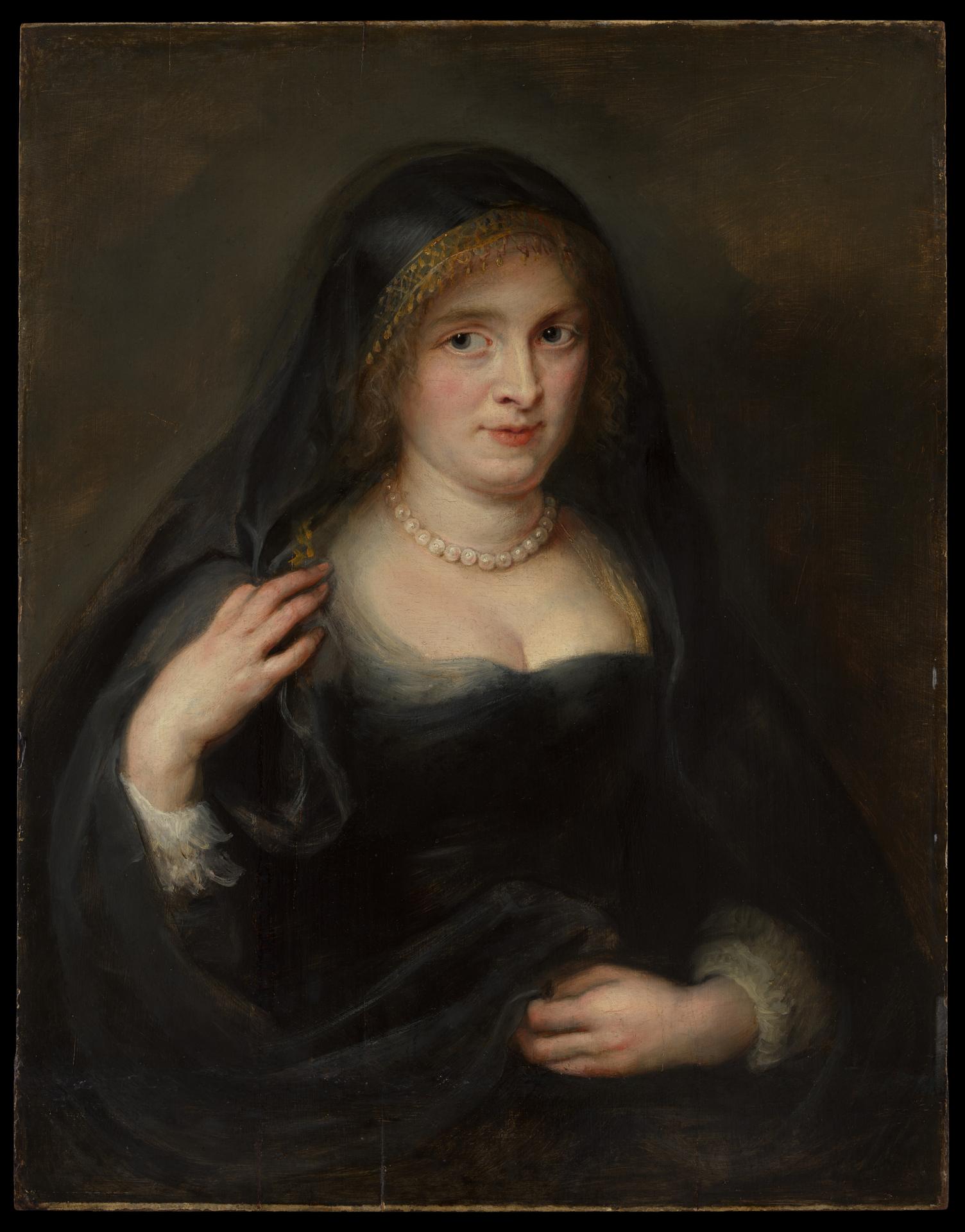
Portrait of a Woman, Probably Susanna Lunden (Susanna Fourment, 1599–1628)
Original title: Portrait of a Woman, Probably Susanna Lunden (Susanna Fourment, 1599–1628)
kurzbeschreibung
A half-length portrait of a young woman, painted by Peter Paul Rubens in oil on wood around 1625–1627. The sitter is thought to be Susanna Fourment, the artist's sister-in-law. What stands out is the precise rendering of her clothing and jewelry against a dark background.
Description
She wears a dark gown with a high collar, a black veil cap adorned with a yellow ribbon. Curly hair falls over her shoulders, and a pearl necklace encircles her neck. Her right hand holds the veil, while her left rests before her body. The background remains dark and indistinct, making the figure emerge. Light from the side highlights contours and the texture of fabric and hair.
Context
The portrait was likely made in Antwerp, where Rubens worked as a sought-after portraitist for the nobility and bourgeoisie. Susanna Fourment was the sister of Hélène Fourment, whom Rubens married in 1630. The sitter's identity is not entirely certain, but stylistic features point to the 1620s. The picture belongs to a group of intimate family portraits Rubens produced during that period.
Impact
The dark background and side lighting give the portrayal an immediate, composed quality. The careful execution of fabric, pearls, and hair lends the image an almost tactile sensuality. The woman's calm posture conveys dignity and reserve.
Technique
Rubens used oil paint on oak panel, a common support in Flanders for cabinet pieces. He applied fine glazes for the skin tones, while the lighter areas of fabric are handled with thicker paint. A 9.5 cm strip of wood added at the bottom edge suggests a later change in format.
AI-generated description text
Source: Metropolitan Museum of Art · Public Domain (CC0 1.0)