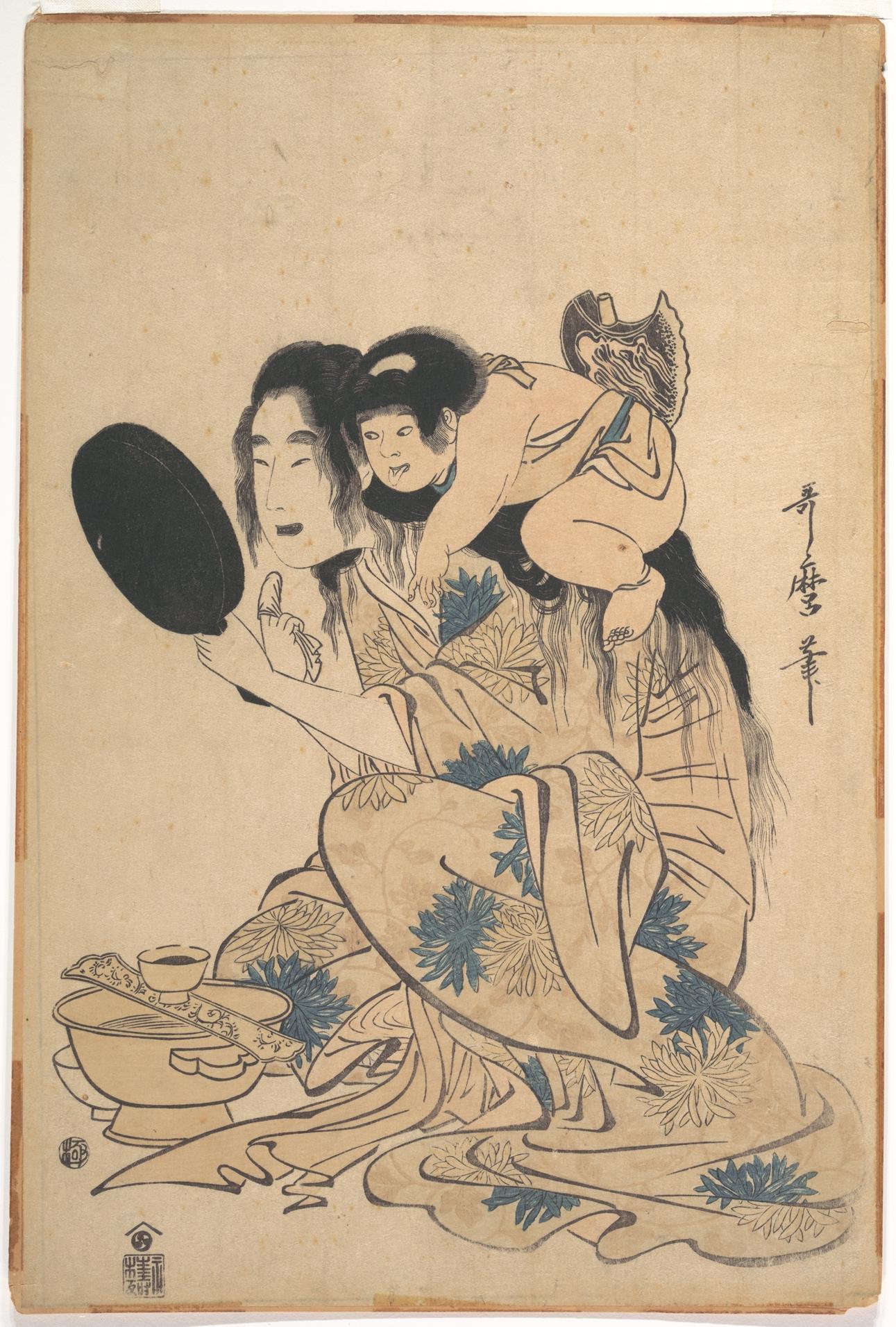
Yamauba Blackening Her Teeth, with Kintarō
Original title: Yamauba Blackening her Teeth, with Kintarō
kurzbeschreibung
Seated before a mirror, Yamauba blackens her teeth while little Kintarō clings to her back. Kitagawa Utamaro captured this episode from Japanese folklore around 1795 in a colour woodblock print (nishiki-e), ink and colour on paper. The sheet measures 37.5 x 24.8 cm, the standard ōban format.
Description
A woman in traditional Japanese dress holds a mirror up and tends to her teeth. On her back a small boy, also traditionally dressed, holds on tight and looks straight ahead. Her long black hair is gathered into a knot. On the floor in front of her sit a bowl of tooth-blackening paste and a mirror. Blues and browns dominate the palette, as was usual for prints of this period. Woman and child occupy the middle of a symmetrically balanced layout; the light falls evenly, with no visible shadows, suggesting an interior.
Context
Utamaro made this print during the Edo period, a phase of intense cultural flourishing in Japan. The tale of Yamauba and Kintarō was a well-known legend, taken up often in art and literature. The woodblock belongs to the ukiyo-e tradition, which pictured everyday scenes alongside figures from myth and popular belief. Dating from around 1795, it falls in a period when Utamaro was known for his portrayals of women and children.
Impact
Quiet and intimate, the scene conveys care and domestic closeness. The symmetrical arrangement and clear outlines give the image a balanced calm, while the contrast of blue and brown produces a subtly harmonious colour effect.
Technique
Ink and colour were printed on paper; this method of colour woodblock printing (nishiki-e) allowed the fine lines and precise colour reproduction characteristic of Utamaro's work. The ōban format was a common size for single sheets in ukiyo-e production.
AI-generated description text
Source: Metropolitan Museum of Art · Public Domain (CC0 1.0)