Sankatsu and Hanshichi
Original title: Sankatsu and Hanshichi
kurzbeschreibung
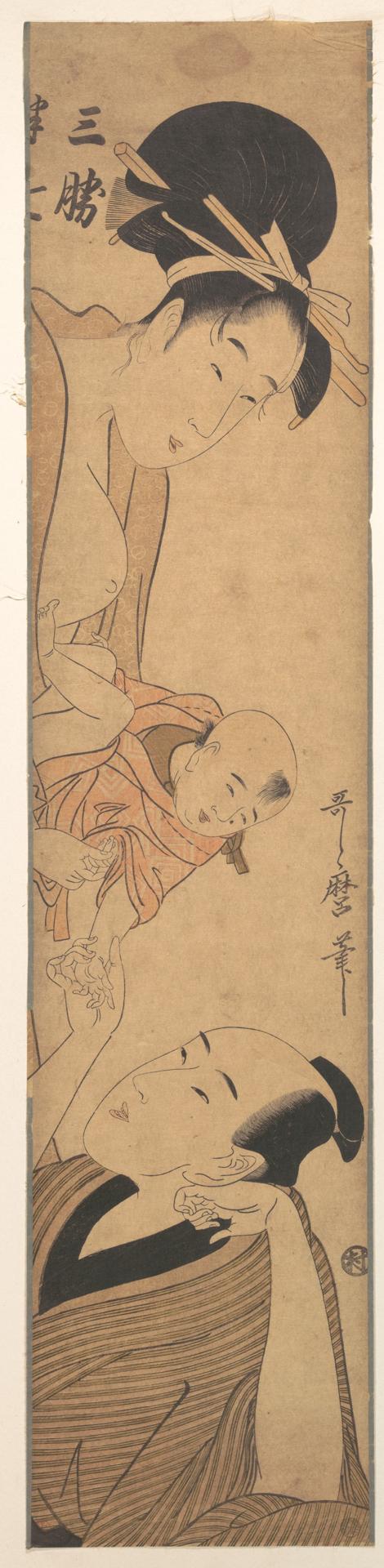
Kitagawa Utamaro's colour woodblock print from around 1800 is titled Sankatsu and Hanshichi. It presents three figures in an intimate interior, rendered in ink and colour on paper. The sheet belongs to the narrow vertical format characteristic of Utamaro's ōkubi-e and genre scenes.
Description
A woman in traditional dress holds a barefoot child on her lap in the foreground; beneath her sits another figure, calm and thoughtful, likewise in traditional clothing. The figures are drawn realistically, and the muted colours create a distinct contrast between light and dark. Even light falls across the scene without visible shadows, suggesting an indoor setting. The vertical arrangement centres the figures and emphasises their interaction.
Context
Utamaro was among the leading artists of ukiyo-e in the late eighteenth century, known for his portrayals of women and scenes from the pleasure quarters. This print was made around 1800, when woodblock prints circulated widely as a mass medium in Japan. The narrow hosoban format was often used for portraits and intimate scenes.
Impact
A quiet, intimate mood emanates from the print, carried by the central group of figures and the subdued colours. The vertical layout draws the eye to the relationships between the people and evokes a reflective atmosphere.
Technique
The work was produced as a woodblock print with ink and colour on paper. Several colour blocks were applied in succession to create the fine lines and areas of colour. Measuring about 62.2 cm in height and 14.9 cm in width, it conforms to the narrow vertical format common in Japanese prints.
AI-generated description text
Source: Metropolitan Museum of Art · Public Domain (CC0 1.0)