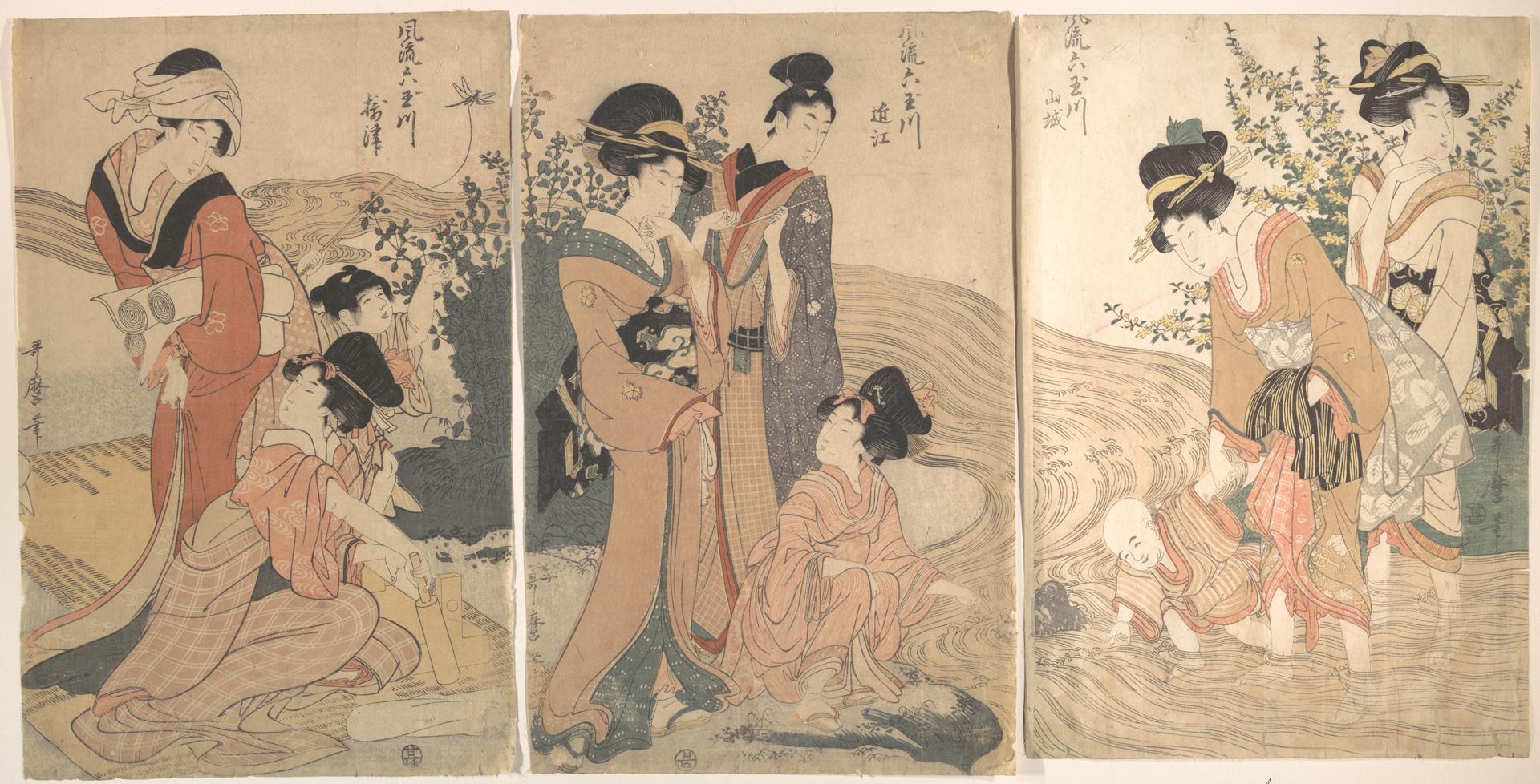
Women and Children on the Banks of a Stream
Original title: Women and Children on the Banks of a Stream
kurzbeschreibung
This triptych by Kitagawa Utamaro dates from the Edo period: women and children linger by the water in a rural setting. Three woodblock prints in ink and colour on paper join to form a single scene. The exact year of production has not come down to us.
Description
Across the three panels, groups of women with children stand or kneel at the bank of a stream. The women wear kimonos and carefully dressed hair; some carry parasols or bowls. Down by the water the children squat and play. Trees and blossoms frame the picture space and reinforce the closeness to nature. The figures occupy the foreground, vegetation spreads out behind them, and the arrangement feels balanced. Earth tones dominate the palette, with accents of red and blue.
Context
Utamaro ranks among the outstanding masters of ukiyo-e in eighteenth-century Japan, best known for his portrayals of women, often from the pleasure quarters. Woodblock prints circulated widely during the Edo period, and this sheet likely belongs to those years. What it offers is an idealised rural idyll, a subject valued in the art of the time.
Impact
A balanced layout and muted earth tones create a calm, conciliatory mood. Figures and nature are described in such detail that the eye likes to linger. Crisp outlines and restrained colour give the print a timeless, refined grace.
Technique
The triptych was printed by woodblock: designs were transferred from woodblocks to paper in ink and colour. Precise linework and carefully matched colours characterise ukiyo-e printing. At roughly 37.2 x 23.9 cm per sheet, the three panels remain relatively compact.
AI-generated description text
Source: Metropolitan Museum of Art · Public Domain (CC0 1.0)