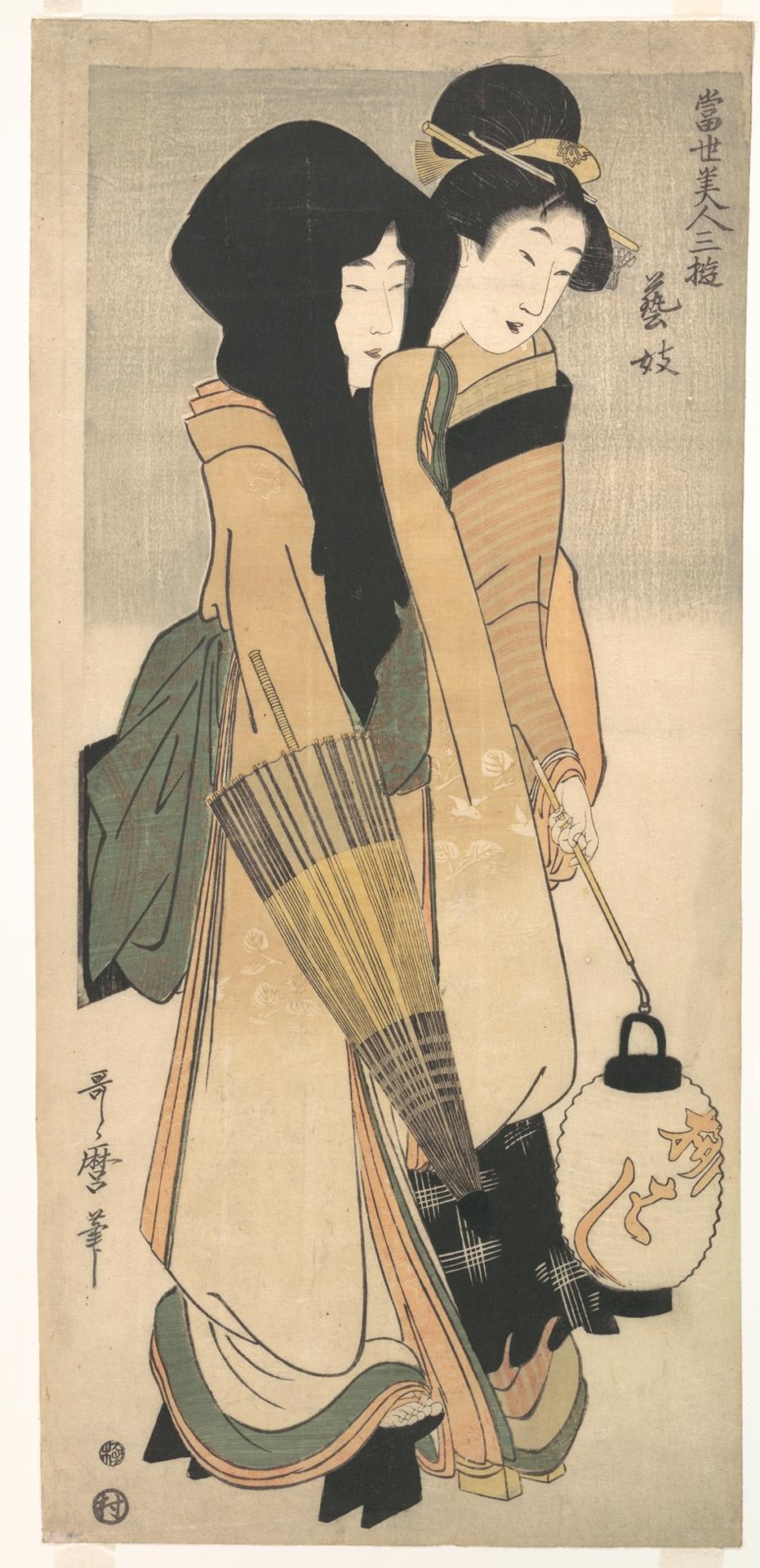
Geisha, from the series Three Amusements of Contemporary Beauties (Tōsei bijin san'yū: Geigi)
Original title: “Geisha” from the series Three Amusements of Contemporary Beauties (Tōsei bijin san’yū: Geigi)
kurzbeschreibung
Kitagawa Utamaro's print Geisha belongs to the series Three Amusements of Contemporary Beauties and dates from around 1800. It is a colour woodblock print with ink on paper, showing two women in traditional Japanese dress walking side by side.
Description
Two women in traditional Japanese dress step forward together. The left figure wears a wide black hat, a kimono with a pale obi and a green sash, and carries a large fan in her left hand. The right figure has a smaller, gold-decorated hat, a kimono with a brown obi, and holds a small round lantern in her right hand. Both have their hair done up in traditional styles. A plain grey sky fills the background; Chinese characters for the title and series appear at the upper right, and a signature at the lower left. The palette stays muted, relying on brown, green, white and black, with clear outlines and even lighting.
Context
Around 1800, when ukiyo-e prints were widely circulated in Edo (present-day Tokyo), this series was made. It gathers contemporary beauties enjoying different pleasures and brings the geisha into focus as a central figure of entertainment culture. Utamaro was known for his pictures of women from the pleasure quarters, often capturing everyday moments.
Impact
The print feels calm and elegant, carried by clear lines and subdued colour. The two women make a relaxed everyday scene, given a refined touch by the carefully observed details of clothing and accessories.
Technique
As an ukiyo-e woodblock print, ink and colours were printed on paper. The method allows sharp outlines and even colour application, characteristic of Japanese printmaking of the period. The use of several tones shows the printer's skill in fine gradation.
AI-generated description text
Source: Metropolitan Museum of Art · Public Domain (CC0 1.0)