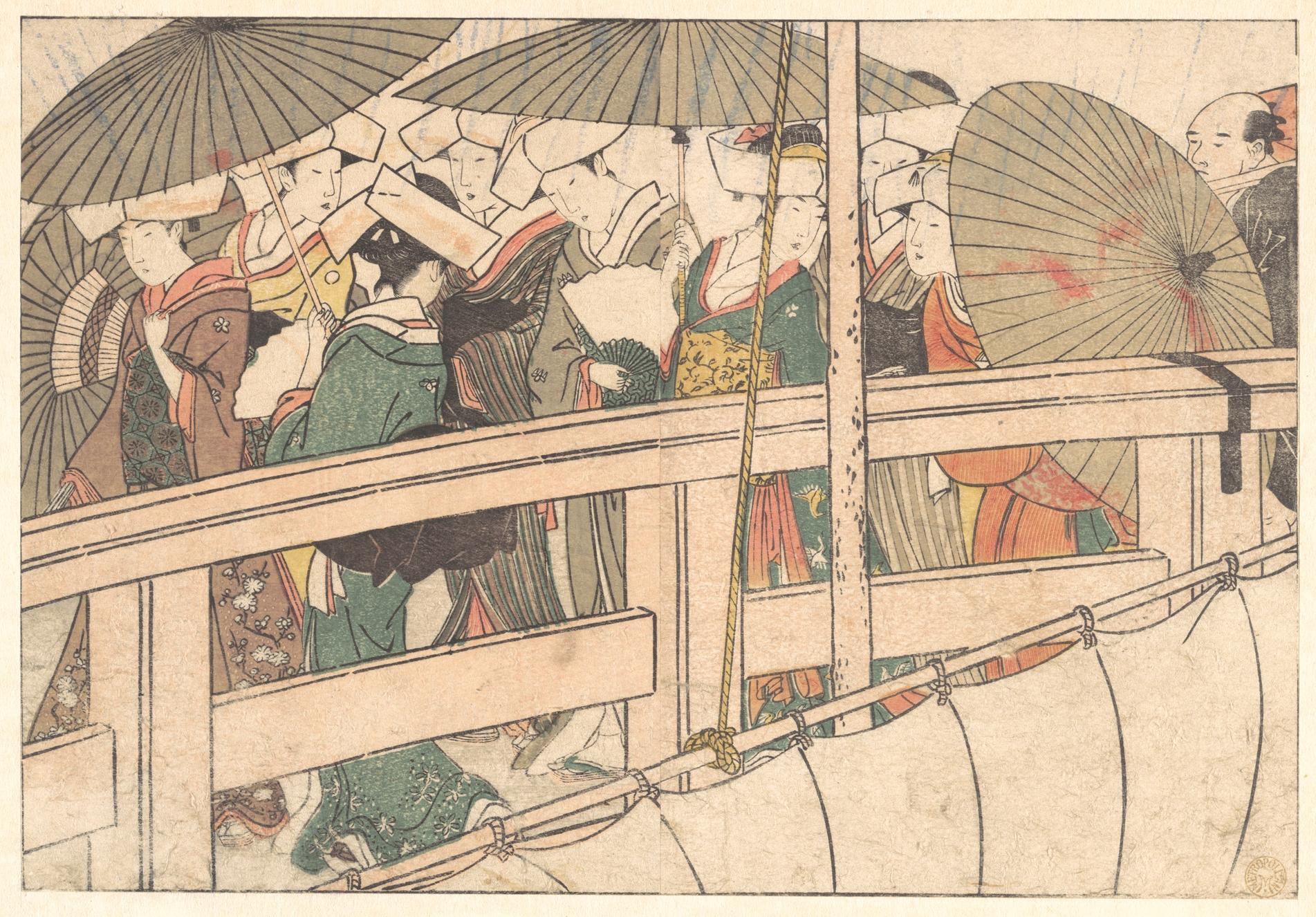
Women on a Bridge, from the illustrated book Flowers of the Four Seasons
Original title: Women on a Bridge, from the illustrated book Flowers of the Four Seasons
kurzbeschreibung
This print by Kitagawa Utamaro, dated 1801, comes from the portfolio 'Flowers of the Four Seasons'. It presents a group of women on a wooden bridge, all dressed in kimonos and holding parasols, which make them pause in various poses. The image was executed in ink and color on paper.
Description
On a wooden bridge with a pillar rising at its center, the women are spread out; their garments show different colors and patterns. Each holds a large parasol turned to the side, revealing numerous ribs. Poses and expressions vary: some look into the distance, others turn toward the viewer. Behind the figures, other staff are hinted at, including a man with a parasol. Earth tones and blues dominate the palette, contours stand out sharply, and the color areas remain clearly separated.
Context
In 1801 Utamaro contributed this print to the portfolio 'Flowers of the Four Seasons', a collaborative work by several artists. He was famous above all for his depictions of women, especially scenes from the pleasure district of Edo. By this late phase of his career he was long established. Everyday scenes with women belong to the genre of bijin-ga, which was widespread within ukiyo-e art.
Impact
The calm distribution of the figures and the even light give the print a harmonious and balanced appearance. Because the parasols are held to the side, a rhythmic structure emerges that guides the eye across the paper. Clear lines and a restrained color scheme lend the print a quietly stylized aesthetic.
Technique
For this print the design was cut into woodblocks and then transferred to paper with ink and colors. This produces sharp contours and distinctly separated color areas, characteristic of ukiyo-e. The dominance of earth tones and blues matches the usual palette of Japanese woodblock printing around 1800.
AI-generated description text
Source: Metropolitan Museum of Art · Public Domain (CC0 1.0)