Prancing Horse
Original title: Prancing Horse
kurzbeschreibung
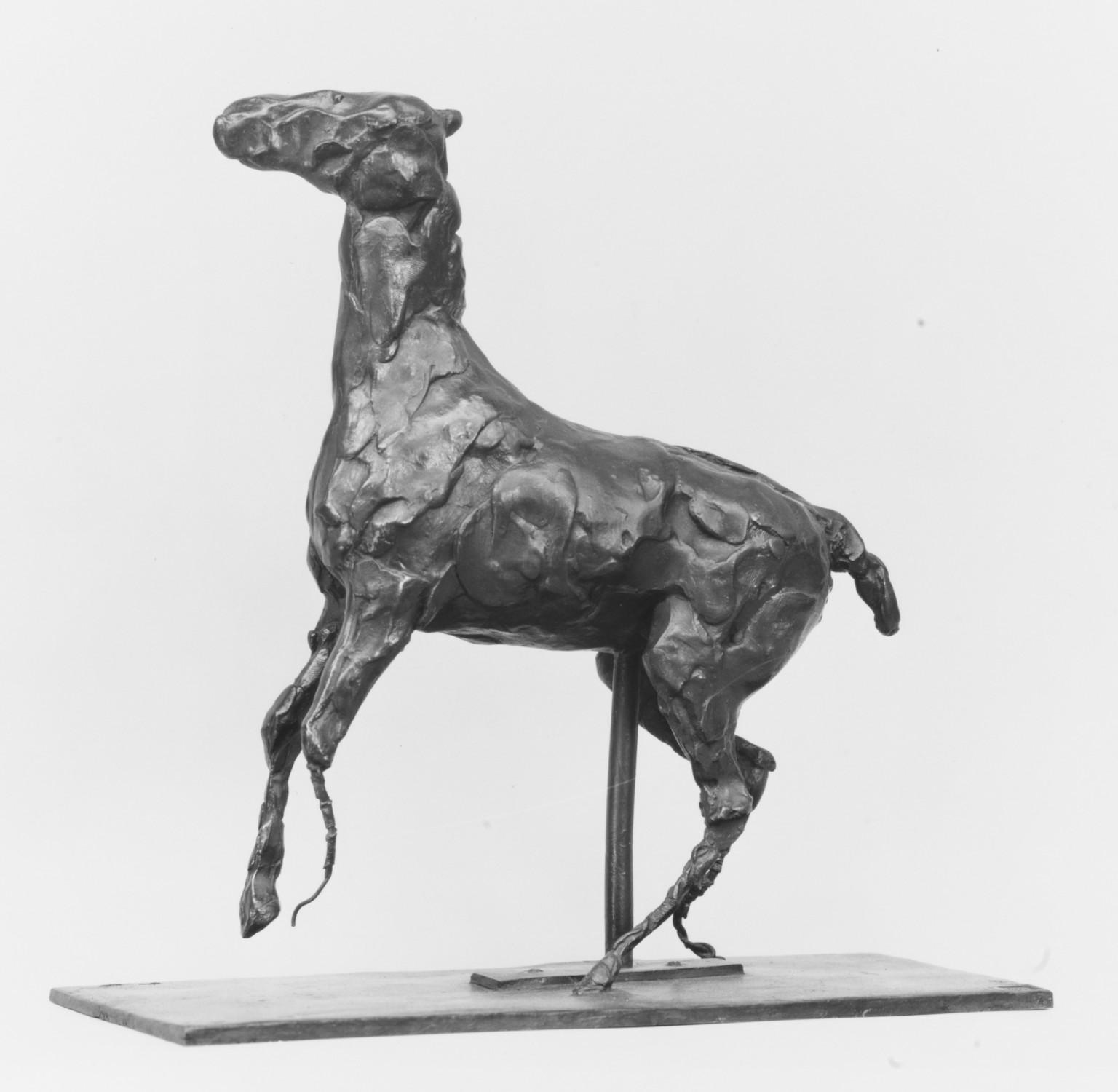
Edgar Degas probably modeled this horse before 1885; it was cast in bronze in 1920. The animal is shown in mid-gallop, head lifted high, one hind leg raised, front hooves planted. The sculpture captures movement and energy, with a detailed, physical treatment of the body.
Description
A horse in a dynamic galloping pose: head up, one hind leg lifted, while the front hooves touch the ground. The musculature is modeled with a fluid, almost tactile quality, and precise details emphasize the anatomy. The figure stands on a simple base with a supporting metal armature. The surface appears uniform in bronze-grey; side light picks out contours and forms. The neutral background directs attention entirely to the animal.
Context
During this period Degas was deeply engaged with equine subjects, which grew out of his paintings and drawings. The model was probably made before 1885, and the cast was made posthumously in 1920. Degas often worked on his sculptures for years, reworking them repeatedly without exhibiting them during his lifetime. The bronze casts were produced only after his death, in collaboration with the founder Adrien-Aurélien Hébrard.
Impact
The asymmetrical pose and emphasis on movement create an immediate sense of dynamism and liveliness. Flowing contours and the physical musculature give the work an almost impressionistic lightness that captures the moment of the gallop. The side lighting enhances the spatial effect and makes the bronze surface appear alive.
Technique
Cast in bronze, a material Degas preferred for his sculptures in order to capture fine details and movement. The surface shows an even patina in bronze-grey, resulting from working and the casting process. Base and metal armature provide stability and are part of the sculpture's presentation.
AI-generated description text
Source: Metropolitan Museum of Art · Public Domain (CC0 1.0)