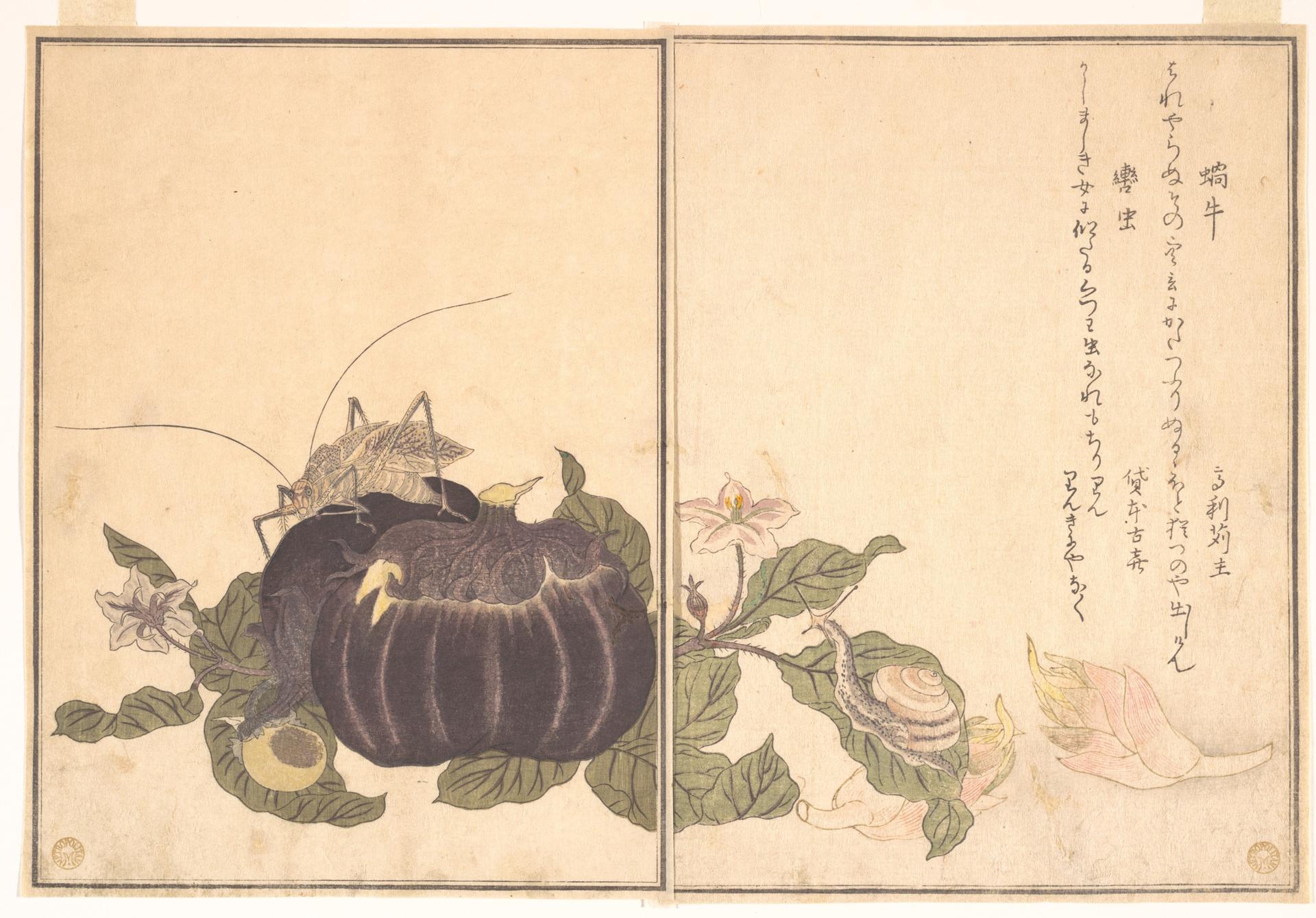
Land Snail (Katatsumuri); Giant Katydid (Kutsuwamushi), from the Picture Book of Crawling Creatures (Ehon mushi erami)
Original title: Land Snail (Katatsumuri); Giant Katydid (Kutsuwamushi), from the Picture Book of Crawling Creatures (Ehon mushi erami)
kurzbeschreibung
Unlike many nature studies of the same period, this double-page spread from Kitagawa Utamaro's woodblock-printed book Ehon mushi erami (1788) does not focus on a single creature but places a land snail and a giant grasshopper side by side. Ink and color on paper, measuring 26.7 by 18.4 centimeters. Here, close observation of nature is combined with a decorative arrangement.
Description
On the left half, a large land snail creeps over a dark, grooved object that resembles a gourd, surrounded by leaves and blossoms. To the right, a powerful grasshopper sits on a leafy shoot with flowers. Green and brown tones dominate the sheet, as is typical of woodblock prints. Clear, detailed contours and an even, rather flat light define the view. A Japanese text block on the right complements the motif.
Context
The book was produced in Edo, present-day Tokyo, in 1788, in the middle of the Edo period, when woodblock printing flourished. Ehon, or illustrated books, often combined nature studies with poetic or encyclopedic texts. Utamaro became known primarily for bijin-ga, pictures of beautiful women; here his interest in nature comes to the fore. The work belongs to a series that captures insects and other small creatures with scientific precision.
Impact
Precise observation and a carefully considered layout create a calm, reflective mood. The clear contours and coordinated colors give the animals an almost monumental presence, while the leaves and blossoms provide a loosening effect. Standing before the print, one can discover the details of nature without the tone becoming instructive.
Technique
To make the print, the design was cut into woodblocks and then transferred to paper with ink and color. Multiple layers of color produce the subtle gradations of green and brown. Sharp contours and flatly applied colors characterize the Japanese printmaking technique of the late eighteenth century.
AI-generated description text
Source: Metropolitan Museum of Art · Public Domain (CC0 1.0)