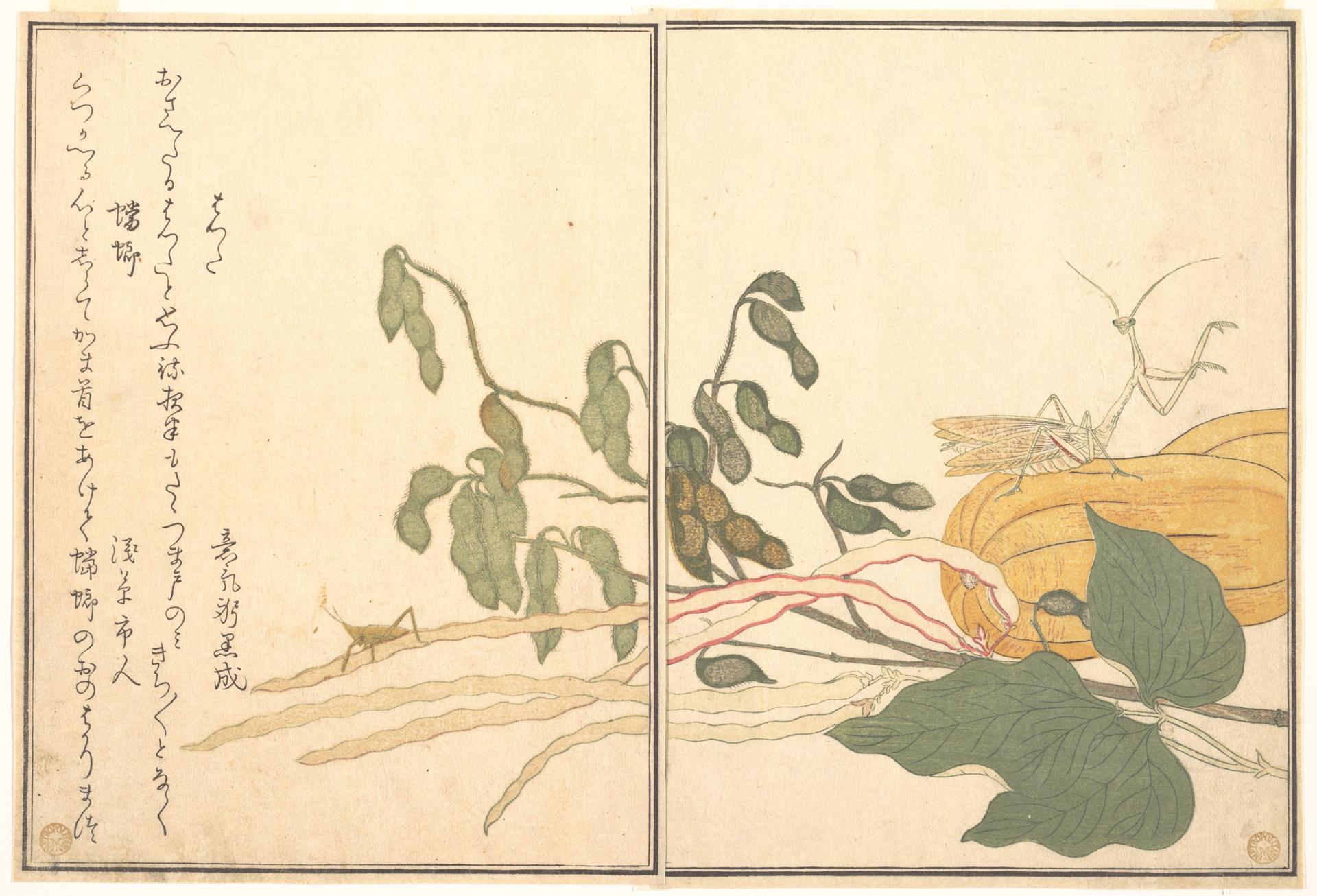
Cone-headed Grasshopper or Locust, (batta); Praying Mantis (Tōrō or Kamakiri), from the Picture Book of Crawling Creatures (Ehon mushi erami)
Original title: Cone-headed Grasshopper or Locust, (batta); Praying Mantis (Tōrō or Kamakiri), from the Picture Book of Crawling Creatures (Ehon mushi erami)
kurzbeschreibung
This double-page spread comes from Kitagawa Utamaro's Ehon mushi erami (Picture Book of Crawling Creatures), published in 1788. It shows a grasshopper and a praying mantis in their natural surroundings, rendered as a woodblock print in ink and color on paper. Here, close observation of nature and artistic form flow into one another.
Description
On the left page, an insect with a conical head squats on a root, while beside it a branch bears leaves and fruit. The right page belongs to a praying mantis on a pumpkin, which has settled on a leafy branch with another fruit. Earth tones, green leaves, and brown branches dominate the color scheme. Japanese characters appear on both pages, likely as labels or a title. Even light brings out the details of insects and plants with clarity.
Context
Ehon mushi erami was created in 1788 and belongs to several illustrated books by Utamaro devoted to natural phenomena. In the late Edo period, interest in natural history grew, along with an appreciation for small creatures in Japanese art. The series shows insects and other small animals in their habitat and stands in the tradition of kusa-e, pictures of plants.
Impact
Calm emanates from these pages: the eye follows the animals, which appear almost monumental in their surroundings, and lingers on precisely observed details. Scientific accuracy and aesthetic design meet, creating a mood of quiet contemplation and admiration for nature.
Technique
The sheet was printed as a woodblock print in ink and color on paper. The color woodblock print (nishiki-e) allowed for fine lines and precise areas of color, as seen in the details of the insects and plants. Natural tones and clear contours point to the high quality of late eighteenth-century woodblock art.
AI-generated description text
Source: Metropolitan Museum of Art · Public Domain (CC0 1.0)