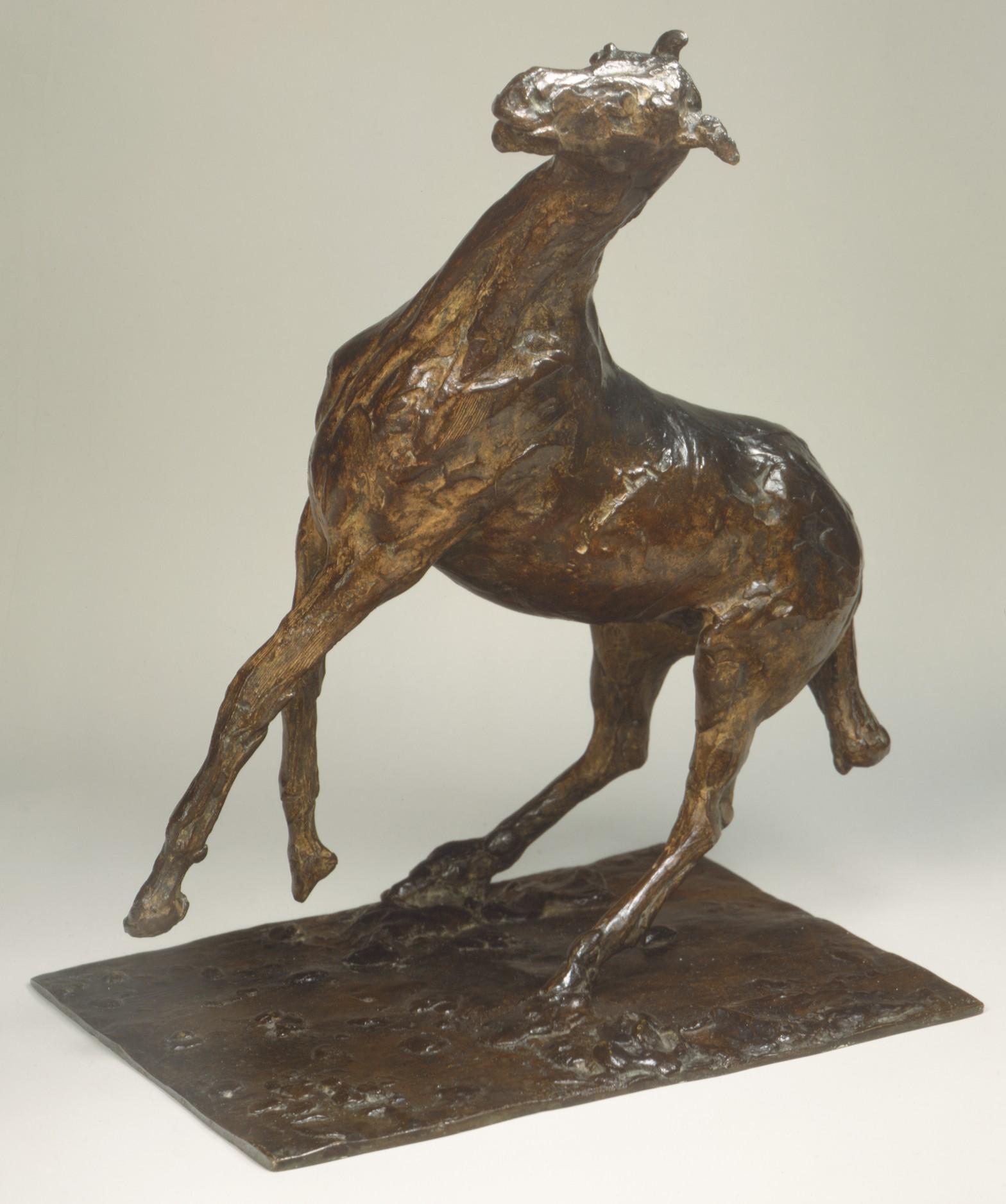
Rearing Horse
Original title: Rearing Horse
kurzbeschreibung
Edgar Degas's bronze sculpture "Steigendes Pferd" (Rearing Horse) was modeled in wax, probably between 1880 and 1890, and cast in bronze in 1920. It shows a horse rearing up on its hind legs, its muscles sharply defined. The figure stands on a flat, square base.
Description
The bronze captures a horse in violent motion: hind legs lifted, forelegs stretched far forward. The flanks appear powerful and emphasized, conveying energy and tension. The head is pulled back, the posture concentrated. Slightly raised wings heighten the sense of dynamism. The surface shifts between dark brown and almost black, with a pronounced patina; the texture follows the muscle groups.
Context
The model was likely made between 1880 and 1890, when Degas was deeply engaged with equine subjects. The bronze cast of 1920 falls after his death and belongs to the posthumous editions of his wax works. Degas studied movement in both painting and sculpture; this example reflects his interest in the dynamics of horse racing.
Impact
The rearing pose and striking musculature evoke a feeling of immediate power and movement. The pulled-back head and slightly raised wings create a tension that holds the viewer's gaze. The dark patina gives the work a serious, timeless presence.
Technique
The bronze was cast using the lost-wax method; the surface carries a natural patina. Visible structures and irregularities trace the muscle movement and body form. This reveals a careful modeling of the surface typical of Degas's sculptural studies.
AI-generated description text
Source: Metropolitan Museum of Art · Public Domain (CC0 1.0)