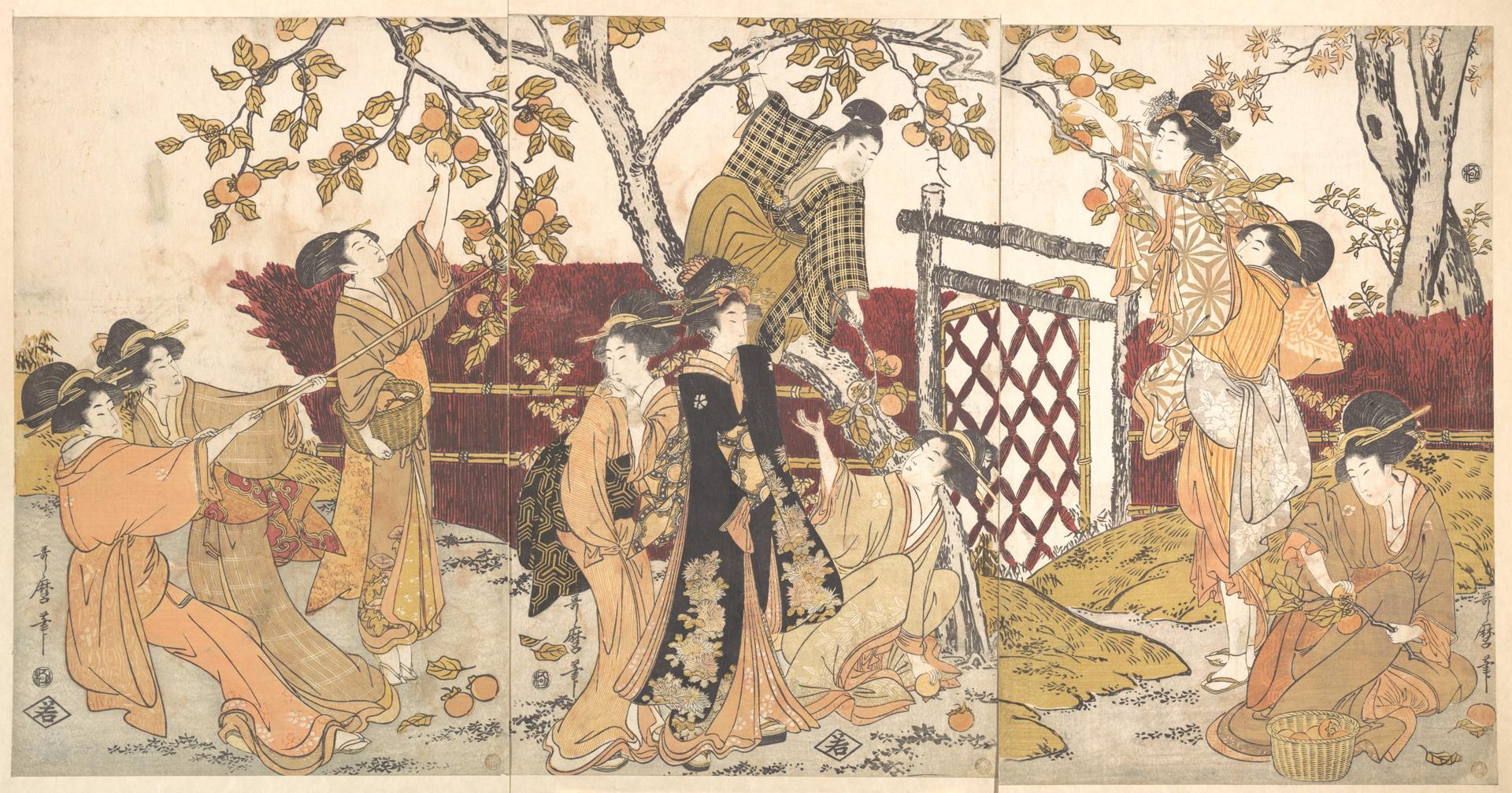
Picking Persimmons (Kaki-mogi)
Original title: Picking Persimmons (Kaki-mogi)
kurzbeschreibung
Kitagawa Utamaro's triptych Kaki-Pflücken, made around 1802–4, presents women in traditional Japanese dress harvesting persimmons in an orchard. Executed as woodblock prints in ink and color on paper, the motif extends across three connected sheets.
Description
Women in kimonos of varied colors and patterns are distributed throughout the orchard: some are picking persimmons from the branches, while others have seated themselves on the ground to gather the fallen fruit. Trees and a fence enclose the garden space. Earthy tones dominate the palette, punctuated by orange-brown accents; the even light brings out the fabric patterns and the shapes of the fruit.
Context
Utamaro ranks among the defining masters of ukiyo-e between the late eighteenth and early nineteenth centuries. This triptych belongs to his late period, around 1802–4. As often in his work, women in everyday scenes take center stage, here engaged in field labor. Such subjects were highly popular in the Edo period and attest to an interest in women's activities.
Impact
Calm and rural idyll emanate from the print, sustained by the even light and the harmonized earth tones. Clear lines and an uncluttered layout let the eye travel quietly across the three parts, almost meditatively. The women appear at once elegant and casually natural.
Technique
The triptych was printed by the woodblock method with ink and color on paper. This technique allowed precise, fine lines and an exact reproduction of details. Multiple printing passes brought the colors onto the paper in sequence, creating the graduated tones of the kimonos and fruit.
AI-generated description text
Source: Metropolitan Museum of Art · Public Domain (CC0 1.0)