A View of the Pleasures of the Taiko and His Five Wives at Rakutō
Original title: A View of the Pleasures of the Taiko and His Five Wives at Rakutō
kurzbeschreibung
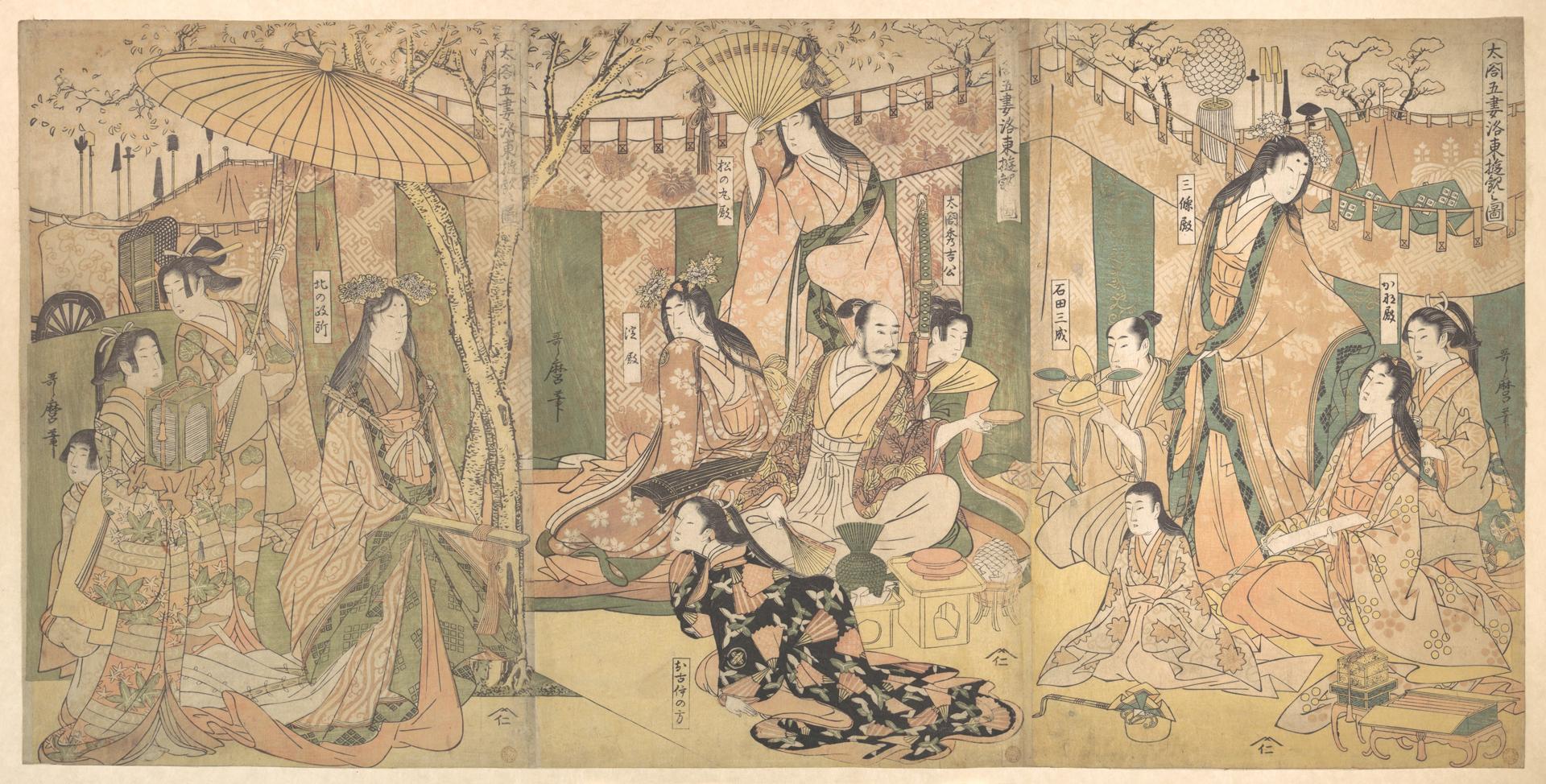
A festive pavilion shelters Toyotomi Hideyoshi—known as Taiko—and his five wives in this 1804 triptych by Kitagawa Utamaro. The color woodblock print, ink and color on paper, presents an episode from the life of the historical commander, arranging the figures in their traditional robes into a balanced, nearly symmetrical scene.
Description
Banners and ornaments divide the interior of a ceremonial tent, where the figures are spread out: some have taken seats, others kneel or stand. Their robes carry patterns and strong hues, while the whole is dominated by earthy tones interspersed with blue and green. Even lighting suggests an indoor setting. The participants draw toward the center, and the banners frame them like a stage, holding the arrangement in balance.
Context
Utamaro made this print in 1804, toward the end of his career, when his reputation rested chiefly on pictures of women and scenes from the pleasure quarters. The title alludes to Toyotomi Hideyoshi, who bore the name Taiko, and to his five wives—a subject poised between history and legend. In the Edo period, when ukiyo-e woodblock printing flourished, lavish interiors and courtly entertainment were popular subjects.
Impact
The quiet color harmony and even arrangement give the print a ceremonial, almost solemn air. The carefully worked robes and festive setting evoke elegance and courtly splendor, drawing the viewer into the sphere of the Japanese upper class.
Technique
Several woodblocks were used for this triptych, transferring ink and colors onto paper. The process allowed precise lines and flat areas of color, layered through repeated printings. At 15 by 30 inches, the horizontal format matches the usual trim of such three-part works and opens a broad surface for the narrative.
AI-generated description text
Source: Metropolitan Museum of Art · Public Domain (CC0 1.0)